A rash of protests have rattled south Asian countries in the last three years – Sri Lanka in 2022, Bangladesh in 2024, Nepal in 2025 and India this year. These agitations are disparate in trigger, scope and effect, but are bridged by their spearheads – Gen Z.
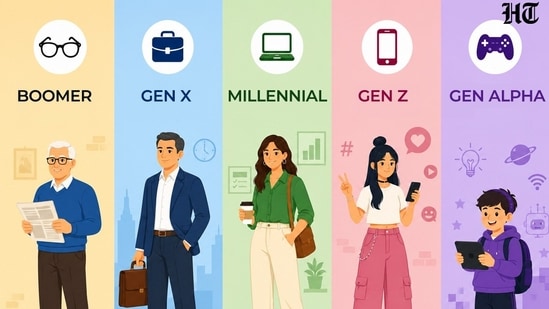
The term, used broadly to describe people born between 1997 and 2012, spent years being tossed about as shorthand for a generation of young people with bottomless appetites for smartphones, social media and a unique lexicon. Now, it rattles governments across the world.
Beware the kids with the smartphones and endless stream of memes. But where did the term Gen Z come from? Indeed, how were generation labels first coined, what socio-cultural factors underpinned these formations and why are the age brackets so seemingly arbitrary?
Also read: 'Gen Z are our own, protesting doesn't make them anti-national': Mohan Bhagwat
Social generations: Where the idea came from
The idea that a society divides into generations is nearly 150 years old. Nineteenth-century French and Italian thinkers tried to fix a generation’s length at a set number of years. German historians argued instead that a generation was a shared way of seeing the world, not a span of time. Karl Mannheim, a Hungarian-born sociologist working in Germany, rejected both.
{{/usCountry}}The idea that a society divides into generations is nearly 150 years old. Nineteenth-century French and Italian thinkers tried to fix a generation’s length at a set number of years. German historians argued instead that a generation was a shared way of seeing the world, not a span of time. Karl Mannheim, a Hungarian-born sociologist working in Germany, rejected both.
{{/usCountry}}The underlying thinking and modern foundation of generations goes back to his seminal 1927-28 essay Das Problem der Generationen, translated into English in 1952 as “The Problem of Generations”.
Mannheim argued that a shared birth year does not make a generation, a contention that bucked years of academic thinking from the 19th and early 20th centuries. Rather, he argued that generations were structural positions – class, for instance – that expose them to certain experiences without determining what they make of them. They form only when an epochal event, such as a war or an economic collapse, reaches people while they are still young enough to be shaped by it.
The American writers William Strauss and Neil Howe took the idea mainstream in 1991, though along a separate path from Mannheim. Their book Generations described American history as a repeating cycle of generational types on a fixed schedule. It also gave the word “millennial” wide currency.
But at first, the labels came in retrospect and by chance, rather than through science and logic.
The Lost Generation, born between 1883 and 1900, was the first to get one – in a French garage, if American novelist Ernest Hemingway were to be believed.
In his memoir A Moveable Feast, Hemingway writes that the owner of a French garage lost his temper with a young mechanic who had been slow to repair fellow American writer Gertrude Stein’s car and dismissed the whole cohort of young men as “a lost generation”.
Stein then slapped that phrase on Hemingway and the American writers around her in Paris where she lived. “You are all a lost generation,” she famously said, referring to a generation bred and scarred by World War I. Hemingway printed her remark as an epigraph to The Sun Also Rises, and the label attached itself to the cohort that came of age in the war.
A caveat
Generation labels were – and continue to be, to a major extent – focused on American contexts and experiences. So, they often take unkindly to being fitted on to other cultures. For instance, there are technically no “baby boomers” in India. That cohort was named after a population boom in the US, and there was no such surge in births in India at the time the corresponding cohort was born.
Still, the more modern labels have outgrown these strict contexts, to some degree at least. Globalisation, the internet and the perceived international homogeneity of social media have streamlined experiences, many of which are broadcast in real time across the world.
So, whose name is it anyway?
For the first few cohorts, the names were arbitrary – they stuck when enough people started using them, usually years after the generation
was born.
Time magazine named the Silent Generation, born between 1928 and 1945, in a cover story in 1951 titled “The Younger Generation”. It said the most startling fact about young Americans then was their silence – “a still, small flame” compared with the “Flaming Youth” of their parents’ generation. To be fair, the generation grew up through the Great Depression, two World Wars and was coming of age under McCarthyism – a period of brutal crackdown on Communists and Soviet sympathisers in the US – with speaking out a genuine risk.
US TV journalist Tom Brokaw named the Greatest Generation, people born between 1901 and 1927, several decades later, when most of them were already in their seventies. His 1998 book, titled The Greatest Generation, profiled Americans who survived the Depression as children and fought World War 2 as young adults.
The baby boomers are the only generation named after a statistic rather than an experience. American births jumped in 1946 as servicemen came home from the war. The births soared in 1957 and stayed near record levels until 1964, the year that closes the boomer chapter. Generation X had been in circulation since 1964, when the British journalists Jane Deverson and Charles Hamblett published a book of that title, based on interviews with British teenagers about sex, religion and their parents. It went nowhere as a generational label until 1976, when the London punk singer Billy Idol found a copy on his mother’s bookshelf and named his band after it.
The then unknown Canadian writer Douglas Coupland picked up the phrase for his own 1991 novel, Generation X: Tales for an Accelerated Culture.
It hurled Coupland to global fame and fixed the name for the cohort. Strauss and Howe named the millennials, and the reasoning was arithmetic: children born in 1982 would graduate from American high schools in the year 2000. It was catchy, modern and found more acceptance than Gen Y, despite concerted attempts by journalists and advertisers.
Gen Z has no author at all, which is unusual (but apt). It was simply arrived at by the alphabet, as the letter after Y. And so it remains. Mark McCrindle, an Australian consultant, switched to Greek letters when the Latin alphabet ran out, naming them Generation Alpha and Generation Beta. Of course, until such time an epochal event shifts that thesis.
The events behind the labels
Each label points back to an event or a technology.
The Lost Generation came of age in World War 1. The Greatest Generation spent its childhood in the Depression and fought World War 2. The Silent Generation straddles the depression and the war years. The boomers grew up with post-war affluence and television. Generation X grew up as personal computers arrived. Millennials came of age with the internet and were at school or college on September 11; the older half walked into the job market
during the 2008 crash, while the youngest were still in middle school. Gen Z was born into all of that, grew up with smartphones and social media, and lost
school and college years to the pandemic.