Air India flight AI 2030, a Boeing 787-9 flying from Frankfurt to Delhi, was diverted to Jaipur on Wednesday morning after its pilot issued a hijacking alert, according to sources in the Directorate General of Civil Aviation (DGCA). The aircraft was squawking 7500, the internationally recognised transponder code for unlawful interference, which is used for hijacking, the sources said.
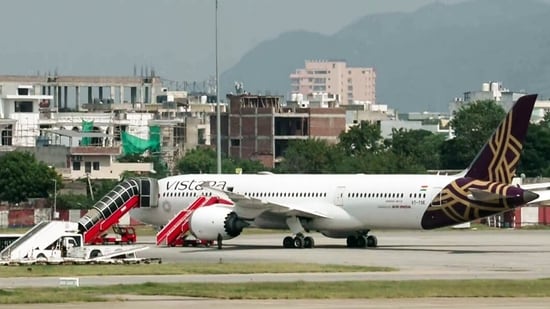
The aircraft landed safely at Jaipur International Airport and was moved to an isolation bay for security checks. All passengers and crew were evacuated, and passengers and their baggage were screened, according to preliminary information.
Air India said in a statement that the flight was diverted "following a perceived security concern", that security agencies had checked and cleared the aircraft and crew, and that passengers had since reboarded.
A passenger on the flight told HT that shortly before the descent, the pilots announced that the plane was being diverted to Jaipur. “The pilot said he doesn't know, why but he has been asked by the ATC (air-traffic controller) to land at Jaipur," said Swasti Rao, a professor at Jindal Global University and consulting editor at ThePrint.
Later, Rao said, the pilots got back with updates and said it appeared to be a hoax threat.
The codes
{{/usCountry}}Later, Rao said, the pilots got back with updates and said it appeared to be a hoax threat.
The codes
{{/usCountry}}Controllers keep track of aircraft partly through a transponder, a radio receiver and transmitter on board that answers a ground radar's call with a four-digit code. The controller's screen displays that reply, rather than a reflected radar signal. Each digit runs from 0 to 7, which allows 4,096 codes, from 0000 to 7777.
Under India's published air traffic rules, every flight departing from an airport in airspace managed from Delhi, Mumbai, Chennai or Kolkata is assigned its own code, which it keeps unless told otherwise. International flights entering Indian airspace keep the code they were using in neighbouring airspace.
Three codes are reserved worldwide for trouble. A crew sets 7700 for an emergency and 7600 when its radio fails. Code 7500 signals unlawful interference, the legal and aviation term that covers hijacking.
According to Indian rules, should a flight be subjected to unlawful interference, the pilot should try to set the transponder to 7500, or switch to 7700 if circumstances warrant it.
The US Federal Aviation Administration's rulebook describes the code’s meaning as "Am being hijacked/forced to a new destination". The American rulebook advises a pilot to describe the emergency over the radio if circumstances permit, and to fall back on the transponder setting if they do not.
In the air
Under international air traffic procedures, drawn up by the United Nations agency International Civil Aviation Organization (ICAO), verbal reference to unlawful interference "should not be made by the controller unless it is first made by the pilot in a radio communication transmission, since it might attract the attention of the hijacker (or of other aircraft) and have detrimental consequences".
Controllers instead ask the crew to confirm the code.
India's rules allow the pilot to confirm it or "not reply at all", and treat silence as a sign that the code was not "an inadvertent false code selection".
Under the US version, a crew that set the code by mistake says so in plain language and resets the transponder. If the pilot confirms the code or says nothing, the controller asks no further questions, follows the flight, responds to the crew's requests and notifies the authorities.
International rules require a crew facing unlawful interference to try to land as soon as practicable at the nearest suitable airport, or at one the authorities assign, unless conditions on board dictate otherwise. Controllers give the aircraft priority, attend promptly to its requests and relay messages between the crew and the authorities on the ground.
The isolation bay
ICAO rules require every airport to designate an isolated parking position, or tell its control tower of a suitable area, for an aircraft known or believed to be under unlawful interference. The spot should be as far away as practicable and never less than 100m from other parking positions, buildings or public areas, and should not be placed over buried gas or fuel lines.
ICAO guidance says the aircraft should stay there until the act of unlawful interference ends. Passengers may have to leave without the terminal's boarding equipment, using mobile stairs, the aircraft's own stairs or its slides.
At Jaipur, pilots and passengers were deplaned in phases under security supervision, according to preliminary information. The Anti-Terrorism Squad, airport security agencies and local police were involved in the operation, and the National Security Guard (NSG), the commando force whose remit includes counter-hijack operations, was placed on standby in New Delhi.
In 2010, the Union civil aviation ministry told a parliamentary standing committee that hijack crises were handled by three designated committees: the Committee of Secretaries on Aircraft Hijacking, a Central Committee, and Aerodrome Committees at individual airports. The ministry also cited the deployment of sky marshals, and a panel of psychologists and linguists available to communicate with hijackers.
HT reported in 2017 that, depending on the seriousness of a threat, a central-level committee is formed, and if it judges the threat to be genuine, the matter goes to the Cabinet Committee on Security, which the prime minister heads.
What happens next
Details of what prompted the alert on AI 2030 were awaited, and the DGCA is investigating. Air India said the flight was expected to continue to Delhi shortly.
Hijacking in India is prosecuted under the Anti-Hijacking Act, 2016, which came into force on July 5, 2017 and replaced a 1982 law. The Act defines hijacking as seizing or exercising control of an aircraft in service by force, threat, coercion or intimidation, "or by any technological means". It also counts a credible threat to hijack, an attempt, and abetting or organising a hijacking as the offence itself. An aircraft is in service from the start of pre-flight preparation until 24 hours after any landing.
Under the 1982 law, the maximum sentence for hijacking was life imprisonment. Death penalty was first considered after the 1999 hijacking of an Indian Airlines flight from Kathmandu to Kandahar, IC 814. Under the 2016 Act, death penalty can be awarded when a hijacking results in the death of a hostage, a member of the security personnel or anyone not involved in the offence. Otherwise the sentence is life imprisonment. A prosecution needs prior sanction from the Centre, which can also give the National Investigation Agency (NIA) powers to investigate.