The task to compile independent India's first voter list was done by hand.
Clerks, 16,500 of them, were hired on six-month contracts to type the rolls and collate them by constituency. About 380,000 reams of paper went into printing them, historian Ramachandra Guha writes in India After Gandhi.
Behind those figures was a process that spanned nearly four years, from November 1947 to the first vote in October 1951. It ran through a Partition that had driven close to 8 million refugees into India, and it enrolled an electorate of 173 million, most of whom could not read. The process of the time was starkly different from the digitised rolls of today, which election officials revise every year. But that first roll was where universal adult franchise was put into practice, and the officials who compiled it had to work out who qualified and on what proof, questions that every revision of the rolls has had to answer since, particularly now, as the controversial Special Intensive Revision (SIR) exercise has triggered widespread protests.
The work for the first national election in 1951 had begun years before the vote. From November 1947, a handful of officials at the Constituent Assembly Secretariat started preparing the country's first draft electoral roll on the basis of universal adult franchise. The Secretariat was the small office that served the body drafting India's Constitution. At the time, India didn’t have a Constitution, nor a citizenship law.
{{/usCountry}}The work for the first national election in 1951 had begun years before the vote. From November 1947, a handful of officials at the Constituent Assembly Secretariat started preparing the country's first draft electoral roll on the basis of universal adult franchise. The Secretariat was the small office that served the body drafting India's Constitution. At the time, India didn’t have a Constitution, nor a citizenship law.
{{/usCountry}}When did Indians first vote?
Indians had voted under colonial rule for years, but only a select few. About 7 million could vote in provincial elections under the reforms of 1919.
The Government of India Act, 1935, the last colonial constitutional framework for India, raised that to a little over 30 million, who first voted in the 1937 provincial elections. Even then, only about a fifth of the adult population was eligible to vote, according to historian Ornit Shani. The eligibility depended mainly on property, education and gender.
That law still has some legal implication today, although in a different context. In its May judgment this year on challenges to the SIR in Bihar, the Supreme Court noted that the 1935 Act turned enrolment into a formal legal regime, with rolls prepared for each constituency and revised by reference to a prescribed date. The Act, nonetheless, was narrow and retained communal and special electorates.
In April 1947, at the start of the constitutional debates, the Constituent Assembly's Advisory Committee on Fundamental Rights backed giving every adult a vote. And the job of organising it fell to the Assembly’s secretariat, more than two years before the office of the Election Commission was set up in January 1950.
Also read: 26-year-old man claims name deleted from Goa voter list despite SIR mapping; to move HC
How was the first roll put together?
Shani, who teaches modern Indian history and heads the India programme at the University of Haifa in Israel, argues in her book 'How India Became Democratic: Citizenship and the Making of the Universal Franchise' that Indians became voters before they became citizens. By the time the Constitution came into force in January 1950, she writes, universal franchise was already established in practice.
The secretariat sent out detailed instructions for preparing the rolls in mid-March 1948. Every citizen aged 21 or above could register, unless disqualified by unsoundness of mind or non-residence. A voter also had to have lived in the electoral unit for at least 180 days in the year ending March 31, 1948.
The Constitution's provisions on citizenship were still being drafted, so officials were told to work from the definition in the draft Constitution.
What of refugees?
Partition made the residence rule difficult to apply. The 180-day rule meant a voter had to have been living in a place from September 30, 1947, at the latest, and many refugees had crossed the border after the date. Soon after the instructions went out, letters from officials and citizens' groups began reaching the secretariat, asking whether, and how, refugees should be enrolled.
Between May and July 1948, Shani writes, the secretariat worked on a formula for refugee voters' residence.
According to the ECI's 1955 report on the first general elections, states were advised that, pending a final decision, people who had migrated to India should be registered "on a mere declaration by them of their intention to reside permanently" in a town or village, irrespective of the actual period of residence. One secretariat member reasoned that refugees were always on the move, so no residential qualification could be prescribed for them if they were to vote at all, Shani writes.
In Assam, citizens' groups complained that officials were leaving people off the rolls. Soon after registration began in April 1948, one organisation wrote that "attempts are being made to exclude all persons who were not born in Assam as constituted now". Those being excluded were mainly Hindu refugees from Partition, according to Shani.
The process that eventually settled on universal adult franchise was not without debate.
Rajendra Prasad, who presided over the Constituent Assembly and became India's first President, had also raised some concerns. In October 1948, Shani records, he warned in a public address that, unless properly exercised, adult franchise would mean “putting educated and ignorant and honest and dishonest persons on the same footing”. He was not alone; Shani's account shows that other educated Indians also doubted whether voters who could not read would grasp what they were voting for.
Prasad struck a different note a year later. In his concluding address to the Constituent Assembly on November 26, 1949, he acknowledged that some had doubted the wisdom of adult franchise. He called it an experiment whose result no one could forecast, but said he was “not dismayed by it”. If things were explained to voters, he said, they would “cast their votes in an intelligent manner”. He added that he had "no misgivings about the future, on their account", according to the Constituent Assembly Debates.
The Election Commission
Shani argues in her book that reports of exclusion led the Constituent Assembly to change how elections would be run.
On June 15, 1949, BR Ambedkar, who chaired the Constitution's Drafting Committee, moved a new version of draft Article 289. The original, as Ambedkar described it, provided for one election commission for elections to the central legislature and a separate commission for each province and state, appointed by its governor or ruler.
Ambedkar told the Assembly it had been brought to the notice of the Drafting Committee and the central government that some provincial governments were keeping people who were “racially, linguistically or culturally different from the dominant people” off the rolls.
No adult entitled to vote, he said, should be excluded merely because of “the prejudice of a local Government, or the whim of an officer”, according to the Constituent Assembly Debates of June 15, 1949. Ambedkar then proposed a single central Election Commission that alone would direct officials who prepared and revised the rolls.
HV Pataskar, a Constituent Assembly member from Bombay, objected. He argued that the remedy for such malpractice was to act against the officials responsible. He also saw the proposal as part of a drift away from the federal structure the Assembly had set out to build, according to the Constituent Assembly Debates of June 15, 1949.
Ambedkar's version was adopted and became Article 324 of the Constitution. It says the superintendence, direction and control of the preparation of electoral rolls, and of the conduct of all elections to Parliament, the state legislatures and the offices of the President and Vice-President, shall be vested in an Election Commission.
In its May judgment upholding the Bihar SIR, the Supreme Court described the debates as having placed the preparation and revision of electoral rolls beyond executive control.
Alladi Krishnaswami Ayyar, a lawyer and member of the Drafting Committee, returned to the subject on November 23, 1949, as the Assembly concluded its work. He said that despite widespread illiteracy, the Assembly had adopted adult franchise "with an abundant faith in the common man", the Constituent Assembly Debates record. It did so, he said, in the belief that democratic government would bring enlightenment and better living standards.
How big was the job?
Sukumar Sen, an Indian Civil Service officer, took charge as India's first chief election commissioner on March 21, 1950. It was under his name that the Election Commission's report on the first general elections was published in 1955. The report called the Constituent Assembly's adoption of adult suffrage “an act of faith” in the common man of India and in his practical common sense. It also described the decision as launching an experiment “unique in the world in its stupendousness and complexities”.
The report put the number of enrolled electors at 173,213,635, roughly half of the population of about 361 million counted by the 1951 Census. Jammu and Kashmir did not vote, and its seats in the House of the People were filled by presidential nomination.
An ECI atlas of general elections says that polling began on October 25, 1951, stretched over about four months and was held on 17 days. Voters cast their ballots at 132,560 polling stations with 196,084 booths, the 1955 report says.
Guha, in India After Gandhi, writes that a documentary on the franchise was screened in more than 3,000 cinemas in the run-up to the first general election. All-India Radio (AIR), he says, also broadcast programmes on adult franchise, the preparation of the rolls and how to vote.
Who was left out?
In several states, women had been registered by their relationship to a man, as someone's wife or mother, rather than by name.
Sen directed that an entry without the voter's own name could not stand. Of nearly 80 million women voters, the ECI’s 1955 report says, “nearly 2.8 million eventually failed to disclose their proper names”, and their entries were deleted. Practically all such cases were from Bihar, Uttar Pradesh, Madhya Bharat, Rajasthan and Vindhya Pradesh, the report says.
After the election, the ECI instructed officials to persuade these women to enrol under their own names, and sought the help of political parties and local women’s organisations.
The ECI’s report on the 1957 election recorded about 92,141,597 women on the rolls, about 94% of adult women. It also noted that many of the women deleted in 1951 had been disappointed to watch others vote while they could not.
Who voted first?
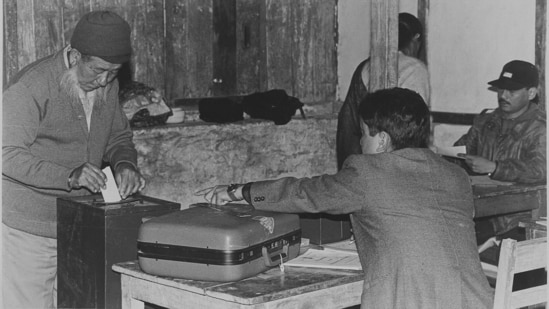
Most of India voted between December 1951 and February 1952. The ECI, however, held polling in the high-altitude areas of Kinnaur, in Himachal Pradesh, on October 25, 1951, ahead of the winter snow.
Shyam Saran Negi, a teacher at the local school, had been assigned polling duty in another village that day. He reached his own booth at Kalpa early, persuaded the staff to let him vote before he left, and cast the first vote. The ECI later honoured him as independent India's first voter.
Weather has continued to influence these decisions. Himachal Pradesh, Jammu and Kashmir and Ladakh are not part of the ongoing third phase of SIR, which the ECI had said was because of the ongoing Census exercise and weather in the region's upper reaches and snowbound areas.
The ECI has said it will announce a separate SIR schedule for the three later.