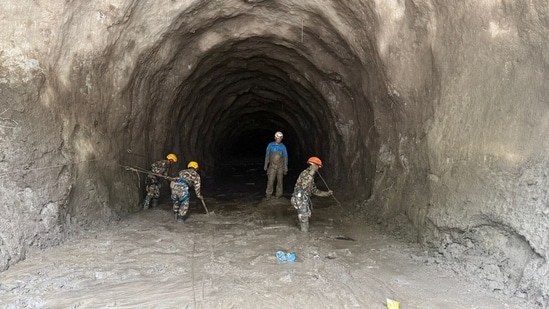
Ashish Gurung, a mountaineer normally paid to guide climbers, has spent this past week wading through mud that reached his chest. His team laid wooden planks across the sludge inside the Chilime hydropower tunnel in Nepal's Rasuwa district, then used them as makeshift bridges, roped together for safety. About 130 metres in, he told The Guardian, "It looked like it was just bodies."
Seven days after a glacier collapsed high in the Himalayas and sent a wall of rock, ice and meltwater surging down the Bhote Koshi and Trishuli valleys, more than 600 people are still unaccounted for at 11 hydropower project sites in Rasuwa and Nuwakot districts, Nepal's National Disaster Risk Reduction and Management Authority said.
About 500 of them are believed to be trapped inside the vast water tunnels that these projects use to channel Himalayan rivers into their powerhouses.
Nepal's overall death toll from the August 26 disaster was close to 1,000 on Tuesday, and thousands more were missing, the authority said. Adding the 16 deaths reported by Chinese state media in Tibet takes the toll past 1,000.
Run-of-river hydropower dominates Nepal's electricity grid, and it depends on long tunnels that carry water down the steep gradient between Himalayan rivers and the powerhouses that generate the electricity.
"These tunnels are big enough to drive trucks through," Jakob Steiner, a geoscientist at the University of Graz who is based in Dhaka, told the Associated Press. That is why workers were inside them on the morning of August 26, and why the tunnels, now packed with mud, rock and debris, have been so difficult to reach.
{{/usCountry}}"These tunnels are big enough to drive trucks through," Jakob Steiner, a geoscientist at the University of Graz who is based in Dhaka, told the Associated Press. That is why workers were inside them on the morning of August 26, and why the tunnels, now packed with mud, rock and debris, have been so difficult to reach.
{{/usCountry}}Eleven hydropower stations with a combined capacity of 431.1 megawatts, about 10% of Nepal's installed capacity, have stopped operating, the Nepal Electricity Authority said.
Also read: Nepal floods: 140 tourists from Maha on their way back; over 60 untraceable
A week of blasts, drones and pumped air
Rescuers spent the first 72 hours fighting terrain and weather. Rain, a rising Trishuli and unstable slopes stalled access. Over the weekend, army teams drilled into the upper section of a tunnel at the Trishuli-3A site and began pumping air into it, along with lowering cameras. Overnight rain on August 30 refilled the excavation.
On August 31, teams used explosives to blast into the hillside at Trishuli-3A. One rescue party entered a powerhouse tunnel at another plant, found no one, and withdrew, Reuters reported. Nepal Prime Minister Balendra Shah said on Monday that 279 workers had been rescued from the sites so far and that road access to Nuwakot, one of the worst-hit districts, had been restored. On Tuesday, a 44-member emergency relief team from South Korea flew out on a military transport aircraft to help.
Also read: Concrete frame, mud ramp: How Nepal's ‘green house’ survived devastating flash floods
What the rescuers are up against
The scale of the debris has surprised even veterans.
"There are boulders bigger than houses. I've never seen that before in my life," Arnold Dix, the former head of the International Tunnelling Association who is helping Nepal's teams remotely from Australia, told the BBC.
Tunnel entrances have vanished under the flow, he said, and rescuers have first had to work out where the tunnels are before they could enter them. Dix led the 2023 Silkyara rescue in Uttarakhand, in which 41 Indian workers were pulled out alive after 17 days.
Time is the other pressure. Disaster epidemiologist Jennifer Horney of the University of Delaware told the AP that survival past 72 hours becomes very difficult without access to clean drinking water. Six days on, Mohan Kumar Dangi, president of the Independent Power Producers' Association, Nepal, said fears were growing that some of those trapped might have suffocated.
For the families, hope now runs on the possibility that the tunnels may have offered shelter. "I still have a 50% hope that he is alive because there is an oxygen system inside," Sita Pandey, whose husband was working at one of the plants, told the Nepali daily Kantipur.
Also read: Exclusive: After Air India tragedy, same Indian forensic team battles Nepal flood toll
India chips in
Indian citizens make up the largest group among the missing foreigners, and dozens of them were in the tunnels when the flood struck Nepal.
A 13-member Indian Army team of tunnel rescue experts is working alongside Nepali authorities across several sites, HT reported.
At Chilime, where eight workers are missing, the Indian technical team and the Nepal Army opened a route into a 250-metre tunnel and reached about 90 metres inside, but could not push further. At Rasuwagai, where 93 are missing, drones were sent into a tunnel but no bodies were found. At Upper Trishuli-3A, where 42 are missing, a portion of the tunnel was opened after a crown blast, and workers are now clearing stone and debris by hand. At Langtang Khola, where 41 are missing, an inspection was completed on Monday and work was to begin on Tuesday.
A separate 18-member Indian forensic team specialising in DNA analysis has been on the ground since August 29, Nepal's foreign ministry said. Only 4% of the roughly 900 bodies recovered so far have been identified, a spokesperson for Nepal's health ministry told the BBC.