Rescuers digging by hand into a flooded Nepalese hydropower tunnel are using rat-hole mining, a coal-extraction method India had banned in 2014, to reach six workers trapped underground since floods struck 20 days ago.
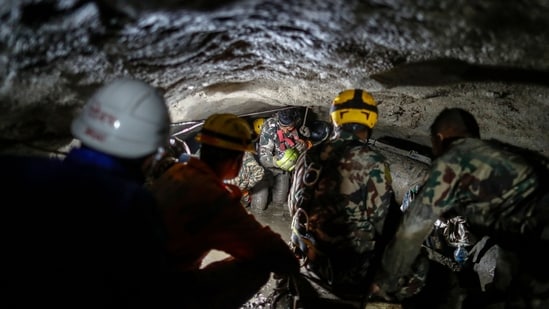
The joint India-Nepal team has cleared about 150 metres of the collapsed access tunnel at the Chilime project in Rasuwa district and was roughly 50 metres from the underground powerhouse where the workers were last seen. Excavators cleared the first stretch of boulders before the technique switched to manual burrowing through waterlogged debris, HT reported.
This is the second such rescue in as many years to reach for rat-hole mining after machinery seized up. At Uttarakhand's Silkyara tunnel in November 2023, a 12-member team of manual excavators from Delhi broke through the last stretch of debris to reach 41 workers trapped for 17 days, after a US-made auger drill got stuck in the rubble.
Also Read | Rat-hole mining, used in Uttarakhand's Silkyara rescue, deployed to save Nepal workers
A devastating flood, triggered by an ice-rock avalanche near the Nepal-Tibet border on August 26, ravaged towns and villages in northern and central Nepal, killing around 1,400 people. More than 5,000 remain missing.
{{/usCountry}}A devastating flood, triggered by an ice-rock avalanche near the Nepal-Tibet border on August 26, ravaged towns and villages in northern and central Nepal, killing around 1,400 people. More than 5,000 remain missing.
{{/usCountry}}The deluge also damaged or knocked offline more than 12 hydropower plants in Nepal. By late August, nearly 900 hydropower workers were unaccounted for, scores of them in mountainous tunnels like the one in Chilime.
A look at what the technique and the method is:
Two ways to dig a rat-hole
The technique takes two forms. Side-cutting involves narrow horizontal tunnels driven into hillsides to follow visible coal seams, typically no more than 3 to 4 feet high, worked by a single miner who crawls in with hand tools. Box-cutting begins with a vertical pit 100 to 400 feet deep dug from the surface, with rat-hole-sized lateral tunnels branching off once the seam is reached.
Both variants exist because coal seams in Meghalaya's Jaintia, Khasi and Garo Hills are unusually thin, often under 2 metres, making mechanised long-wall mining uneconomic, according to documentation held by the Meghalaya Basin Development Authority. The state's Eocene-age sub-bituminous coal is high in sulphur and yields well, which sustained the trade even after regulators moved to shut it down.
At Silkyara, and now at Chilime, rescuers borrow the method. They work through debris in a passage just wide enough for one person, using hand tools and passing muck back through a trolley line.
Also Read | Nepal govt report says floods led to estimated $4.7 billion recovery, reconstruction needs
Why it was banned
The National Green Tribunal banned rat-hole mining across Meghalaya on April 17, 2014, on a petition by the All Dimasa Students Union of Assam. The order followed a Gauhati High Court suo motu proceeding after 15 miners died in a July 6, 2012 accident at Nongalbibra in the South Garo Hills.
The tribunal cited three grounds. Worker safety: shafts were unventilated, unshored and prone to flooding. Environmental damage: acid mine drainage from active and abandoned mines had turned Jaintia Hills streams acidic, with studies of the region, including a 2023 paper in Environmental Science and Pollution Research documenting severely acidic conditions in impacted waterways, with pH values as low as 3. And child labour: the Shillong-based Impulse NGO Network, which filed a parallel PIL, documented children working the tunnels because their size made them useful there.
The Supreme Court upheld the ban on the technique in its judgment dated July 3, 2019, cited as (2019) 8 SCC 177.
Nonetheless, enforcement has been uneven. In December 2018, 15 miners were trapped at Ksan village in East Jaintia Hills after they cut into an adjacent water-filled working connected to the Lytein river. A rescue mounted by the Indian Navy, NDRF and the National Geophysical Research Institute in Hyderabad ran until March 2019, but only two bodies were recovered from the 370-foot pit.
The Meghalaya high court appointed a one-member panel headed by Justice BP Katakey (retired) in 2022 to assess how far the Supreme Court and NGT's directions had been complied with, and to recommend measures for action. Katakey has since filed more than 20 interim reports, finding that illegal rat-hole mining continues across East Jaintia Hills and other coal-bearing districts.
Also Read | India approves up to 654 MW of power export to flood-hit Nepal for 18 hours every day till December 31
Why it has been employed for rescues
Heavy machinery can fail in unstable, waterlogged debris.
At Silkyara, the American auger drill broke down after clearing 46.8 metres, forcing rescuers to fall back on manual drilling for the final stretch, HT reported. Vishal Chauhan, then a National Highways Authority of India official, said at the time that rat-hole miners had been called in because “this is a special situation, this is a life-saving situation”.
The breakdown of machines is a hurdle that rescuers also ran into in Chilime. Australian tunnel rescue expert Arnold Dix, who advised the Silkyara operation and is now involved at Chilime, said on X on September 8 that the Nepal Army, rescue services, Indian Army and National Disaster Response Force (NDRF) were "all on site, all working as a single team".
Augers and roadheaders also create vibration that can trigger secondary collapses in already-fallen debris. Manual digging does away with this issue.
Similarly, rescue pipes pushed through collapsed sections are typically 800 to 900 mm across, roughly the width of a person. No mechanical cutter operates in that bore.
A miner can feel the transition from soil to boulder to void by hand, which a blind drill cannot. At Chilime, HT reported, the team is hoping that the next stretch of tunnel contains a void created by receding water, which would signal proximity to the powerhouse.
Water at both sites also disabled heavy machinery. Manual excavators can continue working in flooded debris if mud pumps drain the passage behind them, though the pace is slower.
The workforce
The excavation at Chilime is being carried out by Nepal Army personnel, working under advisory input from the Indian Army, NDRF and Dix, and Nepali MP and hydromechanical engineer Sagar Dhakal.
Dhakal told news agency ANI that the immediate obstacle was a water pond inside the rat-hole passage that had made it difficult for rescuers to move further, and that the team was bringing in a mini-pump to drain it. Rescuers had by then cleared about 150 metres of tunnel and were roughly 50 metres from the powerhouse, he said.
At the time of Silkyara, the 12-member team was contracted through Trenchless Engineering Services Pvt Ltd and Navayuga Engineers Pvt Ltd, and drawn largely from workers who manually excavate sewer and pipeline routes for the Delhi Jal Board. Most of the Silkyara miners were migrants from the Bundelkhand region of Uttar Pradesh and Madhya Pradesh, some of whom had earlier worked in Meghalaya's coal pits while others learned the trade in stone quarries of Jhansi and Ahmedabad, or in Delhi.