Somewhere deep in space, a star explodes as a supernova, or a supermassive black hole devours matter at the centre of a galaxy. The event scatters radiation of various forms into space. Some of it reaches Earth as particles with energies too high to have originated on the planet. Scientists cannot trace these particles to their source, because interactions with magnetic fields have deflected them along a path nobody can retrace.
Neutrinos could tell scientists more, but they are hard to detect. They rarely interact with light or matter, so they travel huge distances through space in a straight line. A high-energy neutrino detected on Earth could lead scientists to its source and to the event that produced it. The same property, however, makes detection difficult, because a neutrino passes through a laboratory detector as readily as through space, and goes unnoticed.
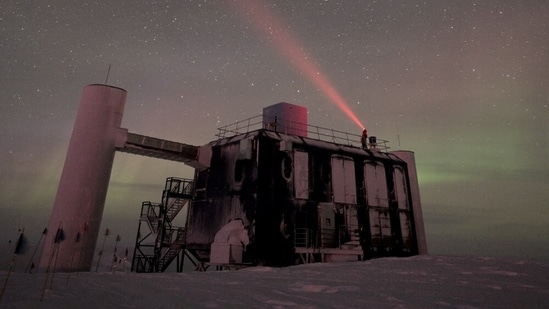
This year’s Nobel Prize for Physics goes to Francis Halzen of the University of Wisconsin-Madison, who conceived IceCube, a neutrino detector spanning a cubic kilometre of Antarctic ice, with sensors 1.5 to 2.5 km below the surface. It is not as if neutrinos never interact with matter, but such interactions are enormously rare, and IceCube’s sheer size is aimed at increasing the chances of capturing such rare moments.
When a neutrino interacts with a particle in IceCube, it gives off blue light. Scientists analyse these signals to infer where the neutrinos came from and what accelerated them towards Earth. Halzen has laid the foundation for an entirely new type of astronomy, the Nobel Foundation said.
The shy particle
{{/usCountry}}When a neutrino interacts with a particle in IceCube, it gives off blue light. Scientists analyse these signals to infer where the neutrinos came from and what accelerated them towards Earth. Halzen has laid the foundation for an entirely new type of astronomy, the Nobel Foundation said.
The shy particle
{{/usCountry}}The neutrino is a subatomic particle but not a building block of matter. Unlike the electron, proton and neutron, it is not part of the atom; but is formed as a result of certain nuclear events, such as nuclear fusion in space or in a reactor.
Every second, 65 billion neutrinos from the Sun pass through an area the size of a little fingernail without interacting with any of its matter. Countless more come from elsewhere in space, some carrying energies several times higher than any experiment on Earth can reach.
So do more easily detected particles, such as protons from space. “Our Earth is constantly bombarded by extremely energetic particles from space — mostly protons, known as cosmic rays. They carry far more energy than anything we can produce on Earth, even at the Large Hadron Collider. Only the most extreme cosmic events — black holes, neutron stars, supernovas — can accelerate these protons to such enormous energies,” said Debanjan Bose, head of physics at the Central University of Kashmir, and a former post-doc with IceCube at its facilities in Belgium and South Korea. He recalled having interacted often with Halzen.
Scientists have predicted that the events producing these protons also produce neutrinos, whose paths are easier to trace. That is why physicists set out to detect them.
ALSO READ | What's the IceCube Observatory work that Francis Halzen has received Nobel Prize in Physics for
“The primary birthplaces of neutrinos include supermassive black holes devouring matter at the centres of galaxies and explosive cosmic cataclysms such as gamma-ray bursts and supernovas,” said Sanjib Agarwalla of the Institute of Physics, Bhubaneswar, who has worked extensively with Halzen in the IceCube collaboration and at UW-Madison, where Halzen was his Fulbright supervisor.
“Because neutrinos carry information directly from these extreme regions without being significantly deflected or absorbed, they act as unique cosmic messengers. Identifying their sources helps us understand how nature accelerates particles to the highest energies and reveals otherwise hidden processes in the Universe,” Agarwalla said. Studying neutrinos and their sources also teaches scientists about fundamental physics “at energies far beyond anything we can achieve on Earth”, Bose said.
The observatory
In the 1980s, Soviet scientists planned to use radio receivers to pick up neutrino signals in Antarctic ice. Halzen, who grew up in Belgium before moving to UW-Madison, heard of the idea and proposed light sensors that would look for flashes in the ice instead of antennas listening for radio waves.
Physicists had proposed light detectors in the 1960s, with water as the medium because it is transparent. Halzen chose ice for practical reasons: the detector needed a huge volume, and a cubic kilometre of natural ice is easier to use than the same volume of stored water. He discussed the plan with his colleague John G Learned, who was working on DUMAND, a project to capture light signals from neutrinos in deep ocean water off Hawaii.
At a conference in Poland in 1988, the two presented their concept for a neutrino observatory in the South Pole ice. Within a few years, researchers from several institutions had joined Halzen.
The team had to solve practical problems such as drilling kilometre-deep holes in the ice and lowering light sensors and other instruments into them. They tested sensors in the Greenland ice before building AMANDA, IceCube’s predecessor, at the South Pole; it was completed in January 2000. AMANDA worked as intended but needed more ice. IceCube, completed in 2011, has 5,160 light sensors strung along 86 cables.
ALSO READ | Scientists discover ‘ghost particle’ with highest energy yet in Mediterranean Sea
The results
On the rare occasions a neutrino interacts in the ice, it produces charged particles that emit light. Sensors deep in the ice detect these photons and convert them into amplified electrical pulses, which travel up the cables to a laboratory at the South Pole. “From there, the data is sent by satellite to research centres in the Northern Hemisphere,” said Bose, recalling his IceCube work. “The data is recorded, filtered, and transmitted by satellite with some delay. Scientists then analyse it offline — though automated alerts can go out within minutes for exciting events.”
IceCube has taken neutrino astronomy to a new level. Researchers also hope neutrinos will reveal phenomena hidden behind dust clouds.
IceCube has identified a few possible sources of cosmic neutrinos, including the active galaxy NGC 1068 (also called M77), though the evidence is not yet conclusive. It has also detected neutrinos from within the Milky Way.