Siang, a river that has sustained generations of indigenous communities in Arunachal Pradesh, is now at the centre of protests over a proposed hydropower project that the government says has geostrategic importance.
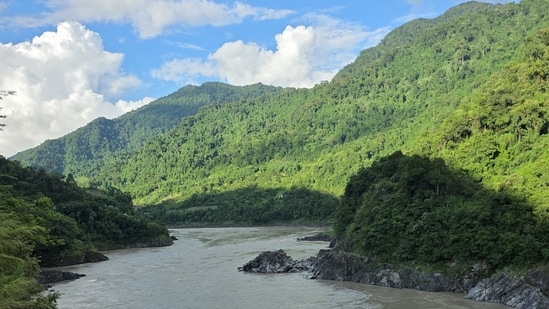
The state government sees the 11,200-MW Siang Upper Multipurpose Project (SUMP) as a strategic safeguard against China’s massive hydropower development upstream, but those who call the banks of the river home in Arunachal Pradesh fear displacement, ecological destruction and the loss of ancestral land.
What began as opposition to preliminary survey activities has escalated into violent clashes between villagers and security forces, arson in Pasighat on October 23 at a police station and the office of the National Hydroelectric Power Corporation (NHPC), the state-run company that would build the dam, and competing claims of injuries and arrests.
Chief minister Pema Khandu insists that no decision has been taken to construct the dam and that the government is merely exploring its feasibility, but protesters remain unconvinced, arguing that even allowing the initial survey could set the stage for an irreversible transformation of the Siang valley.
Why the project is considered strategic
China’s decision to construct a massive hydropower complex on the lower reaches of the Yarlung Tsangpo in Tibet has transformed the debate over SUMP from a regional development issue into a matter of national security.
{{/usCountry}}China’s decision to construct a massive hydropower complex on the lower reaches of the Yarlung Tsangpo in Tibet has transformed the debate over SUMP from a regional development issue into a matter of national security.
{{/usCountry}}The Chinese project, commonly referred to as the Medog hydropower project, is expected to have an estimated generation capacity of around 60,000 MW, significantly larger than the proposed Indian project.
Beijing formally launched construction of the complex in July 2025, announcing an estimated investment of 1.2 trillion yuan.
The Yarlung Tsangpo flows into Arunachal Pradesh as the Siang, before joining other tributaries to form the Brahmaputra in Assam and eventually entering Bangladesh.
Officials have expressed concerns over the possible consequences of upstream water regulation, including changes in river flows, potential diversion and sudden releases of water.
The Arunachal Pradesh government argues that SUMP could help moderate such fluctuations by creating substantial downstream water storage.
Chief minister Khandu has sought to distinguish between hydropower generation capacity and reservoir storage, arguing that the size of a power station does not necessarily indicate how much water it can retain.
According to figures cited by the chief minister, China’s Medog project is estimated to have storage of around 5.5 billion cubic metres, while SUMP could provide approximately 9.2 billion cubic metres of live storage.
The government believes this could create a strategic buffer against sudden changes in upstream water discharge.
However, the extent to which the proposed project could mitigate the effects of China’s dam would depend on detailed hydrological assessments, final engineering designs and operational arrangements.
Why is SUMP facing resistance?
At the heart of the controversy is the government’s proposed Pre-Feasibility Report (PFR), a preliminary technical exercise intended to determine whether the massive dam can be built and where it could be located.
The government maintains that the PFR is not an approval for construction but only a scientific assessment of the project’s technical and geological viability.
For the Siang Indigenous Farmers’ Forum (SIFF), which is leading the resistance, however, the survey represents the first step towards a project that could fundamentally alter the region’s geography, ecology and indigenous way of life.
Protesters have demanded an immediate halt to survey activities, withdrawal of security forces from affected areas and meaningful consultations with local communities.
Tensions first escalated on September 30 when protesters blocked roads during Khandu’s visit to Upper Siang district. The demonstrations turned violent, with vehicles damaged or set ablaze and the residence of local MLA Alo Libang allegedly vandalised.
The situation deteriorated further on October 4, when fresh confrontations erupted between protesters and security personnel in Siang district, and again on October 23, when a shutdown across the Siang belt ended in arson in Pasighat, in East Siang district.
Commenting on the China factor, human rights lawyer and anti-dam activist Ebo Mili earlier this month questioned the government’s narrative and called for a water-sharing treaty between New Delhi and Beijing.
“I wish our diplomats had done something to establish a water-sharing treaty between India and China. A substantial portion of the Siang’s water also comes from glacial lakes within Indian territory,” Mili had said.
“The justification given by our chief minister, deputy chief minister and other ministers that China intends to completely dry up the Siang is incorrect and misleads innocent villagers. I do not see any immediate water threat from China. Instead, the proposed massive 11,000–12,000 MW gravity dam poses a more immediate threat,” he added.
Mili further alleged that the state government had no mitigation plan to address the potential dangers posed by glacial lakes that, according to him, were on the verge of breaching.
A project nearly two decades in the making
The Siang hydropower proposal is not new. Its origins can be traced to the Centre’s efforts to harness the river’s enormous hydropower potential, with the development proposal receiving national importance in 2008.
Earlier plans envisaged separate projects on the upper reaches of the Siang, including the 6,000-MW Siang Upper Stage-I and 3,750-MW Stage-II projects.
The proposal subsequently evolved into a larger multipurpose development, combining electricity generation with water storage and flood moderation.
However, technical challenges, environmental concerns and opposition from local communities prevented the project from making substantial progress.
The current proposal envisages an installed generation capacity of approximately 11,200 MW, although government statements frequently describe it as an 11,000-MW project.
Potential locations, including Parong, Dite Dime and Uggeng, have figured in discussions, but the final site remains undetermined.
The renewed urgency surrounding SUMP is closely linked to China’s ambitious hydropower plans. If it goes through, the project will be executed by the National Hydroelectric Power Corporation (NHPC, the office of which was damaged in Saturday's clashes).
A river inseparable from identity and survival
For indigenous Adi communities living along the Siang, the river represents far more than a source of water or potential electricity.
It is intertwined with their agricultural practices, cultural traditions, ancestral settlements and collective identity.
Opponents fear that a massive reservoir could submerge villages, destroy fertile agricultural land, affect forests and fisheries, and erase sites of historical and cultural significance.
Campaigners have claimed that as many as 27 villages could face submergence, while several others could experience direct or indirect impacts. The actual extent of displacement, however, remains uncertain without detailed project assessments.
Another major concern is the region’s seismic vulnerability.
Located in the highly earthquake-prone eastern Himalayas, the Siang valley has raised questions about the safety of constructing a massive dam and reservoir in an area susceptible to earthquakes, landslides and extreme rainfall.
Indigenous organisations have also questioned the government’s claims of public support for the PFR.
SIFF has alleged that the number of households shown as supporting the exercise does not accurately reflect community sentiment.
The forum has argued that obtaining signatures from individual households cannot replace wider consultations with village communities and traditional institutions.
The All Adi Youth Association has similarly called for engagement through traditional kebang institutions, withdrawal of cases against protesters and restoration of confidence between villagers and the administration.
‘No rush’ and no construction without feasibility
Amid mounting opposition, Chief Minister Khandu has repeatedly maintained that the government has not made a final decision to construct SUMP.
During his visit to Boleng on September 29, he said the administration would not proceed beyond the feasibility stage if technical experts concluded that the project was unsuitable.
The proposed PFR, expected to be conducted over three months between November 2026 and January 2027, would examine possible locations, geological conditions, seismic risks, technical requirements and the project’s potential to moderate downstream flooding.
Khandu has emphasised that the feasibility exercise is only the beginning of a lengthy process.
Any technically viable proposal would subsequently require environmental and social impact assessments, preparation of a detailed project report, statutory clearances and consultations with affected communities.
The chief minister has also sought to reassure villagers that their concerns over displacement, rehabilitation, compensation and livelihoods would be addressed before further decisions.
He has offered to spend up to 10 days visiting affected villages and interacting directly with residents to explain the government’s position and hear their objections.
Following the October 4 clashes, Khandu held consultations with Adi legislators, panchayat representatives and community leaders in Pasighat on October 5. He acknowledged the cultural and emotional significance of the Siang River for indigenous communities and stressed that dialogue remained essential.
The chief minister also appealed to panchayat representatives to help explain the PFR process, maintaining that preliminary drilling and underground rock testing were intended to establish technical feasibility rather than begin dam construction.
After Saturday’s clashes, Khandu again offered to meet representatives of organisations from the Siang region in Itanagar, Pasighat or any other place convenient to them, or to visit a place of their choosing. He said the government was willing to discuss the project’s potential benefits, its possible adverse impacts and the concerns of local communities. “The government’s doors are always open. Any organisation or association that wants to discuss the SUMP project is welcome,” he said.
The government has constituted an empowered high-level committee headed by rural development and panchayati raj minister Ojing Tasing to oversee the PFR process and facilitate stakeholder engagement.
On October 7, Tasing said the project was important for India’s water and national security but stressed that the interests of local communities must also be protected.
The government maintains that the proposed development could generate employment, improve infrastructure, create economic opportunities and strengthen long-term water and energy security.
(This explainer was first published on October 12, 2026. It has been updated with details of the October 23 shutdown and violence, and the state government’s response.)