The Union cabinet on Friday approved Samudra Manthan, a ₹84,084 crore scheme to hunt for oil and gas off India’s coast. The plan, over five years, is to acquire modern seismic data across the country’s offshore basins, drill 60 deepwater exploration wells with the government picking up half the tab, and build shared infrastructure so any discoveries can actually be produced.
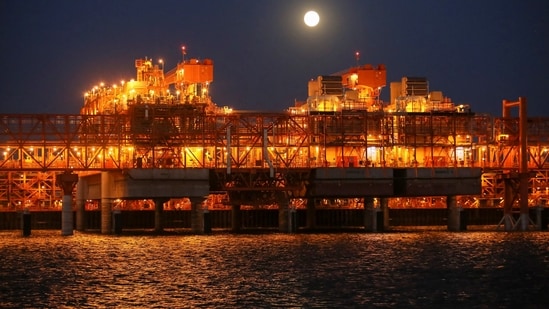
If it works, domestic output rises from about 62 million tonnes of oil-equivalent a year to 80. If it works.
That “if” is doing a lot of work.
India’s crude production has fallen from 36.9 million tonnes in 2015-16 to 28.7 million tonnes in 2024-25, even as import dependency has climbed to a record 88.7% in the financial year just ended.
The International Energy Agency (IEA) and the Organization of the Petroleum Exporting Countries (OPEC) both name India the single largest source of new oil demand between now and 2050. And the immediate backdrop is starker still: the ongoing conflict in West Asia has repeatedly disrupted supply routes through the Strait of Hormuz and the Red Sea, forcing Indian refiners to reroute cargoes, absorb higher freight and insurance costs, and rethink an import mix in which a single geopolitical shock can move landed prices sharply. The scissors — falling supply, rising demand — explain why the cabinet had to act eventually. West Asia explains why now.
Why finding oil is hard
Oil does not sit in underground lakes. It occupies microscopic pore spaces inside certain kinds of rock, and for those rocks to hold commercially useful volumes, five separate things have to be true in the same place at the same time. Geologists call this a working petroleum system, a framework formalised in a 1994 memoir by Leslie Magoon and Wallace Dow that remains the industry’s canonical reference.
{{/usCountry}}Oil does not sit in underground lakes. It occupies microscopic pore spaces inside certain kinds of rock, and for those rocks to hold commercially useful volumes, five separate things have to be true in the same place at the same time. Geologists call this a working petroleum system, a framework formalised in a 1994 memoir by Leslie Magoon and Wallace Dow that remains the industry’s canonical reference.
{{/usCountry}}There has to be a source rock — a sedimentary layer, typically shale, that was once rich in organic matter and has been buried deep enough and long enough for heat and pressure to cook that matter into hydrocarbons. There has to be a reservoir rock — usually sandstone or limestone, porous enough to hold oil the way a sponge holds water. There has to be a seal — an impermeable cap, often clay or salt, that stops the oil from leaking upward. There has to be a trap — a geometric quirk of the geology that concentrates the oil in one spot rather than letting it disperse. And the timing has to work: the reservoir and seal must be in place before the source rock finishes generating oil, or the oil migrates through empty rock and is lost. Miss any one of these, and there is no field.
This is why exploration fails as often as it does. Rystad Energy, which tracks upstream activity globally, put the offshore wildcat success rate at just under 25% in 2020 — meaning three of every four exploratory wells came up dry. And “success” in that statistic is a low bar: it means finding hydrocarbons at all, not finding enough of them to be commercially worth developing. On the stricter test, the hit rate is lower still.
The last decade has produced two spectacular exceptions, both in places nobody was drilling seriously before. Off Guyana, in a block called Stabroek that ExxonMobil began exploring in 2015, the exploration success rate has run at about 80% — Rystad’s Schreiner Parker has called it the highest in the world.
The block now holds close to 11 billion barrels of recoverable oil across more than 30 discoveries, and Liza, the first field, went from discovery to first oil in under five years, a timeline ExxonMobil’s own executives describe as “nearly unheard of” in deepwater.
Off Namibia, in the Orange Basin, TotalEnergies, Shell and Galp have made a cluster of major finds since 2022 — Venus, Graff, Mopane — that could add up to a new oil province. Both are the same story geologically — passive-margin basins where Cretaceous source rocks have charged deep sandstone reservoirs — in places nobody had drilled seriously before.
The counter-examples matter more. Off the Falkland Islands, Rockhopper Exploration's Sea Lion field was discovered in 2010, took 14 years to reach a final investment decision, and is only now scheduled for first oil in 2028 — the geology worked, but the field's remoteness and the collapse in oil prices after 2014 made it uneconomic for over a decade.
Off Ireland, roughly 200 wells drilled in half a century have yielded only about four commercial discoveries, and Barryroe Offshore Energy, which held the country’s most promising undeveloped find, wound down in 2023 after the government refused its development plan and financing collapsed.
Off South Africa, TotalEnergies made two large gas-condensate finds — Brulpadda in 2019 and Luiperd in 2020 — spent more than $400 million appraising them, then walked away in 2024 because, in its own words, the discoveries “appeared to be too challenging to economically develop and monetise”. Geology, commerce, regulation: each can kill a field on its own.
Also read: Shipping via Hormuz, Bab al-Mandab disrupted: Why the narrow waterway matters
What ₹84,000 crore will actually buy
Exploration runs in stages, and Samudra Manthan spends money on each of them.
It starts with seismic surveys — ships towing arrays of air guns and hydrophones that map the layered rocks beneath the seabed, at a cost of ₹28,534 crore in this scheme. Seismic reveals structure and can hint at fluid content, but it cannot confirm oil. Only a well can.
The wells are where the money and the risk concentrate. A deepwater exploration well — drilled through more than a kilometre of water and then several more kilometres of rock — costs somewhere between $80 million and $150 million, and there is no way to know until the drill reaches the target whether the money is buying a discovery or a dry hole.
Samudra Manthan budgets ₹43,200 crore for 60 such wells and, crucially, offers government support of up to half the eligible drilling cost, capped at ₹675 crore per well. That subsidy exists because private operators, faced with three-in-four odds of drilling a dry hole in Indian offshore basins that international majors have largely stayed away from, have not been willing to write the cheques themselves.
Even a successful discovery is years from producing oil. In deepwater, the standard timeline from discovery to first oil runs five to ten years — Guyana's Liza, at under five, is the industry benchmark for speed; Namibia’s Venus, discovered in 2022 and not expected to produce before the early 2030s, is more typical.
Also read: India’s strategic oil reserves, and how Hormuz is affecting the math
What India’s offshore actually looks like
India's offshore is not a blank map.
Mumbai High, discovered in 1974 and in production since 1976, was for decades the country’s single largest field. Its output peaked at 471,000 barrels a day in 1989 and has fallen to about 131,000 today. ONGC signed a technical-services contract with BP earlier this year to try to reverse the decline.
In the Krishna-Godavari basin off the east coast, ONGC’s deepwater block KG-DWN-98/2 began producing oil in January 2024, its ramp-up more gradual than initially projected.
In the Andaman Sea, the petroleum minister announced a natural gas discovery in September 2025 — samples tested at 87% methane — though commercial viability is yet to be confirmed. Rystad Energy describes the Andaman deepwater as “significantly crippled by the lack of high-quality deepwater seismic data”.
In the Mahanadi basin off Odisha, ONGC spudded its first deepwater exploration well under Samudra Manthan on July 25, the first of four planned in that basin alone.
The paradox in these numbers is the point. Under the Open Acreage Licensing Policy, launched in 2017, the government has awarded 172 exploration blocks covering 378,652 sqkm across nine bidding rounds. Domestic output has still fallen.
The pattern suggests that acreage on offer and geological reward are different problems — and that Samudra Manthan is essentially the government's admission of the gap, with the state now underwriting the drilling that private capital has not.
International majors have been largely absent from Indian licensing rounds; the recent OALP-IX in April 2025 was carried by ONGC, OIL, Vedanta and a Reliance-BP joint venture.
That absence is itself a piece of information about how the industry reads Indian offshore geology.
Also read: ‘Not necessary, but…’: Trump reacts to Russia sanctions bill that threatens 100% tariffs on India
The gradient of growth
Samudra Manthan’s target is to lift domestic oil and gas output from about 62 to 80 million tonnes of oil-equivalent a year by 2031.
On the industry’s roughly 25% offshore success rate, 60 wells would be expected to yield around 15 discoveries — but the target requires those discoveries to be, on average, substantial. Very few frontier campaigns clear that bar; Guyana did, most do not. And because deepwater fields take years to develop, even successful 2028 wells may contribute little production before the scheme’s 2031 horizon.
The demand side leaves less room for patience. The IEA projects India’s oil consumption to rise from 5.48 million barrels a day in 2023 to 6.6 million by 2030, more than a third of all global oil-demand growth over that period. OPEC, in a presentation at India Energy Week in Goa this year, put India’s additional demand at 8.2 million barrels a day by 2050 — the largest single contribution from any country.
But that demand curve is not fixed, and this is where the scheme’s logic gets more defensible than its odds alone suggest.
India is also building renewable capacity, ethanol blending, electric mobility, and green hydrogen at a pace that will, over the same decades, take a growing share of the load off oil.
The IEA’s central scenario already sees global oil demand plateauing around 2030 on the back of exactly these shifts; India's own transition will bend its curve too, even if later than the world’s. Samudra Manthan, on that reading, is a bridge — the barrels India needs while the alternatives scale, bought at ₹84,084 crore and against three-in-four odds on each well drilled. If the geology cooperates, the scheme buys the country time. And time, in an energy transition, is the resource that matters most.