More than 5,000 American sailors and Marines aboard the aircraft carrier USS Abraham Lincoln have spent over 250 consecutive days at sea, the longest stretch without a port call by a US carrier in the modern era.
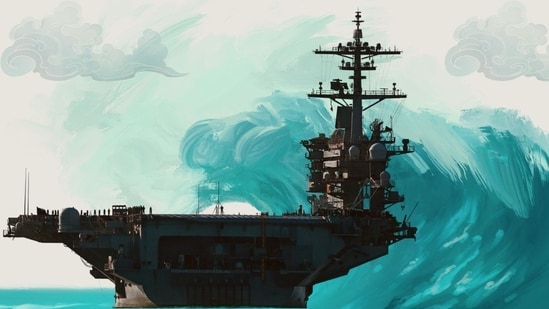
Multiple sailors have tried to jump overboard, according to reports by Navy Times and Stars and Stripes, two publications that closely cover the US military. Families have told US lawmakers of crumbling morale, and one sailor's wife said he had texted her that he "hopes he doesn't wake up tomorrow".
The crisis, unfolding as the US war with Iran keeps extending Lincoln's deployment, has put into focus what months of confinement, motion, disrupted sleep and isolation actually do to a person.
What happened on USS Abraham Lincoln
The Lincoln left San Diego on November 21, 2025, bound originally for the Pacific, before it was redirected towards West Asia ahead of the US-Israel war against Iran, according to the Guardian and Al Jazeera.
The deployment was due to end in May but has been extended repeatedly. The crew has had only two days on land since then, in Guam in December 2025 and Oman in July 2026, the Guardian reported.
{{/usCountry}}The deployment was due to end in May but has been extended repeatedly. The crew has had only two days on land since then, in Guam in December 2025 and Oman in July 2026, the Guardian reported.
{{/usCountry}}At a town hall in San Diego last week, roughly 200 family members confronted acting navy secretary Hung Cao and other officials, Stars and Stripes reported. One woman said at the meeting the US Navy had "broken trust between us and the leadership," according to The Guardian's report of the town hall.
Navy Times separately reported that Annabelle Loma, the wife of a sailor aboard the ship, said her husband had tried to jump overboard after his deployment was extended. Another sailor's wife, Al Jazeera reported, said her husband had physically stopped a shipmate from going over the side.
CBS News, citing two unnamed officials, reported that a sailor went overboard on August 3 and was recovered by helicopter, treated and moved off the ship. The circumstances remain under investigation, as per BBC.
The reports triggered outrage in the US.
According to The Guardian, President Donald Trump dismissed concerns over deteriorating morale, claiming families were not worried and calling the record deployment "not nearly long enough". Addressing the crew's extended time at sea, he said, "That ship is moving right now, or very shortly, and it’s being replaced with another very similar ship."
Democratic senator Richard Blumenthal of Connecticut wrote to defence secretary Pete Hegseth citing "shortages of basic supplies, water contamination, plumbing issues, deteriorating mental health, deck safety concerns and disruptions in the mail system". Senator Mark Kelly, a former naval officer and astronaut, called the reports of overboard attempts "disturbing". And Democratic Congressman Mike Levin of California described conditions aboard as "mouldy showers, broken toilets, laundry down for weeks, long stretches with no hot water, a meal that came down to half a cup of rice and two tortillas. No soap, deodorant, or toothpaste".
Hegseth has pushed back, dismissing the first wave of criticism over conditions on the Lincoln in April as "more fake news". This week, as the latest reports emerged, he called them "completely misrepresented".
Also read: Iran to US warship Abraham Lincoln: 'Enter range and we fire'. Then missiles fly
"We make sure every ship, every crew, every captain has everything we can provide them at every single moment," he added.
The US Navy has given near-identical statements, saying it has "not identified an increase in reported suicidal ideation or suicide attempts aboard the ship", and that medical, religious and mental-health support is available to the crew.
Sea madness, in literature, and what Homer knew
Before modern navies started keeping incident logs, writers were describing what stillness and confinement at sea could do to a mind. Samuel Taylor Coleridge's The Rime of the Ancient Mariner (1798), still taught in India's Class 10 CBSE English syllabus, captures a ship becalmed and a crew unravelling:
"Day after day, day after day
We stuck, nor breath nor motion."
Herman Melville's Moby-Dick (1851) also traced Captain Ahab's psychological descent across an extended voyage, and the cabin boy Pip's breakdown after being left adrift alone at sea.
But the theme is old enough to predate Homer's Odyssey, made ever more famous this year with famed director Christopher Nolan releasing his star-studded Hollywood adaptation of the ancient Greek story.
Odyssey, which follows Odysseus' decade-long, storm-battered journey home after the Trojan War, has been mined by scholars searching for information on what the epic might reveal about ancient sailors' experience.
A 2017 peer-reviewed historical review in Frontiers in Neurology, by Doreen Huppert, Judy Benson and Thomas Brandt of the German Center for Vertigo and Balance Disorders in Munich, traced medical descriptions of motion sickness from Homer's time (roughly 800 BC) through to the late Roman period.
The ancient Greeks, the authors found, already recognized that seasickness was a physiological response to unfamiliar motion, and that experienced sailors built up resistance to it over time, a phenomenon modern science calls habituation.
A 2019 paper in the Cambridge classics journal Antichthon, by independent scholar Rupert Mann, argued that several episodes in the Odyssey track real seafaring experience rather than pure invention. Mann pointed to the encounter with the sea goddess Ino/Leukothea, who appears to Odysseus during a shipwreck to guide him to safety, as an early literary version of a phenomenon documented in modern survival accounts: a sensed, guiding presence reported by people in extreme isolation and crisis.
Also read: Pete Hegseth brutally fact-checks ‘fake news’ about USS Lincoln and Tripoli: ‘Deserve the best’
This sort of an experience is sometimes referred to elsewhere, in polar and mountaineering survival literature, as the “third man factor”.
Mann's argument was that the Odyssey's narrative, desertion at friendly ports, careful navigation through a dangerous strait, a sensed companion during a shipwreck, reads as oral tradition built from what real Bronze Age Mediterranean sailors would have actually gone through.
What modern science says
On land, the human brain gets a fairly predictable stream of information about balance and motion. At sea, those signals can be in conflict. The eyes may register a level-horizon while the vestibular system feels the ship roll and pitch.
Over time, though, the nervous system can adapt due to neuroplasticity: the brain's capacity to recalibrate itself to repeated experience.
That adaptation can persist even after a sailor is back on land, in a disorder called mal de debarquement syndrome (MdDS), a chronic sensation of rocking or swaying that, unlike ordinary "land sickness" does not always fade within days.
In a 2015 review published in the Annals of the New York Academy of Sciences, Dr Yoon-Hee Cha, a neurologist, described functional brain-imaging studies of patients with persistent MdDS. These showed altered activity in the entorhinal cortex, a region involved in spatial processing, and the amygdala, linked to anxiety and chronic stress. Patients also reported symptoms such as chronic fatigue, cognitive slowing and heightened sensitivity to visual motion.
Sleep, too, suffers at sea
Warships do not run on a nine-to-five schedule. Instead, naval forces use watchkeeping to rotate shifts through the day and night. This constant shifting fragments sleep. Over time, that sleep deprivation builds up significantly.
A 2022 study in the International Journal of Environmental Research and Public Health, led by Mikko Myllylä and colleagues, followed 18 crew members aboard a Finnish navy patrol boat through two different watch schedules. The study found that older sailors and those with longer naval service reported greater sleepiness, fatigue and stress responses on board, while sailors with higher physical activity and fitness levels reported less of all three.
That fatigue can be damaging over time.
A study by Olav Kjellevold Olsen and colleagues at the Royal Norwegian Naval Academy, published in International Maritime Health in 2013, tested naval officers in rested and partially sleep-deprived states during a simulated maritime combat exercise. Sleep-deprived officers were significantly worse at anticipating both moral and tactical problems before an operation began, the researchers found. This, they said, was evidence that lost sleep does not just make people tired, it degrades judgement.
A 2025 study in the journal Military Medicine, analysing 441 US Navy sailors, most of them aboard an aircraft carrier, found that the most distressing stressors were loud noise, being unable to rest when needed, and inadequate access to mental and physical health care.
Confinement doesn't end when the shift ends
Sailors on a deployed warship cannot go home after a hard day. The ship is both their workplace and residence. They see the same faces daily, and the outside world arrives only through letters, calls and port visits.
A 2021 study in Frontiers in Psychiatry followed 29 submariners on a nuclear-powered submarine patrol and found that mood and psychological functioning deteriorated over the course of the deployment regardless of fitness levels, though sailors who kept up regular physical activity maintained steadier attention and sensory functioning than those who did not.
But the study also found that physically active submariners reported worse general health and sleep once the patrol ended, suggesting that the benefits of staying active during the patrol came with some trade-off during recovery.
The study's authors noted that submarine confinement was an extreme version of isolation. Warship sailors face similar conditions. Many of the core stressors overlap across both environments. These include tight confinement, disrupted watch rhythms, a total absence of natural light, and constant background noise.
Such pressures, for naval sailors on active deployment in a warzone, rarely arrive one at a time. A sailor sleeping poorly may also be keeping long watches, is separated from family, uncertain when the deployment will end, and, if supply lines are disrupted, contending with less-than-ideal living conditions.
The physical toll
A January 2025 report ('Neurotrauma in Naval Operations: Addressing the Unseen Battlefront') by the Center for Maritime Strategy, a Washington-based non-profit, identified traumatic brain injury, blast exposure and the physiological strain of extreme confinement, isolation and pressure changes as under-addressed risks in naval and submarine operations.
The report argued that untreated neurotrauma can affect a service member's leadership capacity, decision-making, retention and long-term health.
The research is not one on Lincoln’s crew specifically, but the science does establish that physical and mental stressors aren’t uncommon among sailors. Put together, the issues compound into a gap navies around the world should start taking note of, the Center for Maritime Strategy's report suggests.