The World Robot Conference opened in Beijing on August 19, drawing more than 300 domestic firms showing over 2,000 exhibits and launching upwards of 150 new products, according to figures by the organisers.
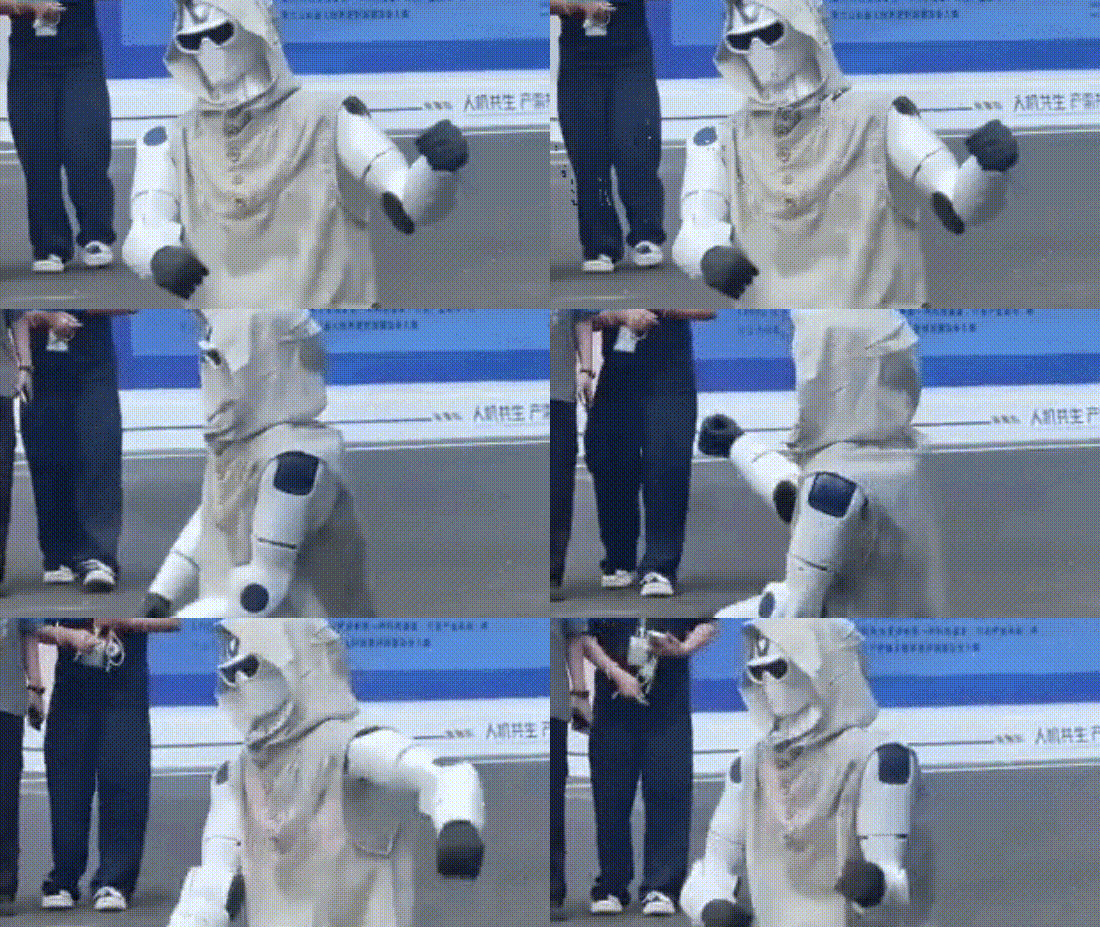
The five-day event is China's biggest annual showcase for a sector in which the country now dominates production, and in which, one of its best-known makers pulled off one of the most talked-about technology listings of the year.
Shares in Unitree Robotics, the Hangzhou-based firm founded in 2016 by Wang Xingxing, soared as much as 629% in their trading debut on the Shanghai Stock Exchange's Star Market on Wednesday. An initial public offering had raised around 6.1 billion yuan ($904 million) and was more than 8,000 times oversubscribed by retail investors, Reuters reported.
Also Read | Humanoid Robots, a new Gemini and OpenAI’s house of disorder
Priced at 150.80 yuan a share, the stock closed 460% higher at 845 yuan on debut day, according to the Associated Press. It fell 11% the next day as investors took the profits.
{{/usCountry}}Priced at 150.80 yuan a share, the stock closed 460% higher at 845 yuan on debut day, according to the Associated Press. It fell 11% the next day as investors took the profits.
{{/usCountry}}Unitree is the first mainland-listed humanoid robot maker, in a sector Chinese leaders have designated a national development priority. What Beijing has been showing off in the capital, and what the market has been buying into, are two versions of the same wager: that China's lead in humanoid manufacturing will translate into a lead in the machines that come after them.
But the industry's most closely watched builder used the same conference to caution that it will not happen soon.
China’s manufacturing edge
A Chinese humanoid industry body reported on Thursday that the country delivered more than 40,000 humanoid robots in the first half of 2026, accounting for 97% of global shipments, Reuters said. Technology research firm IDC puts China’s share at 82%. Counterpoint Research's Ethan Qi told AFP the figure was above 90%.
The scale reflects a long state-backed push. Beijing has named robotics a priority sector in its last two five-year plans and has built out a component supply chain that shares many features with the country's electric-vehicle industry — an ecosystem that keeps unit costs down and lets makers move quickly from prototype to volume.
China's advantage lies in “manufacturing scale, supply chain integration and cost competitiveness", Qi said, while the US was “much stronger” on software and cutting-edge research.
For 2026 as a whole, JPMorgan expects global humanoid shipments to reach 60,000 units, up from 18,000 in 2025, and to rise to 1.75 million by 2030, according to Bloomberg. The bank sees China accounting for more than half of global demand.
Unitree as the concentrated bet
Unitree is the clearest expression of that confidence. The company shipped more than 5,500 humanoid robots in 2025, ranking first globally by shipments, and reported revenue of around 1.7 billion yuan ($250 million) for the year, mainly from sales of its humanoids and quadruped “robot dogs”, the AP reported.
More than 40% of that revenue came from overseas markets, and the US accounted for roughly 13% last year, the company said.
Also Read | US AI arms race: Can America stay ahead of China as Pentagon struggles to control military AI risks?
Unitree plans to spend its IPO proceeds on developing what the industry calls the humanoid “brain” — embodied artificial intelligence that lets a robot interpret and act on its surroundings — along with advanced research and manufacturing capacity.
The shift matters because Unitree's global reputation was built largely on the physical dexterity of its robots, and the pivot reflects where the company now sees the industry’s movement.
Washington's counter
In July, the US Federal Communications Commission (FCC) restricted new equipment authorisations for foreign-made advanced humanoid and quadruped robots, citing national security concerns. It isn’t a straight import ban; previously authorised models could still be sold, but new versions cannot enter the American market.
Unitree has cautioned that the ruling could hit future US sales, and that Washington may expand the restrictions.
IDC estimated that under its worst-case scenario for the American measures, US humanoid sales in 2030 would come in 58% below the firm’s prior baseline forecast.
Also Read | US bans imports of foreign-made humanoid robots ahead of Trump-Xi meet, targets China-dominated market
Chinese makers have signalled they will look elsewhere.
Omdia’s Lian Jye Su told the AP that Chinese firms were likely to target major markets outside the US, such as Europe. Lumos Robotics, a Suzhou- and Shenzhen-based startup backed by Japan's Mitsubishi Electric, said it planned an overseas push next year — initially West Asia and Europe, with Japan and South Korea also under consideration.
The next race, and what's still missing
At the conference’s main forum on Thursday, Wang Xingxing’s pitch on the industry’s future, made a day after Unitree’s blockbuster listing, was strikingly cautious.
“We are marching towards a ‘ChatGPT moment’ in embodied intelligence,” Wang told the audience, invoking the late-2022 breakthrough moment for large language models.
But the tipping point, as he defined it, remains distant. Robots would need to complete “approximately 80% of tasks successfully through voice or text commands” when placed in an unfamiliar household, an inflection he said would trigger “explosive growth” in the sector.
Also Read | China’s robot stars: Country shows off automated doctors, teachers, soldiers
That tipping point is two to three years away in an optimistic scenario, and five to 10 years at the outer edge, Wang said.
Wang also said that robots today perform well in test conditions but “execution collapses once objects or surroundings shift even slightly”, leaving machines slower than human workers and limited in the range of tasks they can handle.
Unitree, he said, was "lagging behind" in the real-world application of physical AI models and had made world models — the AI simulation systems that let a robot navigate the physical world — its largest investment by capital and manpower, Reuters reported.
Georg Stieler, head of automation at the robotics consultancy Stieler, said Wang's message stood in contrast to the mood outside. “Relative to the mood around World Robot Conference and Unitree's spectacular IPO, Wang Xingxing was notably sober about current capabilities,” Stieler said.
Wang He, founder of Chinese robotics startup Galbot, said he expected the “ChatGPT moment” to arrive by 2028 — defining it as the point when robots can perform 70% to 80% of everyday tasks without specialised training.
Mass deployment of robots will need to cross another hurdle – unit economics.
Chinese brokerage Guotai Securities estimates that an industrial humanoid would need to cost about 160,000 yuan, including maintenance, to pay for itself within two years, compared with a worker earning 80,000 yuan a year. In practice, according to Berlin-based think-tank Merics, such robots typically cost between 300,000 and 500,000 yuan.
Stieler estimated that 50% to 70% of the humanoids produced this year could end up in “data factories” — collecting training data rather than performing productive work for paying customers.
“The valuation that goes into all these companies is based on the fact that these robots will become general purpose, human-like at some point. Failing to deliver that will be a very massive blow,” Omdia's Su told AFP.
A commercial test starts this weekend
A public test of this gap will begin later in the week. On Saturday, the World Humanoid Robot Games, running from August 22 to 26 in Beijing, will combine the familiar spectacle events — races, football, fighting — with a growing slate of competitions built around actual work. This will include packing and warehousing, industrial assembly and material feeding, retail and office services, electric-vehicle charging, and dexterous tasks such as connecting cables and using tools.
Unlike a sprint or a dance routine, such tasks test whether robots can identify unfamiliar objects, manipulate them repeatedly, recover from mistakes and complete jobs without engineers stepping in.
“The next phase of the industry is less about demonstrating that a robot can walk and more about demonstrating that it can perform economically useful tasks,” Kangyuxiao Li, an equity analyst at Morningstar, said.