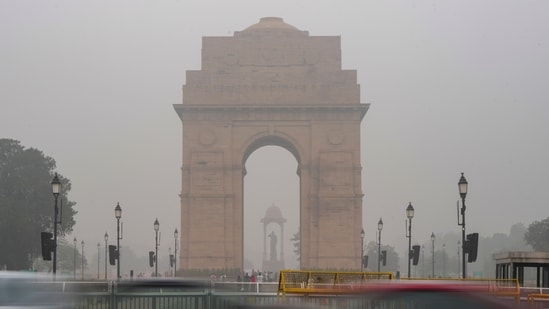
Delhi-NCR’s pollution problem is often seen as a problem limited to the capital. Every winter, the discussion centres on vehicles, construction dust, crop-residue burning, industrial emissions and weather conditions. These factors all contribute, but they are also connected. Air pollution does not stop at state or city borders, which is why neighbouring regions need to work together to address it.
The need for this approach is increasingly reflected in the work of the Commission for Air Quality Management (CAQM). Its 2026 Annual Action Plans cover multiple sectors, including transport, industry, dust mitigation, waste management and crop-residue management. The plans have been prepared by NCR states, municipal corporations and development authorities, with implementation to be monitored regularly.
The challenge becomes clearer when the wider region is considered. CAQM’s February 2026 review of a Supreme Court-mandated expert report noted the influence of both local emissions and the regional movement of pollution across the airshed. The report identified multiple contributors to PM2.5, with their relative contribution changing between winter and summer.
This makes reliable monitoring important, particularly when pollution sources and their movement extend beyond individual cities. This is also creating scope for greater collaboration between government agencies and companies working on environmental monitoring systems. Air-quality monitoring solutions can help expand coverage and provide more localised readings, including for particulate matter such as PM2.5 and PM10. Low-cost sensor-based systems can be particularly useful in this regard, allowing monitoring to be extended to locations where conventional systems may not always be practical.
Wider monitoring can give authorities a clearer picture of pollution levels across different areas and help guide on-ground action.
{{/usCountry}}Wider monitoring can give authorities a clearer picture of pollution levels across different areas and help guide on-ground action.
{{/usCountry}}This matters because there is no single source that can be addressed in isolation. Traffic-related emissions, dust, industrial activity, biomass burning and other sources require different responses, often involving different agencies and jurisdictions.
That is why regional coordination needs to go beyond responding to pollution episodes. The objective should be to understand where pollution is coming from, how it moves and which interventions can have the greatest impact in different parts of the region.
CAQM is already strengthening this framework. In February, it approved the expansion of the Continuous Ambient Air Quality Monitoring Station network across Delhi-NCR to improve monitoring of regional pollutants and baseline air quality. In May, the Commission again reviewed the progress of this network and stressed the need for timely installation of the remaining stations.
Monitoring is an important starting point, but it cannot be the final objective.
Air-quality data can show authorities which areas are seeing repeated pollution problems and where closer attention may be needed. It can help identify dust hotspots, compliance issues at industrial sites or the impact of traffic in particular areas. But collecting this information is not enough. It has to be followed by action on the ground.
That may mean more frequent cleaning in a particular area, closer checks at construction sites or action against activities that are not meeting environmental norms. Technology can point authorities in the right direction. The follow-through still has to happen on the ground.
This is where collaboration between civic bodies and technology providers can have a practical role. Companies working in environmental solutions are bringing different technologies to government agencies through demonstrations and field applications. These include solutions such as PAMARES, which focus on reducing particulate pollutants such as PM2.5 and PM10, as well as mechanised road-cleaning and litter-picking solutions such as JATAU that can support municipal teams with on-ground cleaning. Together, such efforts show how partnerships can bring specialised technology into areas where it can address specific environmental and operational needs.
The broader principle is simple: Technology has value when it addresses a real operational need. Monitoring can identify where attention is required, while appropriate equipment and coordinated teams can help translate that information into action.
Regional cooperation cannot be limited to government departments. Municipal bodies, state agencies, industries, transport operators, researchers, technology providers and local communities all have a role in improving the region’s environmental conditions.
Crop-residue burning illustrates why this broader coordination is necessary. In May 2026, CAQM reviewed the situation around wheat stubble burning and directed concerned state governments and agencies to strengthen enforcement. The Commission has also approved coordinated action plans for preventing and eliminating paddy stubble burning across the NCR states.
Transport is another area where this is already taking shape. CAQM has approved a phased shift towards electric three-wheelers in Delhi-NCR and has also directed that vehicles without valid Pollution Under Control Certificates should not be refuelled. Since these measures cut across jurisdictions, their implementation will depend on coordination between regulators, state governments, transport authorities, vehicle owners and other stakeholders.
The same principle applies to dust, industrial emissions and waste management. Responsibilities may be divided between agencies, but the environmental conditions created by these activities are shared.
Collaboration has to happen at several levels. State governments can coordinate on pollution sources that cross regional boundaries. Civic bodies can bring in technology providers to tackle operational issues, while researchers and monitoring agencies can offer the evidence needed to support better decisions.
Delhi-NCR has several systems in place to monitor and control air pollution, along with action plans and regulations. What matters now is how well these efforts work together on the ground.
The focus needs to move beyond short-term responses towards year-round management of pollution sources. That means regular monitoring, coordinated planning, stronger implementation and the ability to respond quickly when data points to a problem.
Cleaner air will not come from one policy, one city or one technology. It will require several systems working together, with each agency and stakeholder contributing to the part of the problem within its reach.
For Delhi-NCR, regional collaboration is, therefore, not simply another component of pollution control. It is what can help connect monitoring, enforcement, technology and on-ground action into a more consistent approach to cleaner air.
(The views expressed are personal)
This article is authored by Nitin Kaushal, founder and CEO, SFK Group of Companies.