There was a sound that once marked dawn in villages across India: the sputter and cough of a diesel pump being coaxed to life before sunrise, so water could be drawn while the electricity still held. That sound is fading. In its place is something quieter--the near-silent hum of a solar pump, powered by daylight instead of diesel, and owned by a farmer who no longer has to plan the day around a fuel truck or a load-shedding schedule.
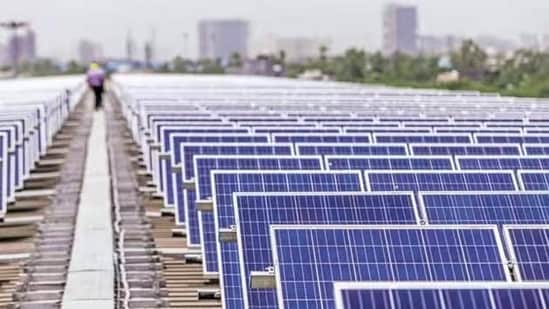
Solar infrastructure is quietly rewriting the story of rural India.
What began as an environmental imperative has evolved into one of the most transformative instruments of rural development. Across the country, solar energy is improving agricultural productivity, expanding livelihoods, empowering women, strengthening local enterprises, and bringing essential services to communities that once remained beyond the reach of reliable electricity.
The transition is not simply from conventional energy to renewable energy; it is a transition from dependence to self-reliance.
The scale of what is underway is difficult to overstate. India crossed 150 gigawatts of installed solar capacity in the first quarter of 2026, overtaking longstanding rivals to become one of the world’s largest solar markets, with tens of gigawatts more expected to come online through the rest of the year. But the more consequential story for rural India is not the size of that number, it is where the capacity is landing.
Two government programmes sit at the centre of this shift. PM-KUSUM (Pradhan Mantri Kisan Urja Suraksha evam Utthaan Mahabhiyaan), first launched in 2019 and since expanded, is built around a simple but radical idea: Let farmers generate their own power. Through its various components, the scheme supports standalone solar irrigation pumps, the solarisation of existing grid-connected pumps, and small decentralised solar plants on farmers’ own land, with a combined target of roughly 34,800 megawatts of solar capacity. By early 2026, close to a million standalone solar pumps had been installed nationally, more than a million grid-connected pumps had been solarised, and the scheme had reached over 21 lakh farmers directly. A second phase, with a stronger emphasis on agrivoltaic systems that allow crops and solar panels to share the same plot of land, is now on the horizon.
{{/usCountry}}Two government programmes sit at the centre of this shift. PM-KUSUM (Pradhan Mantri Kisan Urja Suraksha evam Utthaan Mahabhiyaan), first launched in 2019 and since expanded, is built around a simple but radical idea: Let farmers generate their own power. Through its various components, the scheme supports standalone solar irrigation pumps, the solarisation of existing grid-connected pumps, and small decentralised solar plants on farmers’ own land, with a combined target of roughly 34,800 megawatts of solar capacity. By early 2026, close to a million standalone solar pumps had been installed nationally, more than a million grid-connected pumps had been solarised, and the scheme had reached over 21 lakh farmers directly. A second phase, with a stronger emphasis on agrivoltaic systems that allow crops and solar panels to share the same plot of land, is now on the horizon.
{{/usCountry}}Running alongside it is PM Surya Ghar: Muft Bijli Yojana, the rooftop solar programme aimed at ten million households, which offers eligible families up to ₹78,000 toward the cost of a rooftop system. The government has also begun deliberately converging the two schemes--linking PM-KUSUM and PM Surya Ghar with state rural livelihoods missions, women’s self-help groups, and cooperative and panchayat structures, so that solar adoption stops being a series of isolated installations and starts becoming a coherent rural energy system.
What both programmes share is a shift in posture: From treating rural households as passive recipients of whatever power the grid could spare, to treating them as producers and, in many cases, sellers of energy in their own right.
It is easy for policy language to obscure what this actually means for a household. In practice, the change shows up in very specific ways.
- Irrigation on the farmer’s own terms: A solar pump does not care what time the grid decides to send power, or whether diesel prices have spiked again. It runs when the sun is up, which, for most of the agricultural year, is also when a farmer needs to water crops. Evidence from states such as Gujarat and Madhya Pradesh shows that solar irrigation, when designed well, can raise incomes, ease pressure on groundwater when paired with the right safeguards, and cut a farmer’s single largest recurring input cost.
- Income beyond the harvest: Under PM-KUSUM’s land-leasing component, farmers with barren or uncultivable land can lease it for solar power generation, or sell surplus electricity generated on their own farms back to the grid. For families whose income has historically been seasonal, tied to a single harvest and a single set of prices, a monthly or quarterly solar income can bring a genuinely new kind of stability.
- Women at the centre, not the margins: One of the more overlooked developments is the Solar Didi programme, under which women from self-help groups are being trained to install, operate, and maintain solar equipment, in convergence with urban and rural livelihood missions. In villages where women have long managed household energy, collecting firewood, rationing kerosene, waiting for the grid. This gives them technical and economic authority that has usually gone to men. In my own experience running programmes for women’s financial and economic empowerment, I have seen how transformative it is when a woman moves from being the person who manages scarcity to the person who manages an asset.
- Diesel dependence, and the quiet costs that come with it, in retreat: Diesel has never just been an input cost. It has meant transport risk, price volatility tied to global crude markets, and, this year in particular, exposure to the kind of geopolitical shocks that can disrupt supply overnight. Every pump that shifts from diesel to solar is one household that has stepped outside that exposure.
None of this is to suggest the transition is complete, or that it happens automatically once a subsidy is announced. Having built and run rural programmes across eighteen states, I know that infrastructure alone does not change lives, institutions do. A solar pump installed without a functioning Water User Group to manage shared access can create new conflicts as easily as it solves old ones. A rooftop panel installed without local technicians trained to maintain it becomes, within a few years, an expensive ornament rather than a source of power.
The analysts and practitioners closest to this work are converging on the same conclusion: PM-KUSUM and its companion schemes are sound policy instruments, but they need deeper institutional scaffolding to deliver on their promise at scale. That means water-user collectives embedded in real credit systems, not just irrigation infrastructure sitting beside untouched groundwater rules. It means farmer producer organisations positioned to capture value from carbon markets and agri-processing, not just from electricity savings. It means financing routed through instruments like the Agriculture Infrastructure Fund in ways rural households can actually access, with paperwork and collateral requirements that do not quietly exclude the smallest landholders, who are so often women.
This is precisely the terrain where civil society organisations have a role that government schemes, by their scale and design, cannot fully occupy: the last-mile work of forming user groups, training local maintenance capacity, linking households to the right financing window, and staying present long after the installation crew has left. Solar panels are relatively easy to procure. The trust, training, and local institutions that make them sustainable take years to build, and that is where organisations working directly in villages, alongside the communities themselves, earn their keep.
However, despite impressive progress, important challenges remain. There are villages that will not see a functioning solar pump for years yet, and subsidy schemes whose paperwork remains a genuine barrier for the families who need them most. But I have also spent enough years in the field to recognise the difference between a scheme that exists on a government website and one that is actually changing how a household eats, earns, and plans for the next season. Solar infrastructure, imperfect and unevenly distributed as it still is, belongs to the second category.
What makes it different from many development interventions I have watched come and go is that it does not ask rural India to wait for the grid to arrive, or for the market to decide it is profitable to serve them. It gives villages a way to generate what they need themselves. For a country whose rural development story has too often been written in terms of what was promised and not delivered, that is not a small thing. It is one of the more honest forms of progress rural India has been offered in a long time, and it is worth building on, deliberately and carefully, rather than simply celebrating from a distance.
(The views expressed are personal)
This article is authored by Neelam Gupta, founder, AROH Foundation.