On August 26, 2026, the Bhotekoshi and Trishuli rivers overflowed in Nepal, causing devastating floods. The news headlines that followed this unfortunate climate disaster mentioned: villages buried, bridges gone, roads blocked, more than a thousand dead, and thousands still missing across Nepali districts including Rasuwa, Nuwakot, Dhading, Gorkha and Chitwan.
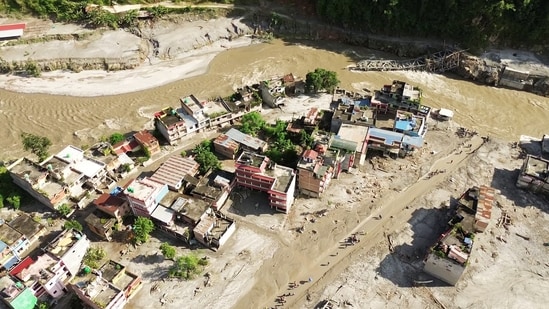
But there is another story that rarely appears in any damage reports worldwide. For women in these worst-hit districts, especially the women of Rasuwa's Tamang communities, they saw much more than just their houses get destroyed. They were also stripped of the resources that kept them safe. UN Women's own alert on this disaster estimates that more than 157,000 women and girls across Rasuwa and Nuwakot have been affected, directly or indirectly. Floods do not simply cause violence against women. But what these floods did was overexpose the vulnerabilities of women in these communities, and it stripped away the social and physical support systems of women who are already living with violence.
Nepal does already carry a heavy load of violence against women. The country's 2022 Demographic and Health Survey found that 27% of women aged 15 to 49 who had ever been married or partnered had faced physical, sexual, or emotional violence from a partner. Among women who had faced physical or sexual violence, 58% had never sought help or told anyone. That silence is not by accident. It is rather held in place by a set of ordinary resources: a working phone to call someone, a passable road to reach a clinic or police post, a small independent income, a neighbour who can be trusted, a room with a door that locks.
Nepali women have in fact faced this situation before, with the devastating Gorkha earthquake in 2015. After that disaster, only 11% of assessed displacement camps had any space set aside for women’s safety, while harassment and sexual violence were documented inside the camps. Nepal also saw trafficking rise sharply after the earthquake, with estimates climbing from a few thousand cases a year before 2015 to well over ten thousand afterward. Some communities that faced the 2015 disaster, including settlements near Uttargaya and villages such as Satbise, Khalte and Thulo Haku, are now facing displacement for the second time in a decade and are doubly vulnerable, having never fully recovered. This pattern shows up around the world after disasters, from a jump in requests for survivor support after Hurricane Maria in Puerto Rico to a rise in trafficking after Cyclone Sidr struck Bangladesh.
{{/usCountry}}Nepali women have in fact faced this situation before, with the devastating Gorkha earthquake in 2015. After that disaster, only 11% of assessed displacement camps had any space set aside for women’s safety, while harassment and sexual violence were documented inside the camps. Nepal also saw trafficking rise sharply after the earthquake, with estimates climbing from a few thousand cases a year before 2015 to well over ten thousand afterward. Some communities that faced the 2015 disaster, including settlements near Uttargaya and villages such as Satbise, Khalte and Thulo Haku, are now facing displacement for the second time in a decade and are doubly vulnerable, having never fully recovered. This pattern shows up around the world after disasters, from a jump in requests for survivor support after Hurricane Maria in Puerto Rico to a rise in trafficking after Cyclone Sidr struck Bangladesh.
{{/usCountry}}The economic side of disaster-driven crises makes things harder for women and girls. Nepal’s floods have reportedly damaged around 42 kilometres of roads and 41 bridges, severing the networks that connect communities such as Satbise, Khalte and Thulo Haku in Rasuwa to markets and livelihoods. Across the wider corridor, crops, livestock, tourism businesses and other sources of income have been damaged or swept away. The scale of the crisis is already stark: more than 1,000 people had died and 4,247 remained missing by September 1, while UN Women estimated that 43,000 women and girls in Nepal required immediate humanitarian assistance.
For women, that economic shock comes with another disadvantage. Only about a quarter of Nepali households have land or housing registered in a woman’s name. With substantial male migration from these districts for work abroad, many affected households will, in practice, be managed by women navigating recovery, farming and a growing burden of unpaid care largely on their own. Yet women are not simply recipients of assistance. Across disaster-affected communities, they often become first responders, organising survival and community care through informal networks. Research on Bangladesh’s flood-prone Jamuna chars, for instance, has found that women relied on one another during displacement, even as violence increased and formal support remained limited. In Rasuwa, where water systems, roads and bridges have been destroyed, such informal networks may again become part of the infrastructure of survival. Nepali women already carry a disproportionate share of unpaid care work; after a disaster, that burden can expand further. This is consistent with LSE Professor Naila Kabeer’s longstanding work on resources and agency: a woman’s ability to leave an unsafe situation is not mainly a matter of willpower, but of what she can control, as Naila Kabeer’s work has long argued.
Recovery in Rasuwa should not be judged only by how many roads are repaved or houses rebuilt, but by whether disaster management is gender-responsive. Nepal does not have to invent that model from scratch. Other disasters have already shown what works. In Palau, a Women’s Peace & Humanitarian Fund and UN Women programme trained 200 community women as first responders and humanitarian leaders, putting women’s knowledge directly into local disaster preparedness and response. Research on mothers affected by the 2004 Sri Lankan tsunami also found that greater participation in community recovery efforts was associated with lower risks of PTSD and depressive symptoms. The study suggests that recovery is not only about what aid is delivered, but whether survivors have a role in shaping it.
The lesson is simple: Women’s safety, knowledge and decision-making cannot be an afterthought. They must be part of the recovery plan from the start. In post-flood Nepal, that means putting cash and food directly in women’s hands, funding local women’s groups from the assessment stage, designing shelters with the women who will use them, and keeping referral and protection services open from rescue through rebuilding.
Rebuilding after the floods is not only about replacing roads, homes and bridges. It is also about who gets to rebuild, who gets heard, and whose knowledge shapes recovery. If women are left out of those decisions, Nepal risks rebuilding the same inequalities that existed long before the floodwaters rose.
(The views expressed are personal)
This article is authored by Tanya Mittal, research associate, New Delhi.