In varying degrees, cities in India experience traffic congestion that results in slower speeds and longer travel times. The rapid growth in the number of private motor vehicles, inadequate road infrastructure, and inefficiencies in traffic management contribute to the congestion. Yet, these issues not only cause inconvenience to people’s lives, but also impact the environment, the city’s economy, and the nation’s development. This brief discusses traffic congestion in Delhi to identify the causes, and proposes measures for minimising congestion. It concludes that the challenge of traffic congestion can be addressed by improving public transport services, keeping roads and supporting infrastructure in good condition, using intelligent traffic management technologies, and enforcing traffic rules.
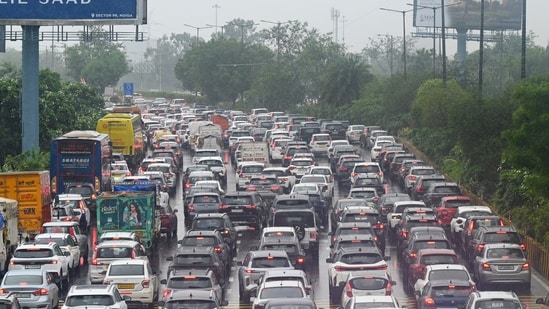
Daily living in urban areas involves movement, in turn, requiring the use of some form of road transport, whether public or personal. In cities with large populations and land area, the demand for various forms of transport is high because of the long distances between two points. This has led to a rise in the number of motor vehicles and per capita trip rates. The resultant high volume of traffic on road corridors leads to longer travel times, travel fatigue, reduced work productivity, higher fuel consumption and emissions of air pollutants, and economic losses.
Delhi presents a useful case study in understanding traffic congestion issues. It is the most populous city in India, with an estimated population of 22.5 million in 2026. The city also has the highest number of motor vehicles. Further, Delhi is surrounded by four populous cities—i.e., Faridabad, Ghaziabad, Gurugram, and Noida—which not only have high vehicle populations but also witness a daily to and fro of vehicles between them and Delhi. Thus, a large number of vehicles ply on Delhi roads every day, and the problem of traffic congestion is observed in its travel corridors.
This brief evaluates the traffic management methods followed by the Delhi Traffic Police and their implications on the state of road traffic in the city. It outlines recommendations for reducing congestion in Delhi roads, which may also offer lessons for other urban regions.
{{/usCountry}}This brief evaluates the traffic management methods followed by the Delhi Traffic Police and their implications on the state of road traffic in the city. It outlines recommendations for reducing congestion in Delhi roads, which may also offer lessons for other urban regions.
{{/usCountry}}This paper can be accessed here.
This article is authored by Rumi Aija, ORF.