Six months have elapsed since the elections were held in Myanmar, which subsequently ended direct military rule and reintroduced limited democracy as envisaged in the 2008 constitution. Over 100 days have passed since the formation of the new government led by Min Aung Hlaing as the President, who was the architect of the 2021 coup.
In the past two months, a number of developments relating to Myanmar’s internal situation and external relations, especially those involving ASEAN, have occurred. Individually, these happenings make some sense, but when viewed and analyzed within a broader framework, they make much more sense, clearly indicating what the Myanmar leadership is seeking and whether it is succeeding. These developments demonstrate that ASEAN continues to address the Myanmar challenge, albeit with very limited success, and that the two sides remain stuck in a situation that warrants further reflection and work.
In the first 100 days since taking over under the new dispensation, the President has been proactive, using force to soften the Resistance, deploying negotiations to confuse it, expanding his diplomatic options through high-level visits to India, China, Laos, and Thailand, and doing more. The ground situation has decidedly turned in favor of the government troops, as the Resistance forces find themselves on the back foot, except in Rakhine State and the lands bordering China. In this light, a few specific developments need to be pinpointed for their significance.
Firstly, a discussion was initiated in Parliament questioning the validity and relevance of ASEAN's Five-Point Consensus (5PC), adopted in April 2021, which has been the bedrock of its policy towards Myanmar for the past five years. It called for the cessation of violence, the provision of humanitarian assistance to all affected sections of the population, the commencement of national dialogue, and a well-considered role for ASEAN's Special Envoy in helping Myanmar's parties find a resolution to the political and security crisis. The Parliament heard Min Aung Hlaing state that the 5PC did not represent a consensus view of ASEAN (which is not true) and that it had now become irrelevant. Within days, the Parliament adopted a motion declaring its rejection of the 5PC and condemning it as a violation of ASEAN’s Charter, which upholds the principle of non-interference in the internal affairs of its member states.
{{/usCountry}}Firstly, a discussion was initiated in Parliament questioning the validity and relevance of ASEAN's Five-Point Consensus (5PC), adopted in April 2021, which has been the bedrock of its policy towards Myanmar for the past five years. It called for the cessation of violence, the provision of humanitarian assistance to all affected sections of the population, the commencement of national dialogue, and a well-considered role for ASEAN's Special Envoy in helping Myanmar's parties find a resolution to the political and security crisis. The Parliament heard Min Aung Hlaing state that the 5PC did not represent a consensus view of ASEAN (which is not true) and that it had now become irrelevant. Within days, the Parliament adopted a motion declaring its rejection of the 5PC and condemning it as a violation of ASEAN’s Charter, which upholds the principle of non-interference in the internal affairs of its member states.
{{/usCountry}}Secondly, ASEAN, riven by two camps led by Thailand and Indonesia, agreed for the first time in five years to hold an informal meeting with Myanmar's foreign minister. At this meeting held on 12 July, the ASEAN side insisted that the 5PC was the only framework for determining relations with Myanmar, and that allowing political-level representation for Myanmar in ASEAN was still quite far off. The Myanmar foreign minister acknowledged the relevance of the 5PC but was later overruled by his government, which issued a statement emphasizing the position outlined in the parliamentary motion.
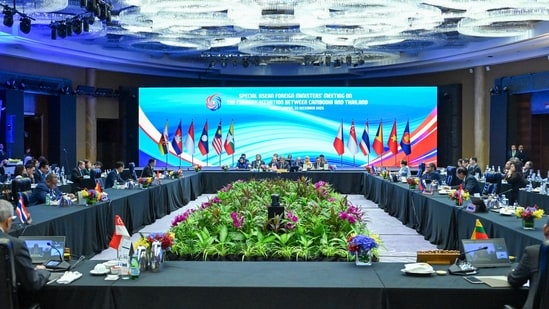
Thirdly, on 21 July, ASEAN foreign ministers held their 59th meeting in Manila, without their Myanmar counterpart. They stressed that the 5PC remained “our main reference to address the political crisis in Myanmar.” As a concession to Naypyitaw, they took note of the recent general elections without passing judgment on them, and also discussed “the possible elements for addressing progress” in Myanmar.
Fourthly, on August 3, the Myanmar government played ‘the Aung San Suu Kyi card’. Detained for over five years since the coup on 1 February 2021, the democracy icon and the supreme leader of the National League for Democracy was extended a rare privilege. The government permitted a meeting between her and Arnaud de Baecque, Resident Representative of the International Committee of the Red Cross to Myanmar. The meeting was welcomed by many, including her son – Kim Aris – as a first step towards “the beginning of transparency, humanitarian access and ultimately my mother’s freedom.”
Finally, President Min Aung Hlaing paid an official visit to Thailand from 6–7 August. The two governments reaffirmed their commitment to further strengthening cooperation “in all areas of mutual interest,” including economic cooperation and cooperation at “the regional level.” In a significant concession to the visiting President, the Thai Prime Minister articulated his commitment to supporting Myanmar's “full and equal participation in ASEAN mechanisms and processes in accordance with the ASEAN Charter.” Myanmar was happy to appreciate “Thailand’s constructive role in facilitating the normalization of its relations with ASEAN.”
It is evident to long-time observers of the Myanmar scene that President Min Aung Hlaing’s pro-activism has triggered negotiations at multiple levels. Within the country, pro-regime political parties and forces are being encouraged to develop a package of reforms to the 2008 Constitution that may be acceptable to the government. Of course, its redlines must be respected: the military's dominant role in governance cannot be diminished, and, in the name of federalism, the central government cannot be turned into a weak entity. Interaction with internal actors has implications for the Resistance, which remains inclined to continue a long-term struggle against the military’s future vision. The message being conveyed to it is that it is on the losing side of history; therefore, it must also negotiate. Daw Suu Kyi, too, is a target of negotiations: if she wants to regain her freedom and some political role, she should consider collaborating with the President.
Another level of discussions and negotiations has been underway with ASEAN at full steam. Naypyitaw’s message is that the 5PC is dead and that ASEAN must back off because the grouping is no longer united on the Myanmar file. The driving impulse here is the thirst for legitimacy and investments from abroad. The Thailand-led camp, supported by Laos, Cambodia, and Vietnam, has called for a “calibrated re-engagement,” while the Indonesia-led camp, with the support of Malaysia and Brunei, wants some progress in implementation of the 5PC. Singapore and the Philippines probably want to play a mediator's role in this complex game.
The coming weeks will be significant. Senior ASEAN officials are known to be working on a ‘Non-Paper’ on the terms of reference for the Special Envoy of ASEAN on Myanmar. Then, in the last quarter, the Special Envoy – the Foreign Minister of the Philippines – is likely to visit Myanmar.
This should clear the way for a comprehensive review of 5PC by the ASEAN Foreign Ministers, followed by the 49th ASEAN Summit. The ongoing diplomatic process is likely to gain momentum, with the goal of arranging Myanmar's return to the ASEAN fold. Myanmar's other friends – India, China and Russia – will welcome such an outcome. As to the West and the UN, they seem to have become indifferent to Myanmar. That highlights their irrelevance at the present juncture.
(The views expressed are personal)
This article is authored by Rajiv Bhatia, Distinguished Fellow, Gateway House and former ambassador, New Delhi.