Some media outlets have reported that Iran’s new Supreme Leader Mojtaba Khamenei has agreed to engage in negotiations with the United States and work towards a deal, signalling a possible diplomatic opening amid the ongoing conflict. However, an official confirmation from the Iranian government is still awaited.
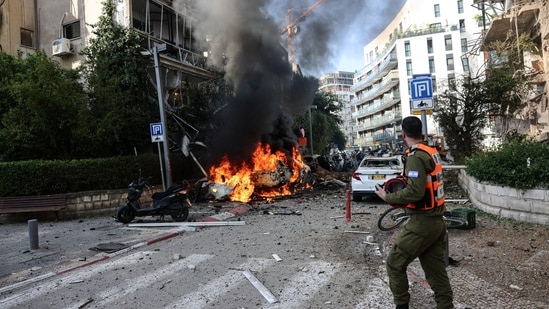
There are conflicting accounts from Washington and Tehran regarding the existence and nature of diplomatic talks aimed at ending the ongoing conflict. President Donald Trump has repeatedly claimed that high-level, "very good and productive" discussions have taken place over the last few days. Citing progress in these talks, Trump announced a five-day postponement of threatened strikes on Iranian power plants and energy infrastructure. The President identified Steve Witkoff and Jared Kushner as participants in these discussions with "top" Iranian figures. Reports suggest a high-level meeting could take place in Islamabad later this week, possibly involving Vice President JD Vance.
However, Iran firmly denied that any direct or indirect negotiations have occurred. Parliamentary Speaker Mohammad-Bagher Ghalibaf dismissed the claims as "fake news" intended to manipulate oil and financial markets. Iranian State media denied any talks and claimed that Trump "retreated" from his deadline "out of fear of Iran's response." While denying formal talks, Iran’s foreign ministry later confirmed receiving messages from the US via mediators. A senior Iranian foreign ministry official reportedly said that "we received points from the US through mediators and they are being reviewed."
President Trump’s strategy for the ongoing conflict with Iran is characterised by shifting objectives, aggressive ultimatums, and recent, sudden diplomatic overtures. The core of his plan has evolved through several distinct phases. The administration's stated military goals have fluctuated between surgical strikes and broader infrastructure destruction. The Pentagon, led by secretary of war, Pete Hegseth, has focused on destroying Iran’s offensive missiles, naval forces, and defence industrial base. Trump has repeatedly pledged to ensure Iran "never" obtains a nuclear weapon and to "annihilate" its ballistic missile industry. Recently, Trump expanded his list of targets to include power plants, starting with the largest, and crown jewel military assets like Kharg Island.
{{/usCountry}}President Trump’s strategy for the ongoing conflict with Iran is characterised by shifting objectives, aggressive ultimatums, and recent, sudden diplomatic overtures. The core of his plan has evolved through several distinct phases. The administration's stated military goals have fluctuated between surgical strikes and broader infrastructure destruction. The Pentagon, led by secretary of war, Pete Hegseth, has focused on destroying Iran’s offensive missiles, naval forces, and defence industrial base. Trump has repeatedly pledged to ensure Iran "never" obtains a nuclear weapon and to "annihilate" its ballistic missile industry. Recently, Trump expanded his list of targets to include power plants, starting with the largest, and crown jewel military assets like Kharg Island.
{{/usCountry}}Trump’s vision for an endgame remains ambiguous, though he has demanded "unconditional surrender" through hardline conditions. Reports indicate a draft peace plan includes a five-year halt on all missile programs, zero uranium enrichment, and the total dismantling of nuclear facilities like Natanz. Trump has framed his long-term goal as liberating the Iranian people and working with new leaders to make Iran "economically bigger, better, and stronger".
Has Israel agreed to end the Iran war? Israel has not officially ended the conflict with Iran. While Prime Minister Netanyahu discussed a potential agreement with President Trump to leverage military gains into a deal, Israel has continued, and vows to continue, strikes on Iran and its allies, indicating a formal peace agreement is not yet in place. Netanyahu confirmed on March 23, 2026, that Israel is continuing its strikes on Iran and Lebanon.
Israel's current military strategy against Iran is a multi-layered campaign aimed at regime change and the permanent dismantling of Iran's nuclear and military capabilities. This plan focuses on a "decapitation" strategy and systematic infrastructure degradation. Netanyahu has addressed the Iranian people directly, urging them to overthrow the clerical regime. Israel has targeted the top political and military leadership, including Ayatollah Khamenei, the IRGC commander and several defence officials in order to paralyze Iran's command and control structure. Another aspect of the strategy is weakening the Axis of Resistance (Hezbollah in Lebanon, Houthis in Yemen and Hamas in Gaza) to remove Iran's ability to wage a multi-front war against Israel.
Israel is applying a strategy of disproportionate, concentrated strikes—similar to its 2006 Lebanon campaign—to throw Iranian forces off balance. Operations have expanded to include energy infrastructure, power plants, and IT networks to increase the "cost" of the war for the Iranian regime. The strategy also involves utilising high-level intelligence for targeted assassinations and cyberattacks to disable water and energy infrastructure.
However, it is unlikely that Israel can sustain a high-intensity, long-term war against Iran without US support. There are several key factors that impact Israel's capacity to continue the war against Iran on its own. The first of these are defensive limitations. Iran has used massed missile and drone attacks to drain Israel’s limited stockpile of interceptor missiles, with some Iranian missiles successfully penetrating defences and damaging infrastructure. The second factor is military sustenance. Without US help, Israel might lose control of its airspace in a prolonged conflict due to the depletion of interceptor rockets and ammunition. Above all, there is the third factor--economic strain. The cost of a war with Iran is astronomical, with previous confrontations costing hundreds of millions of dollars daily and causing substantial damage to the Israeli economy, which was already strained from long-term conflict in Gaza.
While Israel is prepared to strike Iran and its proxies (such as Hezbollah) to protect its interests, the scale of Iranian retaliations indicates that sustained, all-out war requires US assistance. While Netanyahu has declared that Israel will continue to strike in Iran and Lebanon, these operations are often aided by the US. The conflict often devolves into a war of attrition, which is difficult for Israel to manage entirely alone. Thus, while Israel can carry out targeted strikes, it faces significant risks of depleted interceptor stockpiles, overwhelmed defence systems from massed Iranian ballistic missile attacks, and high economic costs, making US aid crucial for maintaining air defence and sustaining military pressure.
What is Iran's plan in the current war against the US and Israel? Iran is pursuing a strategy of endurance and horizontal escalation to survive a high-intensity joint military campaign by the US and Israel. Following the death of Supreme Leader Ali Khamenei in the opening US-Israeli strikes on February 28, 2026, the Islamic Revolutionary Guard Corps (IRGC) has taken direct control of the war strategy under Mojtaba Khamenei.
Iran's plan is built on three primary objectives designed to force a US retreat by making the conflict unsustainable. Firstly, Iran is targeting US allies in the Gulf Cooperation Council (GCC)—specifically oil and gas infrastructure in Saudi Arabia, Qatar, and the UAE—to compel these nations to pressure Washington to halt the war. Secondly, by mining the Strait of Hormuz and attacking tankers, Iran has caused a 97% drop in traffic through the world's most vital oil chokepoint. This aims to trigger a global economic crisis that undermines domestic political support for President Trump. Thirdly, lacking conventional air power, Iran uses a war of endurance involving constant drone and missile volleys to deplete the stockpiles of US and Israeli air defence interceptors (like Arrow 3 and THAAD).
What are Iran's operational tactics? The first of these is horizontal escalation. Iran is widening the geographic scope of the war to include Lebanon (via Hezbollah) and Iraq to stretch U.S. and Israeli resources. Secondly, Iran is carrying out asymmetric precision strikes. It is transitioning from high-volume saturation to precise strikes using solid-fuel and hypersonic missiles (e.g., Kheibar Shekan) to bypass sophisticated defences and destroy critical infrastructure like the Haifa oil refinery. Thirdly, Iran is carrying out hybrid/cyber Warfare. Despite a near-total domestic internet blackout, Iran-aligned groups have launched massive cyberattacks against Israeli energy firms and regional airports to disrupt civilian life.
Summing up, against the above background, the prospects for US-Iran talks are highly fluid and contradictory, with President Trump claiming productive discussions and a possible deal while Tehran publicly denies direct contact, calling such reports false. The US has paused any planned strikes on Iranian energy sites to allow for a potential five-day diplomatic window, aiming to address nuclear concerns and reduce regional volatility. While President Trump has hinted at a potential deal, Iranian officials have been maintaining that they will not cave to demands for total surrender or the full dismantling of their nuclear programme. The next few days are considered a narrow window for de-escalation. Whether these productive signals lead to formal talks depends largely on whether both sides can move past public rhetoric to address the core issues of nuclear enrichment and regional security.
This article is authored by Prabhu Dayal, former ambassador, New Delhi.