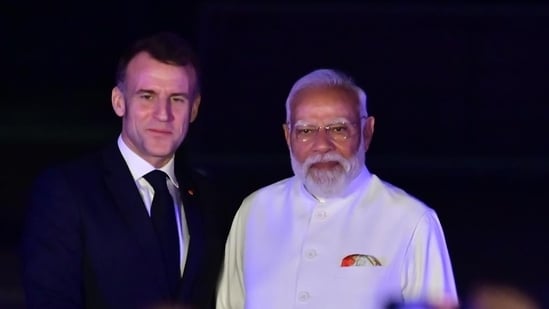
When Prime Minister (PM) Narendra Modi and French President Emmanuel Macron jointly launched Bharat Innovates 2026 in Nice on June 14, 2026, the moment carried weight beyond its photographs. It arrived against the backdrop of a bilateral trade relationship that has more than doubled over the past decade to 13.59 billion euros ($ 15.81 billion) in 2025-26, and only months after India and France elevated their ties to a Special Global Strategic Partnership in Mumbai. Bharat Innovates is best read not as a standalone showcase but as the innovation layer of a relationship that has been quietly deepening across trade, investment and technology for years.
France remains India's third largest trading partner within the EU, after the Netherlands and Germany, and is the 11th largest source of foreign investment into India, with cumulative inflows of 10.50 billion euros between April 2000 and December 2025. Of the 40 most prominent French companies, 38 already operate in India, spanning aviation, energy, cement and services. Add to this the India-EU Free Trade Agreement signed on January 27, 2026, and the picture that emerges is of two economies whose commercial ties already run wide enough that an innovation platform like Bharat Innovates has existing infrastructure to plug into, rather than a relationship being built from scratch.
What Bharat Innovates adds to this infrastructure is scale and specificity. More than 120 Indian deep-tech startups across 13 sectors, ranging from satellite launch vehicles to quantum computing, were on display in Nice. Agnikul Cosmos, which builds small launch vehicles with rocket engines made through 3D printing, shared space with Dhruva Space and GalaxEye, both working on satellite hardware and imaging. Days later in Paris, India holds the newly created designation of AI Country Partner at VivaTech, where Modi presented India's MANAV framework for AI governance.
This is where the more interesting story lies, and it has little to do with deal value. India's own account of its AI ambitions rests on three words: sovereignty, inclusivity, innovation, a starting point quite different from Europe's tradition of rights-based caution arriving before market access. Yet when India and France upgraded ties to a Special Global Strategic Partnership in February, the joint statement committed both countries to Artificial Intelligence (AI) that is secure, trustworthy, oriented towards the public good, and capable of narrowing the gap between countries with AI capacity and those without. Nice is where that commitment acquired pavilions and pitches. What is converging here is the vocabulary, trust, safety, responsibility, even as the rules underneath remain distinct on each side. Call it trust without sameness, a less romantic basis for partnership than ‘shared values’ usually implies, but possibly a sturdier one, since neither side has to pretend to be something it is not.
{{/usCountry}}This is where the more interesting story lies, and it has little to do with deal value. India's own account of its AI ambitions rests on three words: sovereignty, inclusivity, innovation, a starting point quite different from Europe's tradition of rights-based caution arriving before market access. Yet when India and France upgraded ties to a Special Global Strategic Partnership in February, the joint statement committed both countries to Artificial Intelligence (AI) that is secure, trustworthy, oriented towards the public good, and capable of narrowing the gap between countries with AI capacity and those without. Nice is where that commitment acquired pavilions and pitches. What is converging here is the vocabulary, trust, safety, responsibility, even as the rules underneath remain distinct on each side. Call it trust without sameness, a less romantic basis for partnership than ‘shared values’ usually implies, but possibly a sturdier one, since neither side has to pretend to be something it is not.
{{/usCountry}}This sturdiness shows up in less photogenic commitments. The two countries have set up a Joint Advanced Technology Development Group to co-develop emerging technologies, agreed to swap officers between the Indian Army and French Land Forces this year, and launched an India-France Innovation Network to link startups, incubators and universities. In March, the Reserve Bank of India and Banque de France signed a memorandum of understanding to deepen central bank cooperation. Indian firms such as TCS and L&T Technology Services already run innovation centres in France. None of this makes headlines the way a missile contract does, but trust between states is built by letting institutions sit inside each other, often enough that it stops being newsworthy.
Sceptics can reasonably ask whether announcements like these survive past the photographs, given how many years of innovation get launched and quietly archived. The calendar this year offers a partial answer: an AI summit in Mumbai in February, Bharat Innovates in Nice in June, a G7 outreach session in Evian days later, and VivaTech in Paris before the month ends. Diplomacy that returns to the same theme four times in five months looks less like a one-off summit and more like a relationship that has decided to keep meeting.
As with any trade or technology agreement, the real test will lie in implementation. It will show in whether Indian startups convert pavilion time in Nice into European contracts, laboratories and capital, and whether France's ageing innovation economy finds in India's young engineering workforce the partner it needs. The numbers behind this visit, in trade, in investment, and now in AI vocabulary, suggest the foundation already exists. What Nice adds is the willingness to build further on that foundation without insisting the other side build it the same way.
(The views expressed are personal)
This article is authored by Sanket Kumar Prajapati, doctoral candidate and junior research fellow, Centre for European Studies, Jawaharlal Nehru University, New Delhi.