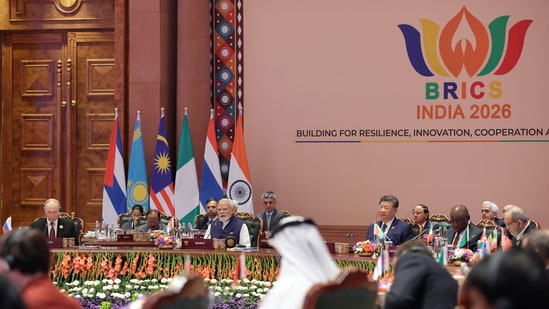
BRICS declarations are not written for readers looking for clean commitments. It is often more useful to distil the underlying proposition running through them. In the case of the most recent one, the Delhi Declaration, that is for the countries of BRICS, climate action will endure as it strengthens energy security (stable fuel supplies), economic resilience (measures to protect livelihoods) and industrial competitiveness (support for domestic clean‑tech manufacturing.)
That proposition is neither naïve nor a retreat from climate action. It recognises the limitations under which many emerging economies operate like expanding electricity access, building cities and transport systems, and creating productive jobs at scale. They are doing so while facing higher borrowing costs, more frequent climate shocks and an international trading system in which the rules of green competitiveness are increasingly being set elsewhere.
The Delhi Declaration makes clear that BRICS wants a larger hand in writing those rules. For instance, it recognises that fossil fuels will remain part of the energy mix, particularly in emerging and developing economies, while they undertake energy transition. However, the declaration also puts uncommon weight on the systems that make this transition possible: Smart grids, energy storage, hydrogen standards, solar manufacturing, resilient supply chains and critical minerals. This reflects a practical understanding that clean power will be achieved by going beyond adding renewable capacity. It requires grids that can absorb it, storage that can balance it, industrial capabilities that can produce the equipment for it, and finance that can cover the time and risk associated with it.
The road ahead is to make all these part of real investment deal flows. A set of guiding principles on smart grids is useful as from it can emerge a pipeline of financeable storage and grid-modernisation projects. Cooperation on critical minerals can support a more stable global clean-energy supply chain and should also help resource-rich countries capture more value than simply exporting raw materials.
{{/usCountry}}The road ahead is to make all these part of real investment deal flows. A set of guiding principles on smart grids is useful as from it can emerge a pipeline of financeable storage and grid-modernisation projects. Cooperation on critical minerals can support a more stable global clean-energy supply chain and should also help resource-rich countries capture more value than simply exporting raw materials.
{{/usCountry}}The declaration’s position on trade is aligned with how the BRICS grouping has looked at global trade and climate politics. Its call for guardrails around cross-border carbon taxes, reflects a wider concern across developing economies that climate policy should not become a new trade barrier or a disguise for protectionism. That concern is understandable because many need to navigate unfamiliar carbon-accounting rules, high compliance costs and limited access to clean power, all while trying to move up the value chain.
If BRICS countries want to shape the emerging rules of green trade, they will need to produce cleaner industrial output supported by competitive finance, credible product-emissions data and common standards. It is becoming increasingly apparent that cross-border carbon taxes are a reality going forward and ensuring that firms in emerging economies can both set and meet these standards will be powerful competitive lever.
The same long-term approach is needed on finance. The declaration rightly connects climate vulnerability with high debt burdens and limited fiscal space. It calls for greater debt sustainability and climate finance, while pointing to the New Development Bank, local-currency financing and the emerging BRICS Multilateral Guarantees initiative. There is a bridge to build between intent and execution. The declaration does not establish a new pool of climate capital. Its finance provisions are a useful first step of listing out a series of useful practical instruments. For instance, guarantees can lower the cost of capital. Local-currency structures will reduce exchange-rate risk. Soon after the leaders’ flights back home from Delhi, well-designed guarantee for municipal water systems, clean grids or climate-resilient transport will keep up the momentum started here.
Adaptation is where the declaration is strongest, emphasising early-warning data, resilient urban infrastructure, drought-tolerant seed systems, community-based adaptation, forests and water. The root of all these is the lived reality in the Global South. For a farmer deciding what to plant, a city dealing with extreme heat, or a port exposed to storms, resilience is not an abstract climate objective but a very clear and present economic imperative.
It is noteworthy that carbon markets feature so strongly in the declaration. It supports cooperation, capacity-building and implementation of a BRICS Carbon Markets Partnership. All will help to build confidence in measurement, registries, verification and safeguards. Markets will attract capital only if they are trusted, and they will earn legitimacy only if they deliver real emissions reductions.
Overall, the Delhi Declaration argues that climate action must work with the development priorities of emerging economies and places the transition alongside industrial policy, trade, finance and resilience. It also signals that BRICS intends to be more than a recipient of rules made elsewhere. That ambition is reasonable and is also in the naked self-interest of BRICS. Energy security delivered sustainably is what everyone aspires to. Industrial decarbonisation is as much about industrial competitiveness as it is about carbon accounting. Climate finance will naturally flow to investable, high-integrity solutions. The next test will be whether the group turns its platforms into a few visible results: modernised grids, credible carbon-market systems, resilient cities and farms, and finance that reaches projects at a cost countries can afford. If that happens, the Delhi Declaration will be remembered helping move climate action from the margins of development policy to its economic core.
(The views expressed are personal)
This article is authored by Hisham Mundol, chief advisor, India, to Environmental Defense Fund.