There are certain moments that bring with them more than the excitement of an occasion. They make you pause and reflect on the ideas and experiences that have shaped you. The visit of His Highness Prince Rahim Aga Khan V to India feels like such a moment for me. As an Ismaili Muslim, his arrival evokes happiness and gratitude. For the world, he is Chairman of the Aga Khan Development Network (AKDN); for Shia Ismaili Muslims, he is our Imam, our community’s spiritual leader.
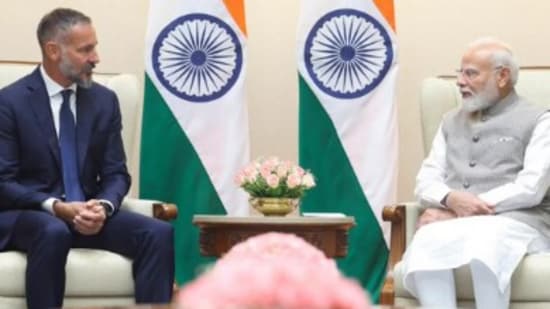
His visit marks his first meeting with the community after succeeding his late father as the 50th Imam of the Ismaili Muslim community. As I follow the news of his visit, I find myself thinking about how faith and music shape our understanding of one another.
As a musician, I have often felt that some experiences reach the heart before they can be explained by the mind. You become immersed in the music, and what began as a performance starts to feel far more personal. I experienced this while singing Ali Maula. As I immersed myself in the name of Ali Maula, our first Imam, I felt an extraordinary sense of inner energy and spiritual upliftment. For me, performing devotional music is a transcendental experience, no matter the religious affiliation. The names and traditions may be different, yet the emotions they inspire are rooted in our common humanity.
Music provides an apt analogy: A symphony that stirs the soul is the collective effort of several instruments, each distinct on its own, but rich when woven together. That thought has stayed with me. We often focus on the differences that are immediately visible while overlooking the deeper emotions that connect us. Perhaps that is how I have gradually come to understand pluralism.
{{/usCountry}}Music provides an apt analogy: A symphony that stirs the soul is the collective effort of several instruments, each distinct on its own, but rich when woven together. That thought has stayed with me. We often focus on the differences that are immediately visible while overlooking the deeper emotions that connect us. Perhaps that is how I have gradually come to understand pluralism.
{{/usCountry}}My ties to music go back to my childhood, when my brother Sulaiman and I accompanied our father for band practice. My father was the musician and group leader for an Ismaili community scouts band. We watched with quiet amazement as my father guided a few dozen instruments into a single symphony of synchronised sound.
Many years later, as an established musician, I had the remarkable opportunity to perform for the late Aga Khan IV during his visit to India in 2013. Sulaiman and I were fortunate to meet with him after the performance, and he spoke to us about devotional music. I remember him telling us that devotional music had been around for centuries and expressing his confidence that it was here to stay. Meeting him was a pivotal moment in my career.
Our identities, traditions and faiths are deeply important, and the beauty of a plural society lies in the fact that they remain distinct. For me, pluralism is not about making everyone the same, nor does it ask us to dilute what we believe in. As a musician, I understand this through music. A composition would be dull if every voice sounded the same and every instrument played the same note. Harmony is not created by sameness. It emerges when different sounds exist together without losing what makes each unique. Perhaps that is also what pluralism asks of us: to remain secure in our own identities while respecting those of others.
My own experiences with the Aga Khan Development Network have also made me reflect on what these values can look like in practice. I have been struck by the inclusive and non-denominational spirit that brings people and communities together in the service of something larger than themselves. We do not have to let go of who we are in order to care about someone different from us.
India gives us an opportunity to experience this every day. Our languages, faiths, music and traditions are remarkably varied, and that diversity is a source of our creative and social richness. We do not have to agree on everything to respect one another, nor surrender our own identities to appreciate someone else’s. Sometimes, all that difference asks of us is curiosity, understanding and the willingness to listen.
The visit of Aga Khan V has brought these thoughts back to my mind with a renewed sense of joy and gratitude. We may pray differently, sing different songs and call the divine by different names. But if those journeys make us more compassionate, more peaceful and more respectful of one another, perhaps they are taking us closer to the same values. And perhaps that is where pluralism truly begins: not in the absence of difference, but in our ability to find a shared humanity within it.
(The views expressed are personal)
This article is authored by Salim Merchant, composer and musician, Mumbai.