Delhi had a special guest recently, as legendary photographer Steve McCurry came visiting. For someone whose lens has captured some of the world’s most evocative images, including the iconic Afghan Girl, McCurry’s relationship with India runs much deeper.
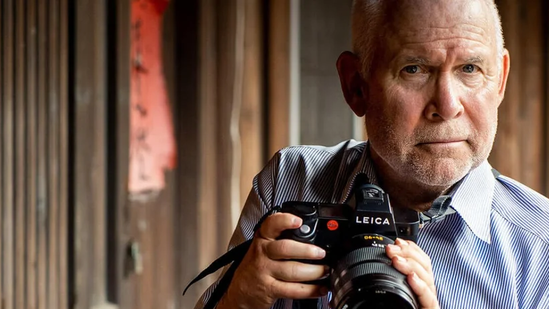
In an exclusive conversation with HT City as he drops by the Leica store in the Capital (before making his way to the brand’s Mumbai store), he reflects on how smartphones have changed the way we take pictures, why authenticity matters more than ever in the age of AI, the art of earning a stranger’s trust and why, even after all these years, returning to India is still about reconnecting with old friends.
Question: You started at a time when cameras used to be much bigger and heavier. Today, everyone has a camera in their hands with high-quality smartphones. What is your take on photography today?
Steve: It's kind of a memory. There are all these pictures floating around. They are not art, just personal notes. I think it's great for us to have this memory and to document our lives, because in the future we will look back and see how we were.
But you won't call it photography?
No. Any more than if you are texting your friend, it's not literature. It's not poetry. It's just, "I'm finishing up work. Let's be together at seven. Have dinner. Is so-and-so going to join us?" "No, that person's out of town." It's just communication. But for somebody to really write a song which is memorable, or a poem, or an essay, or a novel, or create a photograph that sticks in our memory, that's a different kind of thing.
{{/usCountry}}No. Any more than if you are texting your friend, it's not literature. It's not poetry. It's just, "I'm finishing up work. Let's be together at seven. Have dinner. Is so-and-so going to join us?" "No, that person's out of town." It's just communication. But for somebody to really write a song which is memorable, or a poem, or an essay, or a novel, or create a photograph that sticks in our memory, that's a different kind of thing.
{{/usCountry}}Also read: My camera is pretty small: Steve McCurry at JLF 2016
Your photographs often make strangers feel deeply familiar. How do you earn the trust of someone you have just met when you want to photograph them?
I think it's by practice and repetition. Having done it for so many years, so many thousands of times, you have a certain confidence. Also, you don't have a fear of failure. I know that some people don't want to be photographed, I agree with that. Sometimes people, for very good reasons, don't want to be photographed. If somebody has just lost a parent or a loved one, or some traumatic thing has happened, you have to respect that. I think if you have a certain confidence, people sense that. If you know what you want and can manage the situation, you can put them at ease, make them comfortable and make them trust you by showing respect, smiling and treating them...
It sounds funny, but if you just treat a person as a human equal, as an equal, and say, 'We are just on the street at the same time. I think you're interesting. I want to make a picture,' I think people feel flattered that you want to take the time.
It really boils down to practice. It has to be a genuine interest in people and seeing something special in that person.
Since we were talking about smartphones, we also have AI now, and it has completely changed how we look at photography. People can easily alter pictures or even generate them and pass themselves off as genuine photographers. What is your take on the use of AI in photography?
I think it depends on the authorship of the editorial, the newspaper article and the photograph. You know and trust the person or the publication. In India today, for your newspaper, people know that there are certain ethical standards and somebody is making sure the photography and the articles are accurate. So people read your newspaper because they know it's factual.
But if you are on your phone and scrolling, somebody can make up any picture or a story about some politician, or something happening, and you don't know if it's real or not. I mean, some people don't care. Some aren't paying attention.
So you are saying people are too busy to notice if a photograph is actual, enhanced with AI or completely generated with AI. Do you feel, ethically, this is wrong?
If you're doing documentary photography or news photography, then there's no place at all for AI. Pictures are never going to be perfect. Life isn't perfect. So I think there's no use or application for AI in a newspaper or magazine that's doing journalism or documentation.
But what about beautification?
For advertising, we all know it is kind of fake. If it comes to food, cars or fashion, we know that's all... If there's a plate of food, it's somebody in a studio and there's all kinds of nonsense that goes on. But when it comes to a magazine or newspaper, we expect it to be factual. If you're doing documentary photography, it needs to be real. You go somewhere, you photograph the people as they are. That's it. We need authenticity in the work. If I pick up a book, people know that I really went to these places. I was there. I was in the monsoon.
When I was in Calcutta recently, I was walking around in a pair of shoes. My feet got completely wet. It was ten o'clock in the morning. I walked in those wet shoes all day long. Not a big deal. But the point is that when you look at the work, I was actually there. I was walking around. I was in the tea plantation. I was in that place. I wasn't at my computer at home with my slippers and a gin and tonic making sh*t up. So I see no application whatsoever for AI. The world is fascinating on its own.
Some people don't read the newspaper. They don't listen to the news. They're too busy or whatever. Some people work really hard. At the end of the day, they come home tired. They just want to watch TV and go to bed, or they just want to scroll. They don't really pay much attention to what they're looking at. That's going to happen. But the people who read your newspaper want to be informed. They want to know what's happening in the world, whether it's local, international or in the community. They want a picture, they don't want art or embellishment.
Now, if you are an artist, that doesn't matter. An artist can do anything because they label it as art. “I'm an artist. I use artificial intelligence in my art to create some fantasy world.” But if your job is to document and show the world as it is in the year 2026, then we want to see it with all its flaws.
How often are you still asked about Afghan Girl, your most famous photograph of all time?
A lot.
And you're still happy talking about it every day?
Well, it's... I think you have to look at the glass half full. There's a lot of misinformation about that picture. But I think if people appreciate the work, you have to be grateful that people appreciate what you're doing because there's no guarantee in life that people will be paying attention to or like your work. So I look at it as a positive. I don't... We don't want our work to be ignored and not seen. So you have to be grateful and humble if people are appreciating what you're doing.
One last quick question. What's the one thing you have to do every time you come to India? Is there one ritual that you have?
Probably just try and see some old friends.
Any places that you like to eat at, maybe?
No, not really to that extent.
To me, it's more about coming here to reconnect with old friends. That's great fun. To sit with friends and talk about the past, the future and the present. I have friends from when I was here. Friends that I knew from the very beginning of my travels here. So it's always fun to reconnect and think about all the changes that we've both gone through.