A rejected Jamdani length, an old khadi sari or the last few metres of checked cotton may no longer signal the end of a textile’s journey. Across India, independent labels and social enterprises are retrieving handloom rejects, deadstock and fabric offcuts before they reach landfills, turning them into everything from Gen Z-friendly clothing to handmade dolls and lifestyle accessories.
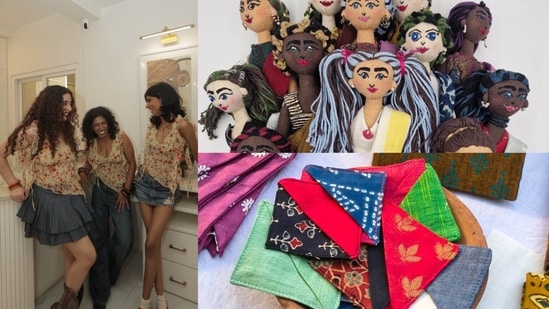
On National Handloom Day (August 7), meet those who are giving traditional textiles a contemporary second life, picking one rag at a time. These handicraft loyalists are also challenging fashion’s appetite for speed. Their small batches depend on the fabric available as handmade pieces cannot be rushed, and no two rescued scraps necessarily produce the same result.
Jamdani finds a miniature canvas
At Raipur-based KathaDoi, rejected khadi, khadi silk and cotton Jamdani sourced from weaving clusters in West Bengal are transformed into miniature outfits for handmade fabric dolls.
Through its flagship initiative, Project Masakali, founder Ridhima Jaiswal, 42, creates dolls conceived as “living ethnographies”, with varied skin tones and clothing representing regional textile traditions. The team also collects handloom offcuts from tailors and garment units, as well as unwanted saris donated by families.
“One weaver’s rejected scrap can become part of a doll’s story,” says Jaiswal. The fabrics are sorted and paired before tailors turn them into tiny blouses, skirts and drapes. Women artisans are then trained to stitch and assemble the dolls, embroider their faces and add yarn hair.
{{/usCountry}}“One weaver’s rejected scrap can become part of a doll’s story,” says Jaiswal. The fabrics are sorted and paired before tailors turn them into tiny blouses, skirts and drapes. Women artisans are then trained to stitch and assemble the dolls, embroider their faces and add yarn hair.
{{/usCountry}}Even practice pieces become Shakl keychains and magnets, while smaller remnants are retained for prototypes. “In India, circularity has never been a trend; it is our heritage,” she says, tracing the idea to grandmothers who once stitched dolls from leftover sari scraps. “We are not circling back to slow fashion. We are finally waking up from the detour of fast fashion,” she notes.
Madras checks get a Gen Z cut
For Noida-based designer Isha Saxena, 23, founder of Ish Museum, the starting point is deadstock: high-quality surplus fabric left unused by the fashion industry.
Saxena sources much of it from Seelampur’s textile markets and turns locally sourced woven cottons, Madras-style checks and embroidered fabrics into wrap tops, babydoll dresses, shirts and skirts.
“I like giving Indian textiles a new life through silhouettes that feel very Gen Z,” she says, adding, “We want people to wear these fabrics because they genuinely love them, not just because they are traditional.”
The availability of surplus fabric determines how many pieces can be produced. Once a particular textile runs out, a design may not return in exactly the same form. The label also works on a made-to-order basis wherever possible, taking around 12 to 18 days to complete an order rather than building large inventories.
“We embrace scarcity. It reduces excess stock and also means that customers receive genuinely limited pieces,” Saxena shares.
Revival of block prints
At Kolkata-based Dui, founder Raka Banerjee and her mother use pre-consumer garment waste to make folders, writing supplies, handbags, pouches, gadget sleeves, table linen, coasters and hair accessories. The smallest scraps become bookmarks and charms, while pieces too tiny to stitch are used as filling.
The enterprise also centres hand-block printing and hand embroidery in its products, allowing discarded textiles to carry forward Indian craft practices rather than merely being repackaged as waste-conscious merchandise.
“Mending, upcycling and making by hand is my response to the current times,” says Raka, who began experimenting with scraps in her mother’s garment unit and estimates that they found uses for 60% to 70% of its annual textile waste.
Bulk and customised orders are produced only after being placed, but handmade work comes with its own pace. Some processes, including block printing, can be affected by the monsoon and must be planned months in advance.
“We lost our way in a daze of hyper-consumption,” she says, adding, “But younger people are becoming conscious about the future of the planet and are making choices that support slower consumption. That makes me hopeful.”
From waste pickers to artisans
For Riddika Bhandari, 30, founder of Ahmedabad-based Upraant Foundation, textile reuse is also about changing who gets to create value from waste. Her non-profit began during the third wave of Covid-19 as a pilot skill-development programme for women from waste-picking communities who could no longer go out to work. Many had previously handled discarded polyester, rayon and factory waste for little money.
After training with master artisans and design students, the women began turning donated and discarded textiles into bags, pouches, artworks and utility products with a craft-led finish, promoting Kantha stitching and handicrafts. “It is the journey of women from slums to artisans. There is pride in moving from holding a rag-picking worker’s card to holding an artisan card,” Bhandari says.
For these makers, slow fashion is therefore not only about extending the life of cloth. It is about recognising the time embedded in a weave, the hands behind its reinvention and the possibility that what the industry leaves behind can still carry culture, livelihood and value.
Catch It Live
To immerse yourself in India’s rich textile heritage, head to these exhibitions and hands-on workshops across the city. From browsing artisan-made weaves to block-printing and painting your own tote, there’s plenty to keep craft lovers busy. Here's a dekko:
Experiment with traditional wooden blocks and fabric paints to customise a canvas tote bag.
What: Block-printing workshop on a canvas tote bag
Where: Nothing Before Coffee, Ground Floor, A55, Old Market, Shivalik Colony
When: August 9
Timing: 3.30pm
Entry: ₹799 (BookMyShow)
Turn your plain tote into a personalised, wearable canvas
What: Paint Your Tote Bag
Where: ShellBeacon Cafe, 1A/1, Hauz Khas Village, Deer Park
When: August 8
Timing: 2pm & 5pm
Entry: ₹1,299 (BookMyShow)
An exhibition brings together handloom products created by women artisans across 43 stalls
What: National Handloom Day 2026: Women Artisans Practising Artistic Textiles
Where: Dilli Haat, INA
On till: August 15
Timing: 11am to 8pm
Entry: ₹30
The showcase celebrates 116 weaving traditions from across India and offers a glimpse into the diversity of the country’s handwoven textile legacy.
What: Weaves of India exhibition
Where: Central Cottage Industries Emporium, Janpath
On till: today
Timing: 10am to 7pm
Entry: Free
For more, follow @htcity.delhijunction