Why settle for artificial food colours when the ingredients in your kitchen can create beautiful shades for your modaks? This Ganesh Chaturthi, give the festive sweet a natural palette - from soft pinks and yellows to greens, blues and earthy browns.
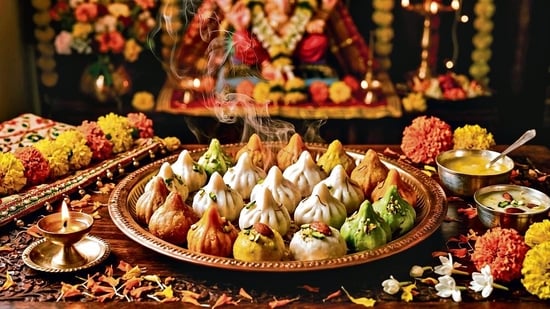
“Natural colours bring a softer, more nuanced look to modaks, and they can make the sweet feel more artisanal and festive without looking artificial,” says food stylist, chef and author Sheeba de Souza.
The idea is to let the ingredients shine rather than chase perfect, neon-bright hues. But which ingredients work best, and how do you use them without changing the texture or overpowering the flavour? Here’s all you need to know.
Ingredients for every shade
There’s plenty to work with, depending on the shade you want. Chef Nishant Choubey suggests these ingredients for building a natural colour palette for your modaks.
Red/Pink: Beetroot, hibiscus, red dragon fruit, rose
Blue: Butterfly pea flower
Green: Spinach, moringa, matcha
Yellow: Turmeric, saffron
Brown: Cocoa, roasted sesame, coffee
Orange: Carrot, pumpkin, saffron + turmeric
{{/usCountry}}Orange: Carrot, pumpkin, saffron + turmeric
{{/usCountry}}Purple: Purple sweet potato, purple yam, butterfly pea + lemon
Black: Black seasame seeds
Colour your modaks right
Getting the colour right is as much about technique as the ingredient itself. Chef Nishant Choubey recommends, “Try working with concentrated forms of natural colour so the modak dough does not become too wet. Use dehydrated or freeze-dried powders rather than juices or purées wherever possible as they give you better control over the intensity of the colour without changing the consistency of the dough.”
Timing also matters. He continues, “Add the colour after the dough has hydrated, and then adjust it gradually. If using a powder, bloom it in a very small amount of warm liquid first, rather than adding a large quantity of liquid directly to the dough.” However if you are using liquid, it is best to start with smaller portions of the coloured liquid as it is easier to build up the colour than to correct an overly intense shade.
Choubey suggests resisting the urge to make the outer shell extremely bright. “Pastel shades often look more elegant after steaming,” he says. “You can create more visual impact through the filling, garnish, dusting or glaze instead.” One more trick: keep the dough covered while shaping. This prevents it from drying out and helps maintain a smooth, clean finish on the modaks.
Diabetes-friendly modaks
For those managing diabetes, the overall mix of ingredients, carbohydrate content and portion size matter too. “The biggest change is rethinking the composition, not just swapping sugar,” says chef Harsh Kedia, chefpreneur and founder of Cocoa & Katli.
Kedia suggests using nuts and seeds such as almonds, walnuts, pistachios, coconut and sesame as the base, rather than relying heavily on carbohydrate-rich fillings. But don't assume that dates or dried fruits automatically make a modak healthier. “They are not sugar-free or carbohydrate-free. For diabetes, total carbohydrates and portion size matter, so choose a recipe that fits the individual's dietary plan,” he says.
Flavours such as saffron, cardamom, cocoa and rose can add sweetness and complexity without adding sugar. “Stevia, monk fruit or an appropriate low- or zero-calorie sweetener can be considered depending on individual needs,” he says. For a festive twist, he suggests combinations such as almond-pistachio with saffron and cardamom, coconut-sesame, dark chocolate with nuts, or peanut-cocoa — all made without added sugar.
Why choose natural colours?
Natural doesn't automatically mean healthier, but it does mean the colour comes from a recognisable food ingredient. “Plant ingredients contain pigments along with other compounds — such as betalains in beetroot, curcumin in turmeric, anthocyanins in butterfly pea and flavonoids in cocoa,” says celebrity dietician and wellness coach Dr Simrat Kathuria.
That doesn't mean a naturally coloured modak suddenly becomes nutritious. “The small amounts used to colour one modak usually do not provide meaningful nutrition. The main nutrition still comes from the main ingredients,” she says.
She also points out that approved artificial food colours are assessed for safety and used within specified limits. “Synthetic colours are mainly there for appearance, whereas natural ingredients can provide colour along with some of the compounds naturally present in that food,” she says. With store-bought modaks, it may be harder for consumers to know what colour has been used and in what quantity, making the ingredient list worth checking.