What if your next workout could be over in four minutes? That’s the appeal of Tabata, a Japanese workout that involves high-intensity movements. The fitness routine is gaining traction online, with #Tabata clocking 1.4 million posts on Instagram and #TabataWorkout crossing 365K. The trend has also been fuelled by viral posts claiming that the four-minute routine can lead to dramatic weight loss. A post shared on X by @rrace on August 31, which has since clocked more than 11 million views, described it as a Japanese diet workout that promises a 5kg weight loss in a week if done daily.
Multiple variations of this exercise trend such as with equipment, or even no equipments is doing rounds. But while its short format makes it an appealing workout for busy schedules, fitness experts say there’s more to it than simply going all-out for four minutes.
What exactly is Tabata?
“Tabata is a specific type of High-Intensity Interval Training exercise: 20 seconds of high-intensity exercise followed by 10 seconds of rest, repeated eight times for four minutes,” explains fitness coach Reetu Verma of MR Fitness Zone, Delhi. “Unlike regular HIIT, which can have varying work-rest intervals and durations, Tabata follows this fixed 20:10 structure,” she explains.
{{/usCountry}}“Tabata is a specific type of High-Intensity Interval Training exercise: 20 seconds of high-intensity exercise followed by 10 seconds of rest, repeated eight times for four minutes,” explains fitness coach Reetu Verma of MR Fitness Zone, Delhi. “Unlike regular HIIT, which can have varying work-rest intervals and durations, Tabata follows this fixed 20:10 structure,” she explains.
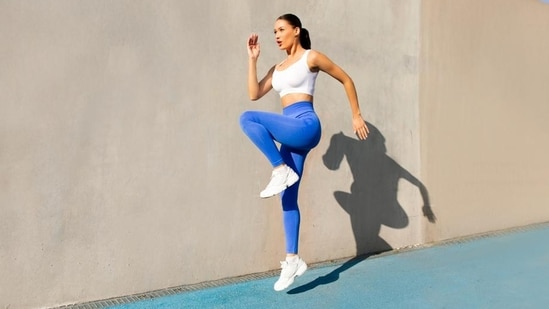
{{/usCountry}}Tabata doesn’t prescribe a fixed set of exercises. The format can be applied to movements such as squats, squat jumps, lunges, push-ups, mountain climbers, burpees, high knees and jumping jacks.
The format emerged in Japan in 1996 when researcher Dr Izumi Tabata and his team at the National Institute of Fitness and Sports in Tokyo studied high-intensity training as part of work involving Japan’s Olympic speed-skating team. The training protocol was developed in collaboration with the team’s coach, Koichi Irisawa, as researchers looked at whether short bursts of intense exercise could improve athletic performance.
Why this short workout works?
Its biggest draw is efficiency. “Tabata is an effective form of high-intensity interval training (HIIT). It works well for people who have limited time but still want to improve their fitness,” says Jaffar Badsha, Fitness Expert, Sanctum House of Wellness, Mumbai. “Even four to 10 minutes can elevate the heart rate, improve conditioning and contribute to calorie expenditure, although it cannot replace a complete workout every time,” he adds.
Verma agrees that its appeal lies in packing a challenging workout into a short window. “Tabata has become popular because it delivers a challenging, time-efficient workout without requiring a long gym session,” she says. It can improve cardiovascular fitness, muscular endurance and conditioning, while also increasing calorie expenditure. “However, it should complement, not replace, a balanced strength and fitness programme,” she adds.
Yash Vardhan Swami, founder and transformation coach at TrainedByYVS, Chandigarh says, “Depending on the exercises you choose, it can also challenge your muscles and improve muscular endurance. It can help you burn calories in a short period because of the intensity. But I would not make calorie burn the only measure of a good workout. The bigger benefit is improving your fitness and finding a form of exercise that you can follow consistently.”
How to Tabata at home
Internationally certified fitness instructor Bhavna Harchandrai says:
- Pick one or two exercises: There’s no need to cram eight different movements into one four-minute round
- Repeat before you switch: Do one exercise for 20 seconds, rest for 10, and repeat. As you get fitter, gradually increase the intensity
- Alternate between two exercises: Try an A-B-A-B format, repeating the pair for four rounds to complete the eight-round Tabata
- Keep it fun: Alternating exercises can make the workout less repetitive and more mentally engaging
- Be cautious: Anyone with serious heart issues or high BP should avoid Tabata. If you are have knee problems, opt for lower-impact movements, such as doing air squats instead of squat jumps, though it may no longer follow the high-intensity format of Tabata.