...
...
Next Story

12 new neighbourhoods in Delhi’s 43 containment zones, mostly in South Delhi

All the containment zones have been classified as red zones, areas where movement of people is strictly prohibited. Areas which are seen as high-risk zones are being classified as orange.

Updated on: Apr 12, 2020, 21:17:24 IST
Hindustan Times, New Delhi | By
Prefer HTon Google
Advertisement

The government on Sunday ordered 12 South Delhi neighbourhoods to be brought under the containment zones, reportedly after fresh confirmed cases were reported from these localities. Sunday’s orders increase the total number of containment zones in Delhi to 43.
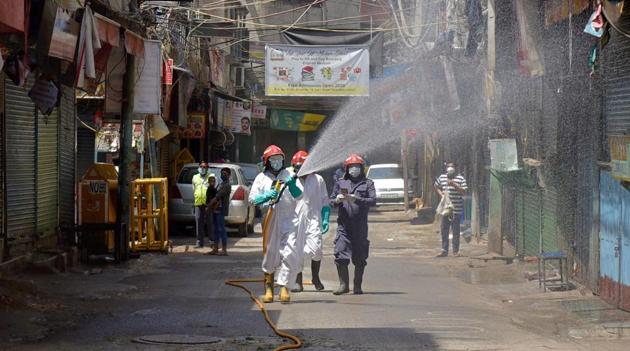
Firefighters spray disinfectants at Zakir Nagar area during the nationwide lockdown to curb the spread of coronavirus, in New Delhi, Saturday, April 11, 2020. (PTI photo)

A government order expanding the list of containment zones came hours after Chief Minister Arvind Kejriwal announced the city government’s decision to seal every locality that reports a Covid-19 case. These areas, he said, would be declared as containment zones and brought under the government’s ‘operation shield’.

All the containment zones have been classified as red zones, areas where movement of people is strictly prohibited. Areas which are seen as high-risk zones are being classified as orange.

In both these areas, the government will launch a massive sanitisation drive to minimise spread of the infection.

The details of the cases reported from these 12 localities weren’t immediately available.

In containment zones, all shops are closed and essentials, including medicines, are procured through orders routed though appointed community leaders and residents’ welfare association office-bearers. These are delivered to common collection points by health workers and sanitation workers.

The spike in the list of containment zones in Delhi comes a day after Delhi saw the highest jump in coronavirus patients with 183 fresh cases. The national Capital had 903 coronavirus positive cases till Friday evening, which included 14 deaths and 26 recoveries.

Of the 903 cases, 584 were linked to the Tablighi Jamaat congregation, while 269 were related to foreign travel and local transmission. The number of new Nizamuddin Markaz cases on Friday were 154.

List of 12 new containment zones (Red Zones)

1. Gali No. 5 & 5A, H-2 Block, Bengali Colony, Mahavir Enclave, New Delhi

2. H. No. 811 to 829 and 842 to 835 - Khadda Colony, Jaitpur, Extension ,

3. Part-II1

4. H. No. 1144 to 1134 and 618 to 623 - Khadda Colony, Jaitpur, Extension ,

5. Part-II

6. Gali No. 16, Kachhi Colony, Madanpur Khadar, Extension

7. Mehela Mohalla, Madanpur Khadar

8. H-Block, Near Umra Masjid, Abu Fazal Enclave

9. E-Block, Abu Fazal Enclave

10. H No. 97 to 107 and H. No. 120-127 Kailash Hills, East of Kailash

11. E-Block (E-284 to E-294) East of Kailash

12. H. No. 53 to 55 & 25, Shera Mohalla, Garhi, East of Kailash

 
ABOUT THE AUTHOR
Shishir Gupta

Shishir Gupta is Executive Editor at Hindustan Times and one of India's top journalists covering national security, strategic affairs, foreign policy and geopolitics. Over the past three decades, he has extensively reported on India's military, diplomatic and security landscape, covering every major conflict and national security challenge, from the 1999 Kargil War and the 2020 East Ladakh standoff to Operation Sindoor in 2025. He has also covered major terror attacks, including the IC-814 hijacking, the 26/11 Mumbai attacks and the 2025 Pahalgam terror strike, along with numerous Pakistan-backed terrorist incidents in the Kashmir Valley and across India. He has reported on national and state elections for more than three decades. A recognised authority on strategic affairs, Gupta has covered India's nuclear programme since the Pokhran-II (Shakti series) tests in May 1998 and has written extensively on global nuclear issues, Indian diplomacy and the country's expanding global outreach. He has also reported widely on international conflicts and terrorism, with a special focus on the Indian subcontinent. Gupta has interviewed Prime Minister Narendra Modi more than four times, including Modi's first interview with the print media after becoming Prime Minister in May 2014. His other interviews include three with the Dalai Lama, as well as conversations with Benjamin Netanyahu, Amit Shah, Yogi Adityanath, S. Jaishankar, Nirmala Sitharaman and Piyush Goyal. He is the author of Indian Mujahideen: The Enemy Within (Hachette, 2011) and Himalayan Face-off: Chinese Assertion and Indian Riposte (Hachette, 2014). He was awarded the Chevening-Wolfson Joint Scholarship at Wolfson College, University of Cambridge, UK, in 1998 and participated in the International Visitor Leadership Program (IVLP) of the US State Department in 2006. He received the Ben Gurion Prize from Israel in 2011 and the K. Subrahmanyam Prize for Strategic Studies in 2015 from the Manohar Parrikar Institute for Defence Studies and Analyses (MP-IDSA). Since 2024, he has hosted Point Blank, Hindustan Times' weekly YouTube show on global geopolitics.

Get the latest India News, breaking headlines and real-time updates from across the country. Stay informed about politics, government policies, crime, weather and major national developments.
SHARE THIS ARTICLE ON
Hindustantimes wants to start sending you push notifications. Click allow to subscribe