Over 2,000 artefacts of everyday life and nearly 500 pieces of textile, including sarees, shawls and clothes used during prayer rituals — all between a century and 300 years old — will be made available for public view on August 1 at a new gallery that has opened in the Humayun Tomb Museum complex.
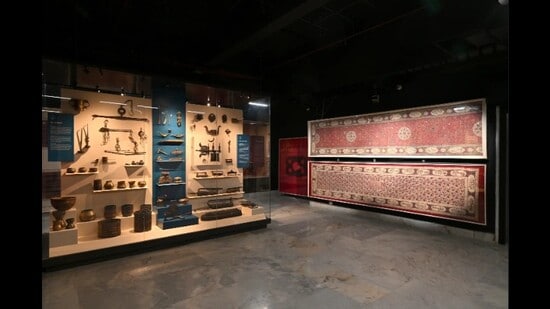
The Sanskriti Museum of Indian Textiles and Everyday Art is the result of a collaboration between the Indira Gandhi National Centre for the Arts (IGNCA) and the Aga Khan Trust for Culture (AKTC). The collection, which belonged to the Sanskriti Pratishthan, a public charitable trust, was donated to the IGNCA in 2023. The government-run cultural centre undertook preservation work on each of these pieces and textiles to make them display-ready.
At least 100 pieces of items like children’s toys, pots, jewellery, lamps, kitchen accessories, hookahs and chillums, beetle boxes, farming implements, writing equipment, mendicants’ objects and portable shrines made from a variety of material, including brass, coconut shell, copper, silver, ceramic and leather, are on display.
“This is who we used to be,” said Ratish Nanda, India CEO-AKTC, referring to the artistry of work on every single piece.
A child’s walker sourced from India, for instance, made in intricately carved wood, resembles a chariot, with a handle and three wheels. Another balancing toy from Rajasthan, also made in wood, has two male musicians on both sides of the scale, and a woman holding a sitar perched atop the central stand.
{{/usCountry}}A child’s walker sourced from India, for instance, made in intricately carved wood, resembles a chariot, with a handle and three wheels. Another balancing toy from Rajasthan, also made in wood, has two male musicians on both sides of the scale, and a woman holding a sitar perched atop the central stand.
{{/usCountry}}In the kitchen equipment display, all rolling sticks — made variously of metal like silver, as well as wood — have bells on either end, which point to an auditory experience that was part of daily food-making practices. Many of these items are no longer in use.
“These objects were not used by aristocrats or rich people, but were part of the everyday lives of commoners. We had so much beauty and artistry even in common objects found in the house,” Nanda added.
The collection, originally housed in the Sanskriti Kendra in Anandgram, was built by OP Jain, a 97-year-old Delhi-based paper merchant during the course of his peripatetic career. The Kendra allowed people a “sense of pride, and...a sense of being cultured,” Jain wrote in the foreword to a book, Everyday Art of India (1984). By 2023, the Kendra had one of the largest privately-owned collections in the country.
The new Sanskriti museum will also house over 500 pieces of textile, of which at least 90 have made it to the inaugural show. These include textile crafts like Kalamkari, Ikkat, Phulkari, Zardozi, Kashmiri embroidery, Jamdani among others.
The collection includes a rare pichwai of white cotton crochet likely made in East Germany in the 20th century. This particular piece depicts scenes of Radha’s ‘shringar’ (adornment) by gopikas, possibly to prepare her for the arrival of her beloved Krishna. They are bordered with cows, and on the outer frame by vases of plants with parrots perched upon the branches. “While the delicacy and exquisiteness of this work are truly outstanding, the object was framed and displayed at Sanskriti Kendra for more than three decades; consequently, it had deteriorated over time due to prolonged exposure to light, air pollutants, and fluctuations in the environment,” said IGNCA project coordinator and textile conservator Shakshi Gupta.
Gupta explained the effort it took by the conservation division to make such pieces display-ready. In this instance, it was first cleaned using a low-suction vacuum cleaner with a separator to collect its thick coat of dust. It was then put through nine washes, including two cycles that used conservation non-ionic detergent, which was then followed by four rinses to remove the detergent and dust while maintaining a pH of 5-6 to prevent damage. The cleaning result was measured using the whiteness index by colourimetry, followed by mechanical stabilisation of the loose threads stitched to the contrast new black lining, so the white pichwai pops on the black background. The whole process took two weeks, Gupta added.
The transfer of the collections from Sanskriti Kendra to the IGNCA is significant because “it is rare for private collections to go to the government,” Jain said. The collection was built to provide “joy and inspiration, to see how art was part of our every day,” he said. But it is tough to be a private collector, he added. “The foundation wanted to ensure that the collection stays for as long as it could,” Jain said.