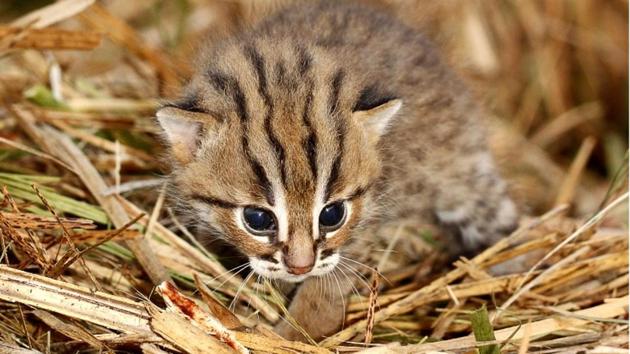
After numerous examples of leopard cubs being reunited with their mothers in the wild in Maharashtra, a team of researchers and wildlife rehabilitators managed to successfully reunite 26 rusty-spotted kittens with their mothers over a period of six years (2014-2019) in the Junnar forest division of the state.
The achievements of the team, part of wild animal conservation group Wildlife SOS, were published in a research paper in the Journal of Threatened Taxa on December 14.
This is the first report from India on multiple reunion efforts for this cat species. Prior to this, a report in 2007 was the only one that highlighted a natural reunion.
All reunions were carried out with the Maharashtra forest department. “There is a large population of rusty-spotted cats across Junnar, Ambegaon and Shirur due to the favourable habitat for these species home to sufficient water and hiding places in sugarcane fields. In 2020, we rescued and reunited three such kittens with their mothers,” said JR Gowda, deputy conservator of forest, Junnar.
Authors of the study included wildlife veterinarians and researchers Ajay Deshmukh, Yaduraj Khadpekar, Mahendra Dhore, and MV Baijuraj, some of whom have spent almost two decades in leopard conservation and conflict management in Junnar.
{{/usCountry}}Authors of the study included wildlife veterinarians and researchers Ajay Deshmukh, Yaduraj Khadpekar, Mahendra Dhore, and MV Baijuraj, some of whom have spent almost two decades in leopard conservation and conflict management in Junnar.
{{/usCountry}}Endemic to India, Sri Lanka and areas along the Indo-Nepal border, the rusty-spotted cats are the smallest cat species in the world protected under Schedule I of the Wildlife Protection Act, 1972, and listed as near threatened by the International Union for Conservation of Nature (IUCN) Red List. With no specific conservation action plan for the habitat of these cats in India or an official census, IUCN estimates a 75% decline in their habitat over the next 10 years.
Kittens are generally separated from their mothers during the night considering their nocturnal activity pattern, during sugarcane cutting, their mothers stray in search of food or human disturbances. All kittens were examined for injuries followed by a medical check before the reunion process.
The study concluded that such reunion protocols could be replicated for kittens or cubs of other wild cat species. “The rusty-spotted cat is very rare to spot in the wild and is a hidden jewel in Indian biodiversity. We have had the opportunity to successfully rescue and reunite these kittens with their mothers and have utilised the same reunion model that we follow for reuniting leopards cubs with their mothers,” said Kartick Satyanarayan, co-founder, Wildlife SOS.
All 26 kittens found in sugarcane fields, aged between 30 and 60 days, were reunited through 18 reunion events with three cases reported every year from 2014 to 2019 during early summer or early winter months of the sugarcane harvesting season. “Locals from these areas are aware about these cats and how they are different from domestic ones. We are ensuring their protection with the help of around 300 village volunteers across Junnar, Ambegaon and Shirur that inform the forest department after any sighting,” said Gowda, adding that a population estimation exercise had not yet been planned.
The key to successfully reuniting the mother and kittens is to ensure it is done as quickly as possible after separation, the paper read. “All reunions happened on the evening of the same day as the mother cats were in the vicinity where the kittens were found, and presumably returned on hearing the kittens’ mewing sounds,” one of the authors said.
Among all the reunion efforts, the maximum time gap between finding a kitten and taking it back for reunion, was around six hours and 45 minutes. After the kittens were brought to the location for the reunion, the minimum time for completion of a reunion was an hour and five minutes, while the maximum was four hours and 20 minutes. No kitten was lost to predation.
If a reunion fails, the displaced young animal is either moved to zoological park or a rescue centre where it is hand-raised in captivity. For example, in September, two three-week-old rusty spotted kittens, a male and a female, were brought to Sanjay Gandhi National Park (SGNP) in Mumbai after a failed reunion with their mother at Daund, Pune. SGNP presently has five rusty spotted cats. These cats have a lifespan of 12 to 14 years in captivity but their lifespan in the wild is unknown.
Independent experts have appreciated the reunion efforts and their parallel documentation over six years. “This is also an example of identifying these species abundantly present in croplands and not forests due to the presence of rodents as their prey. This shows how adaptable these species are, and also calls for focused research in these areas,” said Vidya Athreya, wildlife biologist with the Wildlife Conservation Society-India.
The world’s smallest cat
Its common name is rusty-spotted cat and scientific name is Prionailurus rubiginosus. It resembles a domestic cat but is smaller in size with the average weight of 1kg. In India, it is under severe threat and it is feared that the species may lose a large portion of its population and 75% of its current habitat over the next 10 years. In India, it is found in Andhra Pradesh, Gujarat, Jammu-Kashmir, Karnataka, Kerala, Madhya Pradesh, Maharashtra, Orissa, Rajasthan, Tamil Nadu, Uttarakhand and Uttar Pradesh.