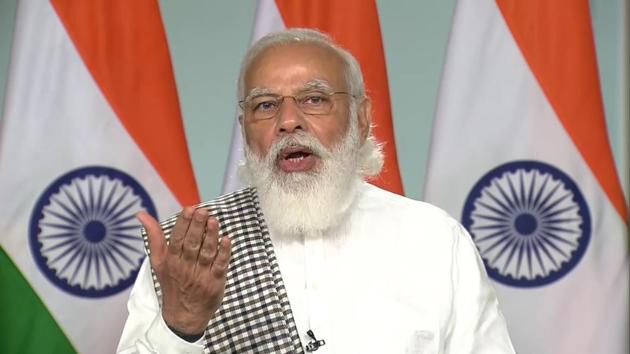
Prime Minister Narendra Modi will address the Climate Ambition Summit on Saturday on the occasion of the fifth anniversary of the landmark Paris Agreement. The virtual summit is being hosted by the United Nations (UN) and the United Kingdom and is being co-hosted by France in partnership with Chile and Italy. This will be an opportunity for countries to show their commitment to the Paris Agreement. The Paris Agreement is a legally binding international treaty on climate change which was adopted by 196 parties at the 21st Conference of Parties in Paris, on December 12, 2015, and was enforced on November 4, 2016.
Here’s everything you need to know about India’s commitment to the Paris climate agreement:
1. While addressing a side meeting on climate change at the G20 Summit, PM Modi said India is not only meeting targets set at the Paris Agreement but is also exceeding them while calling for “an integrated, comprehensive and holistic way” to tackling climate change.
2. In the G20 summit, Modi also said that India aims to restore around 26 million hectares of degraded land by 2030.
3. Ahead of the Paris climate summit, environment minister Prakash Javadekar said, “Climate change hasn’t happened in a day. It is the result of historical emissions over one hundred years. US has 25% of historical emission; EU has 22% of historical emissions; China has 13% and India has only 3%. We haven’t caused this problem but as a responsible nation, we will be a part of the solution.”
4. Currently, India is contributing only 6.8% of global emissions and its per capita emissions are only 1.9 tonnes (per capita).
{{/usCountry}}4. Currently, India is contributing only 6.8% of global emissions and its per capita emissions are only 1.9 tonnes (per capita).
{{/usCountry}}5. India’s nationally determined contribution (NDCs) under the Paris Agreement is 2 degree compliant. The country is also likely to meet and possibly overachieve its NDCs under the Paris Agreement, the emissions gap report 2020 noted.
6. The Modi government has repeatedly touted schemes as national plan on climate change; National clean air programme; Swachch Bharat mission; Pradhan Mantri Ujjwala Yojana; Namami Gange policy, etc, saying that they are helping India reach its climate goals.
7. India’s installed capacity of renewable energy has also increased by 226% in the past five years to over 89 GW now and India has a target of increasing installed renewable energy capacity to 450 GW by 2030.
8. India is projected to meet its pre-2020 climate pledge, also called the Cancun pledge, made in 2010.