E-Paper



50 years after tryst with history, Raini braces for new challenge
“Many of us do not sleep through the night. We wake up suddenly in the fear that it may happen again,” said Devi, who headed the village’s women committee

 Prefer HTon Google


New Delhi It’s been a while since Bina Devi has had a good night’s sleep. The furrows on her sunbaked face have gotten deeper in the last three years, her socks more pockmarked as she paces up and down her brick-and-limestone tenement perched on the side of a mountain, waiting for the distant rumble of calamity.
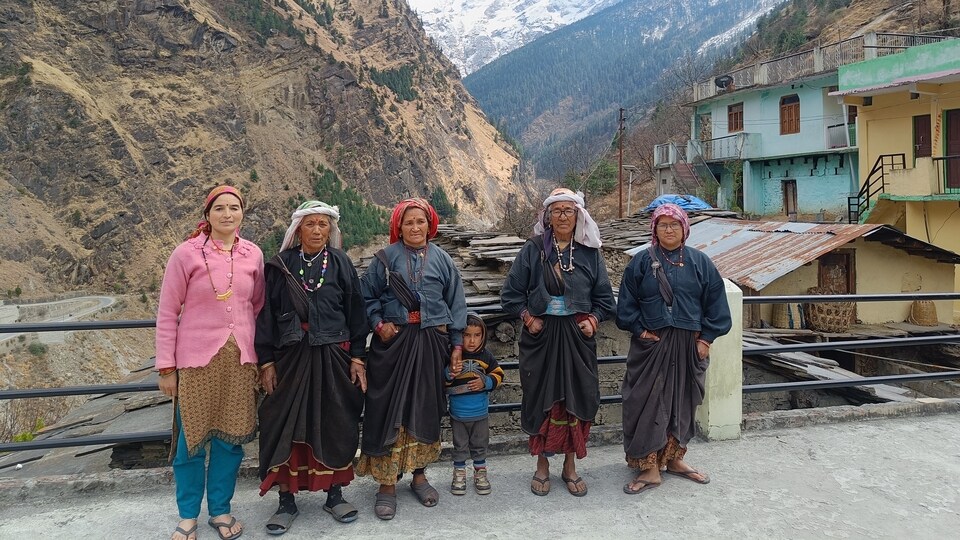
On a winter night three years ago, a wall of water cascading down a mountain slope smashed through her village, marooning most of its residents and killing two. As day broke, the wreckage of devastation around them made clear that a glacial lake outburst had crushed the Rishiganga hydel project and National Thermal Power Corporation’s Tapovan Vishnugad project. A few days later, water again accumulated in the Rishiganga, prompting the state disaster response force (SDRF) to set up a siren-based early-warning water-level sensor system.
“Many of us do not sleep through the night. We wake up suddenly in the fear that it may happen again,” said Devi, who headed the village’s women committee between 2021 and 2022.
Across the Himalayas, this is a depressingly common story – small mountain communities caught in the middle between hulking infrastructure and hydropower projects, and a fragile ecosystem unable to bear the burden of untrammelled development, resulting in dramatic climate catastrophes that kill hundreds of people every year.
But Devi’s predicament is not common because the village she lives in is not common either. Her village of Raini built the earliest people’s movement against environmental degradation with the iconic Chipko, which reached its zenith on March 26, 1974 when village resident Gaura Devi and 27 other women confronted a group of loggers and earthmovers, hugging ash trees and keeping a night-long vigil that forced the lumbermen to finally retreat.
Fifty years later, the Garhwal hills are in ferment again, but this time, Devi and her cohort of local women are not as certain that they will be able to stand up to the forces that threaten to destabilise their lives. The government has retreated and the local organisations that once mobilised hundreds of people in a matter of hours — the Gandhian group, Dasholi Gram Swarajya Sangh, was the driving force behind Chipko – have atrophied. Most of all, the climate crisis has meant a slow degeneration of their quality of life in a way that is difficult to document, except in lived experience – the meadows growing greyer, the mountain slopes more naked.
“We have been seeing a severe decline in snowfall in the past 15 to 20 years. We do not understand what is happening to our hills,” said Devi.
History in the hills
The mobilisation around Chipko began small, with tiny Gandhian groups sprouting all over the Garhwal hills in the 1960s, against the backdrop of companies and mills first entering the then-pristine region. In 1973, a group of villagers and Gandhian activists stopped Allahabad-based sports company Symonds from felling trees in Chamoli district.
Against the backdrop of the devastating Alaknanda floods in 1970 that killed several, local villagers had steeled themselves against any encroachment on their forests. On March 26, 1974, when forest officials and labourers reached Raini’s forests in the morning, some women spotted them going to the forest. Men from most border villages were in Chamoli on that day to collect compensation for some other projects. The Uttar Pradesh forest department saw it as an opportunity to fell the ash trees, as they expected women would not dare to intervene. But, Gaura Devi and 27 other women and girls banded together, hugging a tree in defiance.
“The women did not budge. Some also broke the small road connecting to the forest so that the officials and labourers could not go to the forest at night,” recalled Chandi Prasad Bhatt, one of Chipko’s foremost leaders.
Bhatt recalled that Gaura Devi told him not only about the struggle with the agents and labourers, but also how they latter insulted the local women. The women kept the vigil all night long, and when the men returned the next morning, they joined the protest.
On March 30, the women from Lata, Raini and other border villages put on their traditional Bhotia attire and carried drums up the hills. “The rally started from Rishi Ganga. I used to have a protest song which they also sang. They were carrying Chipko banners. Ber Bhao todne dil ko dil se jodne, rokne tabahi chale shanti ke sipahi (to break hatred and stop destruction, the warriors of peace are marching). I believe people and forests have a relationship and you cannot oversee it. The women proved it,” said Bhatt.
After a four-day stand off, the loggers relented. By then, Chipko had become a household name across north India, and shaken the centres of power in Delhi and Lucknow. A committee formed by chief minister HN Bahuguna eventually ruled in favour of the villagers.
“Sudesha behen, Bachni Devi, Kalavati Devi were all important leaders who are in their 80s and 90s now. But their names did not come up as much as those of the men in the movement,” said Vijay Jardhari, another important leader of the Chipko movement from the Tehri region.
Eventually, Chipko came to be recognised as one of the world’s first eco-feminist movements, where local women used traditional knowledge to speak of their relationship to the ecosystem, the susceptibility of eco-sensitive regions such as Raini , and the need for fair access to forest resources and careful planning in the Himalayan forest regions.
Historic, yet endangered
In Raini, a village of 135 people, time appears still. Located at the tip of the confluence of the Rishiganga and Dhauliganga rivers, it is at the northwestern edge of the Nanda Devi National Park. The Garhwal ranges loom in the background, one peak lush with forests of pine and fir, and another brown and rugged with little vegetation. In their traditionally knotted Garhwali sari that leaves their hands unencumbered for work on the fields, the women spend a majority of the day tending to their animals and sharing duties with the men, who now also work at construction sites and as labourers downhill. The only concession made to modernity in this village of two-storey brick-and-mortar houses and narrow stone-paved paths is the occasional denim jacket slung over their shoulders.
Yet, things are changing. The memories of the two people from Raini – 70-year-old Amrita Devi and 26-year-old Ranjith Singh Rana, both of whom worked at the Rishi Ganga project – who were killed in 2021 are fresh. “If it has happened once, it can happen again,” said Devi.
The low grumble of the earthmovers working on one project or another forms a constant background hum. Nature is turning harsher – the winters shorter but more biting, the showers heavier but more scattered and unpredictable and the summers long and searing. And below them, the ground appears to be literally slipping.
Nowhere is this change more visible than in the three-room house where Gaura Devi once lived and which is now inhabited by her son Chander Singh and his wife Juthi Devi. A huge gash disfigures the front facade of her painstakingly built whitewashed house, serving villagers a distressing reminder of the slope destabilisation that has rendered Raini unfit to stay and showing that even the village’s storied fight against environmental degradation could not safeguard their future in the face of an impending natural calamity.
“There are cracks in all our homes and on the roads. We were hoping that because this is a historical village, it is Gaura Devi’s village after all, the government will do something. But our hope is fading,” said Devi.
Most of the 54 houses in Raini have cracks in their walls and their bases are destabilised. A report by geologists from the Uttarakhand Disaster Recovery Initiative (UDRI) submitted to the Chamoli district magistrate in July 2021 and seen by HT said that the 2021 glacial lake burst destabilised Raini.
“ Raini village is facing serious slope stability problems where the whole area is affected by active subsidence whereas downslope is affected by toe erosion. During investigation wide cracks were observed in the walls and floors of many houses indicating active slope movement in the area. It is therefore advisable to rehabilitate Raini village to an alternative safe location,” said the report, a copy of which was seen by HT.
.During a field visit by the geologists that year, they observed that the material that forms the slope is highly saturated due to incessant rain. On June 14 that year, about 40 metres of the road at Raini broke off and was engulfed by the Dhauliganga on the Joshimath-Malari route, cutting off army and Indo Tibetan Border Police posts and villages along the India-China border.
Local women say they have been protesting against hydropower projects since 2007-08 but to little effect. “They were blasting and tunnelling here, that is why our land started skidding. All our homes and even the roads used to shake. Don’t we understand these things?” asked Manju Devi, a local resident.
At a crossroads
Today, Gaura Devi’s legacy and the future of Raini stand at a crossroads. Most young people have left the village for harsher, but safer, climes in the plains. Large cracks in the fields have rendered many of them non irrigable, and the elderly women complain that their perennial source of water, the Rishiganga, has been replaced with a tank installed on the upper reaches of a hill above the village.
The plan to shift the village also appears to be in limbo; the local administration says land availability is limited. “In 2021 some government people had come who had offered the option of moving us to Suwai gaon near Tapovan. But Suwai villagers refused to give us space. They did not want us to come with our cattle so we did not move,” said Manju Devi.
The Chamoli administration said land was limited. “We earlier identified two nearby areas for the rehabilitation of the villagers. However, the rehabilitation plan couldn’t materialise due to limited availability of land,” said NK Joshi, district disaster management officer.
A statue of Gaura Devi and other women hugging trees stands in the middle of the village in a newly created park – a reminder of the extraordinary movement that reshaped India’s understanding of the environment 50 years ago. But local people say they’d much rather see their present and the future of their children secured. “Nobody visits us anymore,” said Manju Devi.
“We are living in fear of another landslide or glacier break.”
Fifty years ago, women from the village hugged trees, a milestone in India’s environmental movement. Now, they are clinging on to their land, living in hope.