A seventh-century Sanskrit play, Bhagavadajjukam, has been staged in Bengali by a group of young artists in Assam’s Silchar recently. An alumnus of the National School of Drama (NSD), Gulista Aliza from Mumbai, travelled thousands of kilometres to be a part of it.
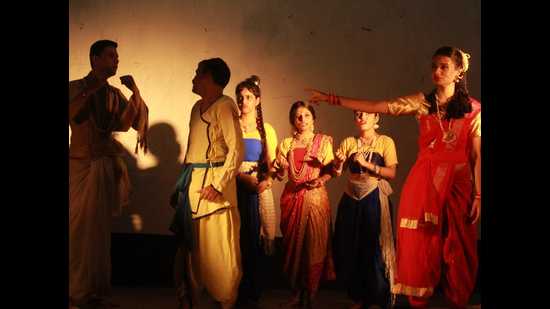
The Bengali screenplay was written by veteran theatre artist Santanu Paul, who claimed that this is probably for the first time for Barak Valley when a Sanskrit play is being staged in Bengali. The play in Bengali is named “Khachachara Atmaram”.
A 40-year-old theatre group, Bhabikal, which organises youth and children theatre workshops twice a year, staged the play at Kalikaprasad Bhattacharjee and Mukundadas Bhattacharjee Smriti Mancha. Most of the cultural groups stage their dramas and musicals in Barak Valley during the Durga Puja festival. Earlier, drama used to be a part of the celebration which is still known as ‘Jatra Gaan” in rural areas.
Bhagavadajjukam is a Sanskrit play written by Bodhayana in the seventh century. The play is about the transmigration of souls as practised by Buddhist monks. It’s called prahasana, a satirical comedy and has been staged in different languages across India.
The dedication of the entire team was seen during the play. The stage was old and comparatively small. There was no ceiling fan and they staged the play twice in a row in heat. Apart from two actors, the rest of the team was performing on stage for the first time. Some of the actors were not Bengali but it never looked like they were struggling with the language. There were only a few people seated in the audience but it did not discourage the actors from giving their best shot.
{{/usCountry}}The dedication of the entire team was seen during the play. The stage was old and comparatively small. There was no ceiling fan and they staged the play twice in a row in heat. Apart from two actors, the rest of the team was performing on stage for the first time. Some of the actors were not Bengali but it never looked like they were struggling with the language. There were only a few people seated in the audience but it did not discourage the actors from giving their best shot.
{{/usCountry}}Gulista Aliza, who directed Khachachara Atmaram, said, “Before staging the play, we did workshops for months to train the artists. Most of the artists who played different roles in the play were not experienced but on stage, they were so much mature and confident. It is a result of their dedication and strong teamwork.”
Gulista is trying to explore Sanskrit drama and Indian mythology. She said, “From Samudra Manthana to many more mythological stories, in my perception, they were beautifully written and rich by content. I have met many theatre artists from western countries like France and Italy. They all believe that Natya Shastra of India has enriched their theatre culture. We need to explore our own culture more and being part of this play is one of my attempts in that direction.”
Santanu Paul, who leads the Bhabikal theatre group, is one of the coordinators of the National School of Drama for northeast India and also a faculty of Sangeet Natak Academy. He said, “Theatre culture in Northeast India is rich but we don’t get proper exposure. The first drama in Cachar district was staged in 1903 by the postal recreation club. We celebrated its hundred years in 2003. Revolutionary Bengali writer Dinabandhu Mitra came here and wrote famous ‘Kamale Kamini’ during his visit to Silchar.”
Paul also informed that several groups across Barak Valley organise competitions and workshops to keep the young generation connected. “We often say that the young generation is not connected to roots but they are interested in theatre in my opinion. We organise workshops twice a year, Rupam Natya Sanstha organises competitions and there are other initiatives. I have seen youths practising in every corner of town before the competition. We need to give them a bigger platform. I had a chance to get a year-long training under Padma Bhushan Heisnam Kanhailal in 2007, it changed my perception. We need to provide our young generation with such chances here,” he said.