
 E-Paper



A 19th century panopticon on gracious Seshadri Road
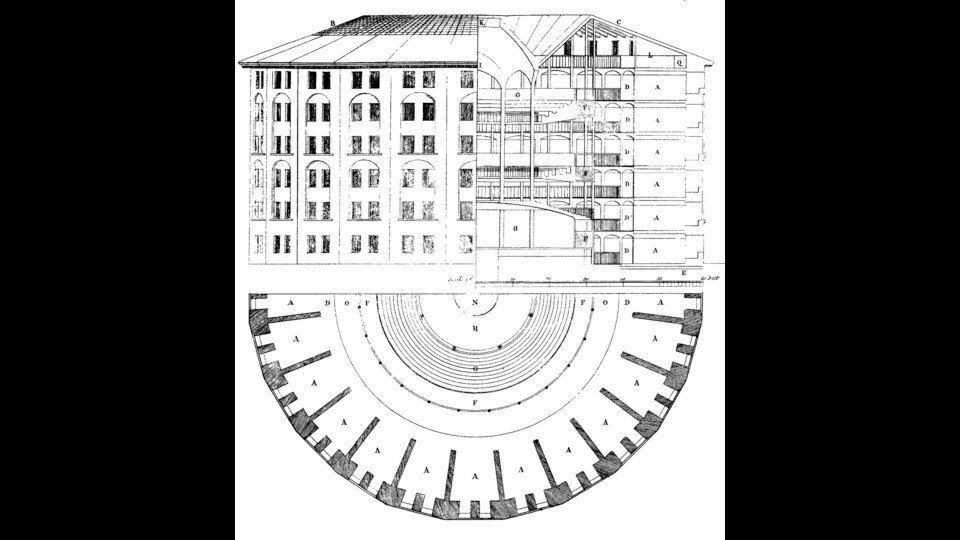
The Panopticon design involved a central watch tower, from which a single prison officer could observe the goings-on in the individual cell blocks that were ranged radially around the tower

 Prefer HTon Google


It has struck half-past-2025, but only just, so let us linger a tad in June, to talk about three events that happened in three long-ago Junes. One was the Indian Emergency, declared half a century ago on June 25. The second and third are connected to two individuals, specifically to their deaths; the first, English philosopher and jurist Jeremy Bentham, passed on 6 June, 1832, aged 84, and the second, Bentham’s much younger Scottish secretary, collaborator and devoted acolyte, James Mill, on 23 June, 1836.
Let’s begin with James Mill, born Milne, whose magnum opus, The History of British India (1818), is arguably the most influential colonial history of the region. A staunch advocate of utilitarianism, a branch of ethical philosophy that advocates actions which bring about the greatest good for the greatest number, Mill believed implicitly that British actions in the subcontinent were justified. In the longest essay in the book, a 10-chapter denouncement titled “Of the Hindoos”, he describes Indian society as barbaric, dismisses Indians as incapable of self-government, and declares that ”insincerity, mendacity, perfidy and (…) venality” are innate in Hindus and Muslims.
Considering that he had never visited India, Mill was reaching here, but his standing as a historian ensured that his book became an instant bestseller and the primary source of the deep Indophobia that persisted until Indian Independence. It also garnered him a plum position in the East India Company (EIC), from which he was able to impact imperial policy in India, including our own city. (Mill’s son, John Stuart Mill, ‘the most influential English-speaking philosopher of the 19th century’, also an EIC man, redressed his dad’s excesses somewhat by having the grace to be conflicted about imperialism.)
On to Mills’ guru, Jeremy Bentham. A radical liberal and utilitarian, as woke as they came in the 18th century, he pushed for the abolition of slavery, equal rights for women, decriminalization of homosexuality, freedom of expression, and animal rights (to give him credit, Mills advocated for all these as well). But Bentham’s passion was prison reform, including the abolition of capital punishment, better conditions for prisoners, and the engagement of inmates in useful and profitable work, all of this to be accomplished at the least cost to the state. Towards this end, he spent long years designing his dream prison, the Panopticon, Greek for ‘all-seeing’.
The Panopticon design involved a central watch tower, from which a single prison officer could observe the goings-on in the individual cell blocks that were ranged radially around the tower in a wide circle. Clearly, the officer could not watch every block all the time, but the fact that he was in an eyrie above the sightline of the prisoners meant that inmates could not tell when they were being watched. That, Bentham argued, would result in self-policing, thus reducing the cost of manpower.
Unfortunately, despite Bentham’s best efforts, the Panopticon prison, reviled by later thinkers as a metaphor for Big Brother totalitarianism, never got built in his home country. But it did in our city, in 1866, in the shape of the Bangalore Central Jail (now Freedom Park). Among its famous inmates during the independence movement was the second chief minister of Karnataka, Kengal Hanumanthaiah. The Panopticon as a symbol of the oppressive state was realised during the Emergency, when prominent Jan Sangh leaders like AB Vajpayee and LK Advani were put away in the Banglore Jail for months on end.
More tragically, it was also where one of the first martyrs of the Emergency, activist and actress Snehalatha Reddy, who played Chandri in the National Award-winning Kannada film Samskara based on the novel by UR Ananthamurthy, was imprisoned and tortured for eight long months with no proof of guilt.
(Roopa Pai is a writer who has carried on a longtime love affair with her hometown Bengaluru)


