NEW DELHI: US ambassador Eric Garcetti on Tuesday called for changes in India’s investment, intellectual property, export and taxation regimes and said the government’s drive for self-reliance could slow down the pace of trade and economic development.
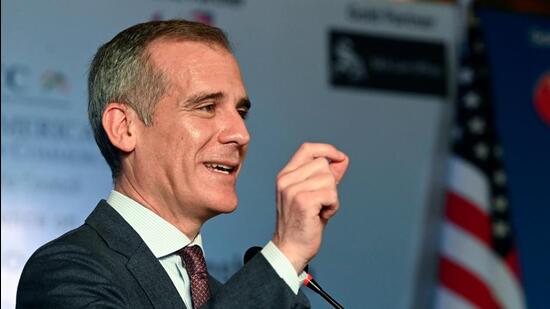
Garcetti, speaking on the theme of “Strengthening Indo-US relationship in Amritkal-Aatmanirbhar Bharat” at an event organised by the Indo-American Chamber of Commerce, highlighted rapid advances made by the two sides in areas such as defence, emerging technologies, critical minerals and semiconductors.
However, he contended India and the US won’t be able to realise their full potential in trade and investment unless New Delhi brings about changes in areas such as export controls, foreign direct investment (FDI), and the corporate tax regime, which he described as “opaque”. He also sought the removal of other barriers for US companies to invest in India.
Noting that being “more frank with one another” is part of deepening the overall relationship, Garcetti said export controls and policy have to change for India and the US to achieve their goals and achieve the required economic growth.
The US wants to see FDI shifting from China to India, “but if you look at the honest numbers…FDI isn’t flowing into India at the pace it should be. Instead, it is going to Southeast Asia, into countries like Vietnam”, he said.
{{/usCountry}}The US wants to see FDI shifting from China to India, “but if you look at the honest numbers…FDI isn’t flowing into India at the pace it should be. Instead, it is going to Southeast Asia, into countries like Vietnam”, he said.
{{/usCountry}}While the US wants India to be self-reliant, it also wants an “India that doesn’t look at self-reliance as a fortress”, given the ability of Indian companies to compete anywhere in the world and invest and create jobs in the US. Garcetti said, “This is not a paradigm of old, of invaders coming in to extract”.
He added, “This is a relationship of equals, that when we break down the walls in both of our governments, whether they are bureaucratic, taxation, regulatory [and] part of our federal system, you only release more jobs, more prosperity, more investment and more strength.”
Garcetti contended that “no country can be self-reliant anymore” and he wanted to see supply chains critical to America coming to India.
“The rhetoric that everything has to be made here in India will slow down the pace. If you tax inputs, many of you in manufacturing know that you are taxing your outputs. You’re not taxing us, you are not protecting the market, what you are doing is limiting the market and we want to bring in greater investment,” he said.
“We also have to see that opaque corporate tax practices still are a barrier to too many [US] companies that want to be here,” Garcetti said, adding that American firms also want to ensure protection of intellectual property.
“Courts often decide that there is a violation of intellectual property but then there is no consequence. This is now increasingly important to Indian companies too because Indian companies are producing patents at such a roaring rate now compared to the past” he added.
The strengthening of intellectual property rights will incentivise investments, while “countries that prioritise their own standards over connectivity will find it difficult to make for the world”, Garcetti said.
“India is big enough to have its own market but if you want to have dominance in the global marketplace, you have to decide on these standards together. It is so exciting to see that happen with 4G, 5G, Open RAN [radio access network],” he said.
Without naming China, Garcetti said the “main competitor” of the US and India wants to use telecommunications to spy on its citizens and others around the world.
Garcetti also highlighted the importance of “simple permitting processes”, saying firms want faster permissions, speedy customs clearances, and tax and regulatory stability. In this context, he gave the example of a US company that wanted to create a base in India and had invested $20 million in the country. This same company had invested $200 million in Vietnam, which doesn’t tax imported components that cannot currently be made in the country.
He also contrasted India with the Association of Southeast Asian Nations (Asean) and said the 10-nation bloc with a population of 700 million has a 20% larger GDP and a per capita income twice that of India. This is due to trade agreements that account for 25% of regional trade and an inter-connected area that works hard to listen to companies regarding changes, he said.
At the same time, he said, the common vision of India and the US for a free, open, secure and prosperous Indo-Pacific can “inexorably link two countries that like each other but also love each other”. Ties between the two sides are no longer “an additive relationship”, and it is now “a multiplicative relationship” or the “US times India or India times the US”.
“When we come together, it’s more powerful than just the two elements, for ourselves and, just as importantly, for our world. We witnessed that in the G20 when we came together as partners to bring 18 other countries and much of the developing and developed world together behind the ideas and principles that still matter,” Garcetti said.
The US is India’s largest trade partner, with two-way trade in goods and services crossing $191 billion in 2022. The US was the third largest source of FDI into India during 2022-23, with inflows of $6.04 billion accounting for almost 9% of total FDI equity inflows. The two sides have also launched new mechanisms such as the Strategic Trade Dialogue and initiative on Critical and Emerging Technologies to drive collaboration in trade, hi-tech and defence.