Even though Pakistan and China, by not attending the Afghanistan conference here on Wednesday are trying to portray India as anti-Taliban, the actual purpose is to stabilise strife-torn Kabul so that rising Islamic radicalisation does not mutate into global jihad and threaten the region and beyond. The Afghanistan conference is hosted by Indian National Security Council Secretariat (NSCS) headed by National Security Advisor Ajit Doval.
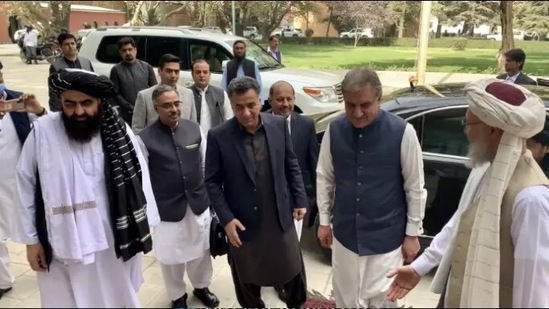
Pakistan National Security Advisor Moeed Yusuf has publicly called India a spoiler in Afghanistan and decided against attending the conference. There is no word from China, which has backed Pakistan’s overt and covert role in Afghanistan, on attending the conference. The conference is being attended by Russia with Nikolai Patrushev, Secretary, Security Council of Russia, and right-hand man of President Putin, leading the delegation along with representatives from Iran, Kyrgyzstan, Turkmenistan, Kazakhstan, Uzbekistan, and Tajikistan.
According to officials handling the conference, its purpose is not to resurrect any opposition to the Taliban regime but to stabilise Afghanistan with so-called Islamic State of Khorasan Province (ISKP) wreaking violence against Shias and other non-Sunni minorities in the country and Al Qaeda showing signs of revival. The biggest fear posed by unstable Afghanistan under the influence of Pakistani deep state is that the drought prone lawless country may descend into total chaos and turn into a hub of global jihad. While Russia is worried about the security threat to Central Asian Republics, Iran is concerned about rising Pakistani interference and persecution of Shias on both sides of the Durand Line. New Delhi is disturbed about the rising radicalisation in the Indian sub-continent.
Nearly three months after capture of Kabul by the Taliban, no country has recognised the Sunni Pashtun force whose sword arm is Pakistani ISI backed Haqqani network (HQN). There is hardly any governance in Kabul with Mullah Yaqoob faction at odds with Sirajuddin Haqqani, who heads the HQN, and all the commitments promised by the Taliban as part of Doha deal have been thrown into Kabul River. The minorities specially women are under vicious attack by the ultra-conservative radicals roaming around the country with state-of-the-art US weaponry.
{{/usCountry}}Nearly three months after capture of Kabul by the Taliban, no country has recognised the Sunni Pashtun force whose sword arm is Pakistani ISI backed Haqqani network (HQN). There is hardly any governance in Kabul with Mullah Yaqoob faction at odds with Sirajuddin Haqqani, who heads the HQN, and all the commitments promised by the Taliban as part of Doha deal have been thrown into Kabul River. The minorities specially women are under vicious attack by the ultra-conservative radicals roaming around the country with state-of-the-art US weaponry.
{{/usCountry}}The situation is so dire in Afghanistan that even Pakistan Army Chief Gen Qamar Javed Bajwa is worried about the jihadist ideology spillover from across the Durand Line and threaten Islamabad itself. It is quite evident that the Pakistan Army has difference of views with the civilian leadership under Prime Minister Imran Khan, who feels that the jihadist forces in Afghanistan will serve the political purpose of Islamabad against India and buy much required economic leverage from the west. The tussle between two power centers in Pakistan may manifest either before the appointment of new DG ISI Lt Gen Nadeem Anjum on November 20 or in the coming three months.
Pakistan’s principal backer China is engaging the Taliban regime directly and through Islamabad so that terrorist groups in Afghanistan do not ally with Uighur terrorist groups to threaten Xi Jinping regime in bordering Xinjiang province through Wakhan corridor. The other reason for supporting the Taliban is to promote the Belt Road Initiative in Afghanistan and more importantly ensure that CPEC projects are not targeted by affiliated Sunni Deobandi groups like Tehreek-e-Taliban, Pakistan. In this context, China is guided by the Pakistani line on Afghanistan given the influence ISI exerts on a section of the Taliban regime in Kabul.
India may be upset with the ISI influence on Kabul but its over-riding concern is stability of Afghanistan even with Taliban heading the government. An unstable Kabul will not only spell disaster for the Indian sub-continent but also the world at large as the Af-Pak region will yet again produce terrorists on an industrial scale.