The Centre has outlawed the Popular Front of India (PFI) and its affiliates for five years, accusing them of involvement in Islamic radicalisation and terrorist activities, a move that came after a crackdown on the group’s leaders and office bearers across several states in which nearly 350 people were rounded up.
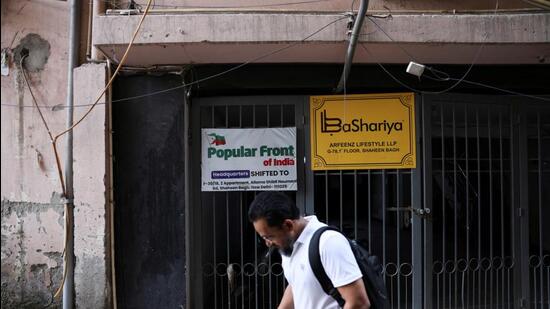
The association has been banned under the Unlawful Activities (Prevention) Act, or UAPA, the Union home ministry said in a notification early on Wednesday. In response, PFI said in a statement that it had dissolved itself and asked its members to stop their activities.
The ministry said PFI, its associates or affiliates and fronts have been involved in violent terrorist activities with the intent to create a reign of terror in the country, thereby endangering the security and public order of the state.
PFI’s associate organisations, including Rehab India Foundation (RIF), Campus Front of India (CFI), All India Imams Council (AIIC), National Confederation of Human Rights Organization (NCHRO), National Women’s Front, Junior Front, Empower India Foundation and Rehab Foundation, Kerala, have also been deemed unlawful.
The Social Democratic Party of India (SDPI), which works with PFI on some issues but was not included in the ban, said the government had struck a blow against democracy and human rights. “Freedom of speech, protests and organisations have been ruthlessly suppressed by the regime against the basic principles of the Indian constitution,” SDPI said in a statement.
{{/usCountry}}The Social Democratic Party of India (SDPI), which works with PFI on some issues but was not included in the ban, said the government had struck a blow against democracy and human rights. “Freedom of speech, protests and organisations have been ruthlessly suppressed by the regime against the basic principles of the Indian constitution,” SDPI said in a statement.
{{/usCountry}}SDPI has not been banned by the government as it is a political party and any action can only be taken by the Election Commission, people familiar with the development said.
The ban under UAPA’s Section 3, which makes PFI a “terrorist organisation”, is expected to cripple its funding, recruitment, and other activities as anyone found associated with it can be booked under terror charges in any part of the country, an official said, asking not to be named. PFI is alleged to have links to proscribed groups such as the Students Islamic Movement of India (SIMI) and Jamaat-ul-Mujahideen Bangladesh (JMB), and international terrorist groups such as Islamic State.
SIMI, which was banned in 2001, has not been able to operate and most of its functionaries have been arrested over the years.
PFI and its remaining office bearers will not be able to organise protests, seminars, conferences, donation exercises, or put out publications.
The home ministry cited anti-national activities of PFI, disrespect, and disregard for the constitutional authority and sovereignty of the state and said immediate and prompt action was required.
“The central government is of the opinion that if there is no immediate curb or control of unlawful activities of the PFI and its associates or affiliates or fronts, the PFI and its associates or affiliates or fronts, will use this opportunity to continue its subversive activities, thereby disturbing public order…”
It added that if the organisation wasn’t banned, it would continue to undermine the constitutional set up of the country; encourage and enforce a terror-based regressive regime; continue propagating anti-national sentiments, and radicalise a particular section of the society with the intention to create disaffection against the country; and aggravate activities which are detrimental to the integrity, security and sovereignty of the country.
The home ministry’s notification banning PFI will now be referred to a tribunal for adjudicating whether or not there is sufficient cause for declaring the organisation unlawful, an official said, asking not to be named.
Once the tribunal receives the case, it will issue a show-cause notice to PFI, asking it to reply in writing about why it should not be banned. Based on submissions from both sides, the tribunal can hold an inquiry to decide whether there is sufficient evidence to declare PFI an “unlawful association”.
About240 people associated with PFI and its affiliates were on Tuesday arrested or detained for questioning in the second round of raids within a week across eight states as part of the largest-ever crackdown against the Islamic group over alleged terror links.
Conducted by state police teams, the raids were spread across Uttar Pradesh, Kerala, Karnataka, Gujarat, Delhi, Maharashtra, Assam, and Madhya Pradesh.
These raids came five days after 108 PFI functionaries, including its chairman OMA Salam, were arrested in multi-agency raids spearheaded by the National Investigation Agency (NIA) in coordination with the Enforcement Directorate (ED), and state police forces at 102 locations across 15 states over charges of terror-funding, radicalisation and attempts at “violent jihad”. NIA is investigating 19 cases involving PFI.
In its notification, the government said PFI was involved in several criminal and terror cases and “shows sheer disrespect towards the constitutional authority of the country and with funds and ideological support from outside it has become a major threat to the internal security of the country”.
“Investigations in various cases have revealed that the PFI and its cadres have been repeatedly engaging in violent and subversive acts. Violent acts carried out by PFI include chopping off [a] limb of a college professor, cold blooded killings of persons associated with organisations espousing other faiths, obtaining explosives to target prominent people and places, and destruction of public property.”
The home ministry said the radical Islamist organisation and its associates “operate openly as socio-economic, educational and political organization but, they have been pursuing a secret agenda to radicalize a particular section of the society working towards undermining the concept of democracy and show sheer disrespect towards the constitutional authority and constitutional set up of the country.”
It cited investigations by various agencies and said PFI has international linkages with global terrorist groups and some of its activists have joined the Islamic State of Iraq and Syria (ISIS) and participated in terror activities in Syria, Iraq, and Afghanistan.
“Some of these PFI cadres linked to ISIS have been killed in these conflict theatres and some have been arrested by state police and central agencies and also the PFI has linkages with Jamat-ul-Mujahideen Bangladesh (JMB), a proscribed terrorist organization,” the notification said.
It said PFI has created these affiliates or fronts “with [an] objective of enhancing its reach among different sections of the society such as youth, students, women, Imams, lawyers or weaker sections of the society with the sole objective of expanding its membership, influence and fund-raising capacity.”
It added that some of PFI’s founding members were the leaders of the Students Islamic Movement of India (SIMI) and PFI has linkages with JMB, both banned organisations.
“The office bearers and cadres of the PFI along with others are conspiring and raising funds from within India and abroad through the banking channels, and the hawala, donations, etc as part of a well-crafted criminal conspiracy, and then transferring, layering, and integrating these funds through multiple accounts to project them as legitimate and eventually using these funds to carry out various criminal, unlawful and terrorist activities in India.”
After the ban order, PFI’s branch in Kerala, where it has a big presence, said in a statement: “As law-abiding citizens of our great country, the organisation accepts the decision of the ministry of home affairs.” On Tuesday, PFI denied accusations of violence and anti-national activities when its offices were raided and dozens of its members were detained in various states.
Several political parties across the country supported the government’s crackdown, but some leaders also called for similar action to be taken against the Rashtriya Swayamsevak Sangh (RSS) — a demand ridiculed by the ruling Bharatiya Janata Party (BJP). State units of prominent BJP-ruled states, including Uttar Pradesh, Maharashtra and Assam, supported the ban saying it was a strong message to all anti-national groups.
All India Majlis-e-Ittehadul Muslimeen chief Asaduddin Owaisi, however, said that though he always opposed PFI’s approach, the ban on the outfit could not be supported.
“While I have always opposed PFI’s extreme and radical approach,..., this ban on PFI cannot be supported because actions of some individuals who commit crime do not mean that the organisation itself must be banned,” he said.