E-Paper



AI reshaping cinema; actors must protect digital likeness: Shekhar Kapur at 56th IFFI
International Film Festival of India (IFFI) director Kapur was in conversation with director of Berlin International Film Festival Tricia Tuttle at a session on 56th IFFI in Goa

 Prefer HTon Google


Goa: Artificial intelligence (AI) is beginning to reshape the film industry, and actors must now legally safeguard their digital likeness, filmmaker and International Film Festival of India (IFFI) director Shekhar Kapur said on Saturday during a session at the 56th IFFI in Goa.
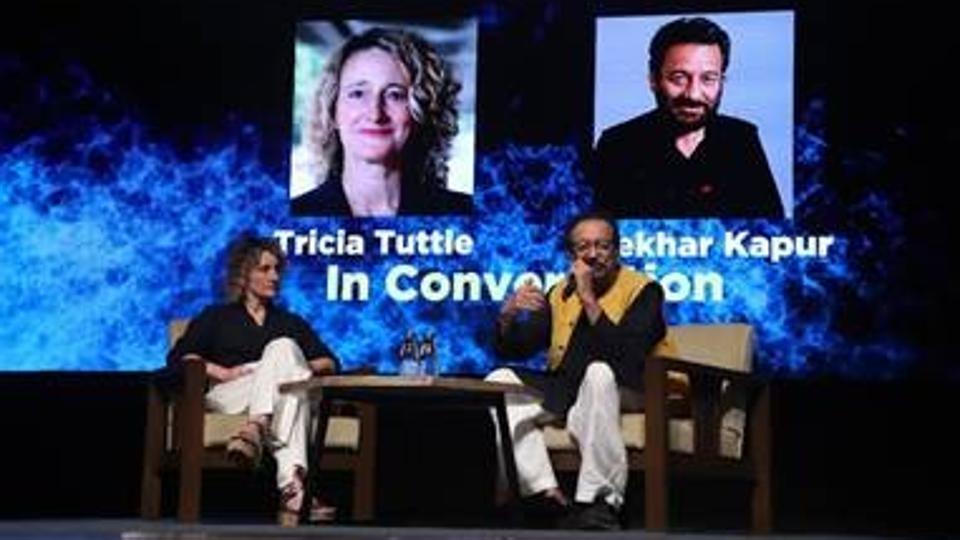
Kapur was in conversation with the director of the Berlin International Film Festival, or The Berlinale, Tricia Tuttle at an IFFI session — An Eurasian Festival Frontier: Do We Need to Redefine Cinema in the World of AI?
Jointly hosted by the National Film Development Corporation (NFDC), the ministry of information and broadcasting, and the Entertainment Society of Goa (ESG) of the Government of Goa, the nine-day film festival is on till November 28.
The discussion at the session on Friday focused on AI’s impact on filmmaking, storytelling, distribution, and the future of film festivals in a rapidly evolving technological landscape.
“Most of the actors I know have been dealing with their lawyers and copyrighting themselves. Tom Cruise, Hrithik Roshan, Anil Kapoor have copyrighted themselves. In the new world of AI, you need to do that,” Kapur said, responding to a question by HT.
Also Read: Culture, ecology take centre stage in IFFI’s Indian Panorama non-feature lineup
In recent months, several prominent Indian actors including Abhishek Bachchan, Aishwarya Rai Bachchan and Hrithik Roshan have successfully added their names to the growing list of celebrities who have managed to safeguard their personality rights with legal intervention.
Seeing the volume of celebrities willingly going to court over the matter may very well look like a ‘trend’ to the layperson, but personality rights — and their protection, especially for public figures — are incredibly important as we rapidly settle into the age of artificial intelligence.
Kapur said there should be legislative change to protect actors’ AI likeness, adding that the challenge is determining the duration of such protection.
He recalled a recent legal hurdle when he asked his lawyer if he could copyright the famous catchphrase “Mogambo Khush Hua” from the 1987 film Mr. India. Lawyers reportedly advised him that while the estate of the late actor Amrish Puri belongs to Puri, the likeness of the character Mogambo belongs to the film and therefore cannot be copyrighted. The line has become one of the most iconic in Indian cinema.
Tuttle cautioned against using technology to revive past stars without consent or context. “I love Paul Newman. But I don’t want to see an AI version of Paul Newman (American actor). I’ll be curious to see whether we all want AI versions of Tom Cruise (actor),” she said, adding that the AI tools are “not what makes the film good. It’s the ideas, the craftsmanship.”
Kapur said that emotional performances remain beyond AI’s reach for now. He said that AI will “first start to replace films like Marvel films like Avengers” because of less emotions, while AI can’t do what Cate Blanchett or Shabana Azmi can do “because the emotional connection is something that AI cannot yet replicate.”
Kapur spoke about experimenting with emerging tools after playing a teaser of his AI-created series War Lord. “A film that would cost 300 million would now cost 3 million with the help of AI,” he said, adding that AI is the most democratic technology ever.
Acknowledging the possibilities with AI, he said the “storyteller remains central to cinema.”
Meanwhile, the ministry of electronics and information technology (IT) recently proposed amendments to the IT (Intermediary Guidelines and Digital Media Ethics Code) Rules, 2021, that would require social media platforms to label AI-generated or synthetic content. However, there is still no explicit copyright provision in India for personality ownership.
Legal experts say the law will need to evolve to keep pace with such disruptions.
“Certain jurisprudence has developed through various court cases around personality rights which provides protection of misuse of likeness of celebrities,” said Dhruv Garg, partner at the Indian Governance & Policy Project.
“A relook at the intellectual property regime may be needed to comprehensively solve the growing issue of AI being used for generating unlicensed and non-consensual likeness of celebrities. However, it must be noted that AI is just one of the many technologies and methods that may be used to exploit the likeness of popular and public persons. It is not so much an issue of AI but rather of not having appropriate legal solutions in place,” Garg added.