In mid 2000, when legislators in the Uttar Pradesh assembly were introduced to laptops, many of them had lightly asked: “Yeh kya cheez hai?” (What is this?) Training sessions were held. A few years later, the majority of the lawmakers, including the non-tech savvy ones, started maintaining the full data of their constituency on their laptops. They hired experts while some took help from their children. Now, information is just a click away.
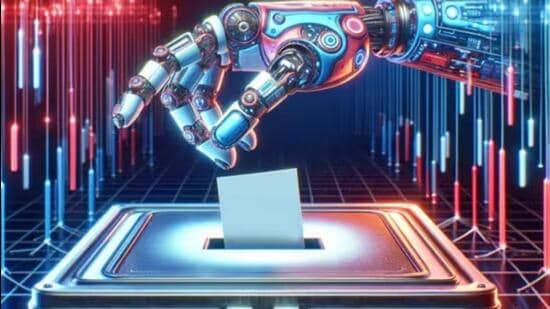
Today, when Artificial Intelligence (AI) is becoming
In mid 2000, when legislators in the Uttar Pradesh assembly were introduced to laptops, many of them had lightly asked: “Yeh kya cheez hai?” (What is this?) Training sessions were held. A few years later, the majority of the lawmakers, including the non-tech savvy ones, started maintaining the full data of their constituency on their laptops. They hired experts while some took help from their children. Now, information is just a click away.
Today, when Artificial Intelligence (AI) is becoming the new normal, a similar exercise was held in August 2025 in which experts from IIT Kanpur apprised the lawmakers of its potential use and possible misuse while addressing their concerns on data accuracy and secrecy. Some of the MLAs wanted to know if AI could differentiate between genuine data and the fabricated one. But what about AI-generated figures?
Recently, at a day-long summit on ‘Reimagining the Future with AI’, organised by the Institute of Career Studies, on completion of its 40 years shaping young minds through counselling, the experts, while hailing AI’s biggest opportunities in the form of a massive boost in innovation and productivity across sectors, also highlighted the biggest challenge of its misuse, bias and privacy breaches. They felt that governance could be threatened without strong institutions, regulations, guardrails and ethics as AI could fuel deepfakes, misinformation, cyber-attacks and concentrated power undermining trust and democracy.
In a country and the state where fake videos had triggered riots, the misuse of AI in the political domain could be dangerous as not only political parties and their candidates but their supporters can also exploit it to win the elections. After all, “All is fair in love and war.”
Perhaps, all state assemblies may like to hold training sessions for their lawmakers, political parties may also deliberate similar sessions for their cadres. The voters are vulnerable and tend to believe what they see in videos.
In 2024, national elections were held in 60 countries, including India, in which half of the world’s population had exercised its right to franchise. Interestingly, along with other social media platforms, Artificial Intelligence was significantly used in the election processes, sparking a debate on its potential use and misuse.
Its significant use in India had evoked both criticism and commendation, as people cautioned, “Technology works both ways, it can be a boon or a bane.”
What if generative AI spreads disinformation and hate speech – undermining truth, facts and safety. By the time people get to know the truth, the damage has been done.
This could be India’s concern also as hate speeches and polarisation politics have been increasingly playing an important role in the elections. AI, with its speed, scope and scale, can improve efficiency, providing real-time information about polling locations, candidate platforms, and voting procedures, making the electoral process.The risks are also multiple including manipulation of the voters and influencing their decisions as AI- generated content makes disinformation more convincing. Deepfakes can make individuals appear to do or say things they never did.
AI-generated deepfakes, highly realistic audio, video, images, could be used to mislead voters.
There are two major concerns: First, the palpable mistrust between the Election Commission and the Opposition and complete breakdown in communication channels between the BJP government and the Opposition.
Second, Indian voters are emotional and gullible. Often, people compare knowledge with degrees, but a large section of voters in India are politically literate even if they may be illiterate otherwise. They are not only passionate about politics but are politically aware. However, not many in the remotest corners of the country have heard about AI and they tend to believe every video or audio they see on social platforms.
What upturned the 2024 Lok Sabha elections? The fears over amendment to the Constitution, triggered by two statements of BJP candidates, which went viral in seconds. Social media came handy. By the time, the ruling BJP woke up and clarified, half of the elections were over. After all, elections are held in several phases- running into months- in the world’s largest democracy.
Who would check or monitor the labels in the poll excitement as the Election Commission of India suggested in January 2025? Will action match AI’s pace as post-poll investigations are usually redundant.
The EC has issued advisories to political parties, candidates, and campaigners, urging them to prominently label any AI-generated or digitally enhanced content used in their campaigns.
In 2024 also, the EC had urged the political parties to refrain from using AI.
In the run-up to the elections,’ AI helped political parties, including the ruling BJP, navigate India’s 22 official languages and thousands of regional dialects’, according to a report in the Mint dated April 14, 2025, according to Global Elections and AI Tracker&Policy Paper.’
The report further states that in the two months before the elections, “over 50 million robocalls were made using this AI technology.”
I asked an expert who said, “AI tools can interpret voting patterns to understand voter mandates on specific issues. It can analyse demographic, geographic, and behavioural data to help parties personalise messages at the constituency or even household level. However, voter profiling will be a major concern and it can lead to breaches of privacy.”
It could be a game-changer, if used wisely. But can also destroy trust and credibility.
After all, as said earlier, AI can help political parties reach specific voter segments with customised content in regional languages. For politically aware but non-literate voters, AI-powered voice assistants or vernacular video explainers can make manifestos accessible.
Yashwant Deshmukh, the founder director of C-Voter, a leading expert agency engaged in public opinion and election management, feels it has become the catchword today. If used wisely and intelligently, AI can be of great use in various ways including predictions of elections. It can improve electoral efficiency, data crunching, voter engagements et al. But AI will come in as disruption by wrong elements creating weird propaganda content. While youngsters would be quick to identify AI-generated videos, elderly generation may trust them.
To conclude, AI will be used in the elections, rightly as well as wrongly by the candidates and the parties chasing power. It will change the way the elections have been fought.
The Indian electorate has always surprised pollsters by their wisdom. Perhaps, as quick learners, they will embrace technology and use it for fraud detection as well as forgotten promises. They are vulnerable but they know the value of their vote.
One Subscription.
Get 360° coverage—from daily headlines
to 100 year archives.
Archives
HT App & Website