National security adviser Ajit Doval is expected to visit China on Monday for a meeting of the Special Representatives on the boundary issue, which is part of efforts by the two sides to normalise ties, people familiar with the matter said on Sunday.
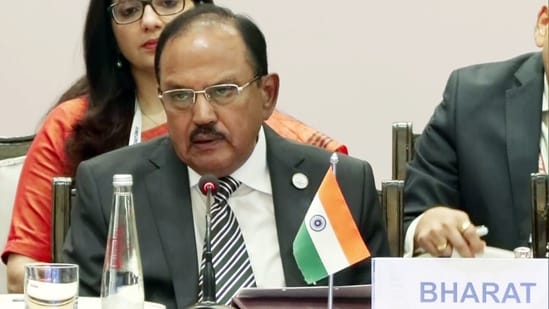
Doval is expected to meet his counterpart for the Special Representatives mechanism, Chinese foreign minister Wang Yi, on Tuesday, the people said on condition of anonymity. This will be the 25th round of talks under the mechanism, established in 2003 to work out a framework for resolving the dispute over the 3,488-km border.
Doval’s visit assumes greater significance as it comes ahead of Chinese President Xi Jinping’s expected trip to India next month to participate in the BRICS Summit in New Delhi. Though both sides have not made an official announcement in this regard, Xi is expected to join the summit to be held during September 12-13, the people said.
This will be Xi’s first visit to India in seven years. Prime Minister Narendra Modi and Xi last met in August 2025 on the margins of the Shanghai Cooperation Organisation Summit in China.
{{/usCountry}}This will be Xi’s first visit to India in seven years. Prime Minister Narendra Modi and Xi last met in August 2025 on the margins of the Shanghai Cooperation Organisation Summit in China.
{{/usCountry}}Also Read I However you measure it, China’s job market is weak
Talks against recent Arunachal Pradesh standoff
The talks between the Special Representatives is being held against the backdrop of a recent standoff between Indian and Chinese troops in the Arunachal Pradesh sector of the Line of Actual Control (LAC). External affairs minister S Jaishankar reiterated at a media conclave on Saturday that the state of the border will determine the course of the overall India-China relationship.
“I think we went through a particularly bad patch between the summer of 2020 and the autumn of 2024, and that was primarily an outcome of the situation in the border areas,” Jaishankar said, referring to a military face-off in the Ladakh sector of the LAC that lasted more than four years and took bilateral ties to a six-decade low.
After the two sides reached an understanding on ending the face-off in Ladakh in October 2024, Xi and Modi met in Russia and agreed on measures to normalise ties and address the border dispute. Though the two sides have taken steps such as reviving the Kailash Mansarovar Yatra, resuming direct flights and easing visa restrictions for Chinese nationals, there has been no forward movement on de-escalation on the LAC.
Also Read I A bolder India on China border
Last round of Special Representatives' talk
At the last round of Special Representatives’ talks in New Delhi a year ago, the two sides reiterated the “importance of maintaining peace and tranquillity” on the border to promote the overall development of ties.
According to an Indian readout issued at the time, the Special Representatives agreed on the need for a “political perspective” while working on a fair, reasonable and mutually acceptable framework for settling the boundary question in line with the Agreement on Political Parameters and Guiding Principles for Settlement of the India-China Boundary Question of 2005.
They also agreed to set up an expert group under the Working Mechanism for Consultation and Coordination (WMCC) on India-China Border Affairs to “explore early harvest in boundary delimitation”, and a working group under the WMCC to advance effective border management.
They further agreed to create general-level mechanisms in the eastern and middle sectors of the border, in addition to the existing general-level mechanism in the western sector.
Also Read I China to be India's main long-term competitor in multiple fields: Army ex-chief Naravane
There has been no word from both sides on what, if any, progress has been made on these matters.
The latest meeting of the WMCC, held in New Delhi on August 6, saw the two sides having detailed exchanges on “boundary delimitation, border management, mechanism‑building and trans‑border cooperation” as a follow-up to the last round of talks between the Special Representatives, according to an Indian readout.