Myadada Venkata Lakshmi, a 65-year-old agriculture labourer from Palwaigate village of Rentachintala block in Macherla assembly constituency of Palnadu district, is angry as she, like many others in her colony, could not cast her vote on the polling day on May 13.
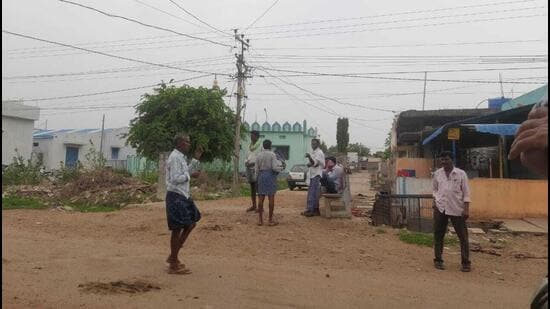
Venkata Lakshmi along with her neighbours had left In fact, early in the morning for polling station (No. 202) located in the government school, a few yards away from her house. But as soon as they approached the polling station, hundreds of people from the adjacent colony, weilding sticks and rods, stopped them and shouted at them for daring to enter the polling station.
“They abused us in foul language and threatened to smash our heads if we came anywhere near the polling station. Some men, who managed to stand in queue, were roughed up. They told us that our votes had already been polled,” she lamented, with a choked voice.
She did not disclose who “they” were, but she mentioned their caste, hinting that they were from Telugu Desam Party. “They captured the booth and polled all our votes,” she alleged.
A few hours later, local YSR Congress party MLA Pinnelli Ramakrishna Reddy arrived at the polling station, along with scores of his followers. The TDP workers resisted their entry, resulting in clashes between the two groups.
{{/usCountry}}A few hours later, local YSR Congress party MLA Pinnelli Ramakrishna Reddy arrived at the polling station, along with scores of his followers. The TDP workers resisted their entry, resulting in clashes between the two groups.
{{/usCountry}}Meanwhile, the MLA barged into the polling station, went straight to the electronic voting machine, banged it on the floor. He also pulled down the VVPAT machine and smashed it. A polling agent of the TDP Namburi Seshagiri Rao rushed towards the MLA and picked up a quarrel with him and his followers.
As the MLA left the place in a huff, his followers and the TDP workers clashed again, resulting in injuries to Seshagiri Rao.
On coming to know that the MLA came to the polling station, Venkata Lakshmi’s two sons – Anji Reddy and Venkat Reddy – rushed there to try their luck in casting their votes. But they were beaten black and blue. “What was their crime? Is exercising our votes a crime?” she asked.
According to her, at least 200 people from her colony were not allowed to vote. “There were only two policemen at the polling station and one of them received injuries. Everybody was silently watching the rigging,” she said.
A septuagenarian farmer Anki Reddy, who was silently observing her anguish, agreed with her. “This is the first time that I could not cast my vote. It’s unfortunate,” he said.
The situation was no different at Tumrukota village, about 10 km away from Palwaigate. This was the birthplace of dreaded Maoist party leader and central committee member Akkiraju Haragopal alias Ramakrishna (RK), who died of illness in 2021.
Subhan Khan (53), who runs a puncture shop in the village, said: “Except for some villagers who were lucky to cast their vote in the first one or two hours, nobody else, identified as a YSRCP sympathiser, was allowed to cast his or her vote. The local TDP leaders and their followers captured the booth and rigged the polling.”
He showed photos of how the TDP workers ransacked the houses and shops of the YSRCP workers on the polling day eve. “This is a TDP stronghold and there is no place for other party sympathisers,” Khan said.
Pichaiah, an agriculture labourer in the village, who was among the lucky few to have been able to cast their vote, said the clashes take place only during the election time. “After all, we belong to the same village and we have to live together,” he said.
The Palwaigate village incident caught the nationwide attention as the video of Ramakrishna Reddy smashing the EVM went viral on social media a week later. The Election Commission of India (ECI), which took serious note of the incident, directed the state police to file criminal cases against the MLA and arrest him.
The MLA was booked under sections 143 (unlawful assembly), 147 (rioting by use of force), 448 (criminal trespassing), 427 (mischief by causing damage), 353 (criminal force to assault a public servant), 452 (trespass to cause hurt and wrongfully restrain) and 120 (B) (criminal conspiracy) of the Indian Penal Code, besides Sections 131 and 135 of the Representation of the People Act, 1951, and Section 3 of the Prevention of Damage to Public Property (PDPP) Act, 1984.
Ramakrishna Reddy approached the high court and got a breather, as the court directed that no penal action should be taken against him till June 5. It also asked the MLA not to enter the Macherla constituency till the day of counting.
Palnadu and political factionalism
According to senior journalist Dasari Bhuvan, there are several villages in Palnadu district, which are divided on political lines. Like Palwaigate and Tumrukota, there are several other villages like Arigoppula, Bogila Veedu, Vyapakanpalli and Chintapalli, which are dominated by the TDP.
Villages like Kandlakunta, K P Gudem, Rentala, Lakshmidevipuram and Reddipalle, are the strongholds of the YSRCP. “There is no scope for the sympathisers of the rival parties to cast their votes. The booths are captured by the dominant parties and votes are polled unilaterally. Any resistance from the rival parties will result in brutal physical attacks and occasionally killings,” Bhuvan said.
In such villages, he pointed out, there are people who have not entered the polling stations for the last few decades. “However, in some areas like Veldurthy and Kambhampadu, besides Macherla town, where both the parties are strong, the polling goes on normally. But more often than not, they witness bloody clashes between both the sides,” he said.
Pavuluri Satish Babu, a political analyst from the region, says Palnadu witnesses a peculiar kind of factionalism, compared to Rayalaseema, which was notorious for factional killings till a couple of decades ago. In Rayalaseema, the factional feuds are between two influential families within a village or two landlords of adjacent villages. A faction leader in Rayalaseema would keep control of several villages, exploit the resources there – mining and agriculture lands and grab the contracts.
“For the Rayalaseema faction leaders, politics is just a cover-up and a shield to protect them from law. But in Palnadu, there is no such fight for resources or contracts. The factional feuds in this region are nothing but ego clashes, only to show their dominance within the village or in the area. Politics gives them power to wield their supremacy in the area and the dominance changes depending on the party in power,” Satish Babu said.
Even the followers of these faction leaders do not gain anything much monetarily. “They blindly follow their leaders and are ready to give their lives in violent clashes with their rival groups, just for nothing,” he said.
When a faction leader rules the roost in the village taking advantage of the political party in power, the rival group leaders and their followers desert the village for a few years. “Yet, their properties remain untouched. Their lands go barren, but are not encroached. Once their party comes to power, they will be back in their villages and drive away their opponents,” Satish Babu said.
For example, soon after the YSRCP led by Y S Jagan Mohan Reddy came to power in May 2019, hundreds of TDP leaders and their followers from Atmakur and surrounding villages in Palnadu deserted their houses and moved to makeshift camps in Guntur district. Some others even moved to Telangana, fearing attacks by the YSRCP cadre. The YSRCP leaders got elected unopposed in gram panchayat elections in 86 villages in 2021.
A few months before the May 13 assembly elections this year, the TDP leaders started returning to their native villages.
“There is no rhyme or reason for this animosity among the faction leaders in Palnadu except to display their authority or dominance in the villages. Even the people of this region have some kind of aggression in their blood. Maybe, they still have the genes of Palnadu warriors of 11th century, when this region witnessed a historic battle between cousins of two royal families on the lines of Mahabharata,” the analyst said.
For those who are not aware of the history of Palnati Yuddham (the great battle of Palnadu), it was a war between two Haihaya kings of neighbouring villages – Nalagama Raju of Gurajala and Malideva Raju of Macherla, who were cousins, but were divided for power.
If it was loss in the gambling that led to Pandavas to go into exile in Mahabharata, it was cockfight which forced Malideva Raju to go into exile for seven years. When he staked claim for his land after his return from exile, Nalagama Raju rejected it and it led to the bloody war that caused huge loss of lives on both sides.
The statues of heroes of the Palnadu Battle are lined on the streets of Macherla town, as a mark of “pourusham” (aggression) which is reflected in the factional feuds of the region.
According to Gadde Srinivas alias Chinni, a local entrepreneur, the factional feuds of Palnadu, which used to witness bloody murders a few decades ago, had actually come down after 2001, when it witnessed the killing of seven Congress workers at Veldurthy, allegedly at the behest of TDP leader Julakanti Brahma Reddy, son of then TDP MLA Julakanti Durgamba.
“After the incident, TDP president and then chief minister N Chandrababu Naidu suspended Brahma Reddy from the party. The latter deserted Palnadu and left for Guntur, where he lived an ordinary life for almost two decades. This brought factional feuds under control to a large extent,” Chinni said.
Besides, the Maoists of the erstwhile CPI (ML) People’s War Group, who were ruling the roost in the adjacent Nallamala forest range. “They played a major in controlling the factionism in Palnadu. They drove away the faction leaders, mostly from TDP, to the other parts of Andhra,” he said.
As a result, Macherla and surrounding areas of Palnadu, have become Congress strongholds gradually, as the Naxalism was crushed with iron hand by the then Y S Rajasekhar Reddy government. Since the bifurcation of the combined AP in 2014, the YSRCP has been dominating the areas.
The factional feuds began surfacing after the YSRCP came to power in the state, as the party leaders have started crushing the TDP. According to official figures, the political violence in Macherla alone claimed at least 10 lives since 2019, and many pro-TDP families were forced to flee the area.
The TDP had no option but to bring back Julakanti Brahma Reddy back into action to counter the aggression of Ramakrishna Reddy and other YSRCP leaders in the area. “This has led to fresh bout of factional violence, which was reflected in the recent elections,” Bhuvan said.