Around 39 per cent of all job card-holding households interested in working under the MNREGA scheme did not get a single day of work in the Covid pandemic year 2020-21, according to a survey.
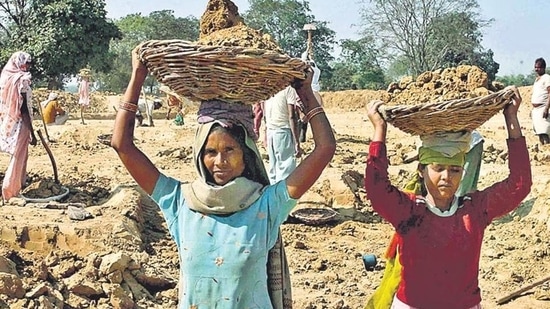
On average, only 36 per cent of the households that worked received their wages in 15 days, showed the survey of 2,000 households across eight blocks in four states conducted by Azim Premji University in partnership with the National Consortium of Civil Society Organisations on NREGA and Collaborative Research and Dissemination (CORD).
The survey was conducted in November-December 2021 in Phulparas (Madhubani) and Chhatapur blocks (Supaul) in Bihar, Bidar (Bidar) and Devadurga (Raichur) in Karnataka, Khalwa (Khandwa) and Ghatigaon (Gwalior) in Madhya Pradesh, and Wardha and Surgana (Nashik) in Maharashtra.
"Across all blocks, roughly 39 per cent of all the job card-holding households interested in working in MGNREGA in the Covid year could not get a single day of work while they wanted 77 days of work on average.
"Among households that found some work, the unmet demand (difference between the number of days desired and the number of days of work received) across all blocks was 64 days," the report stated.
{{/usCountry}}"Among households that found some work, the unmet demand (difference between the number of days desired and the number of days of work received) across all blocks was 64 days," the report stated.
{{/usCountry}}"The most frequently mentioned reason for not getting as much work as needed, across all blocks, was the lack of adequate work being sanctioned or opened. On average, 63 per cent of all job card-holding households cited this reason in the surveyed blocks," it added.
Despite these shortcomings, the survey found, the Mahatma Gandhi National Rural Employment Guarantee Act made a marked difference during the pandemic, protecting the most vulnerable households from significant loss of income.
Increased earnings from MGNREGA were able to compensate for somewhere between 20 to 80 per cent of the income loss depending on the block, it stated.
"Our study shows how much the workers value the need and utility of MGNREGA. More than eight out of 10 households recommended that MGNREGA should provide 100 days of employment per person per year.
"We also found a massive extent of underfunding. A conservative estimate yields that the allocations in the surveyed blocks should have been three times the amount that was actually allocated in the year after lockdown to fulfil the true extent of work demand," said Rajendran Narayanan, co-author of the study and faculty member at Azim Premji University.
Ashwini Kulkarni of the NREGA Consortium said one of the objectives of MGNREGA is to act as a social protection measure during times of distress.
"Covid pandemic, lockdown created unprecedented distress and MGNREGA, as expected, rose to the need and provided work for many more villages and many more households than in the preceding years. MGNREGA's role in reducing vulnerability has been re-emphasised and continues to be of vital importance in post-pandemic times," he said.