When the World Health Organization (WHO) recently awarded India’s Accredited Social Health Activists (ASHAs) for their outstanding services, it was an opportunity for the representatives of the 1.4 million odd workforce driving the country’s public health services to remind the government of their long-standing demands to provide better remuneration, regularisation of work and social security.
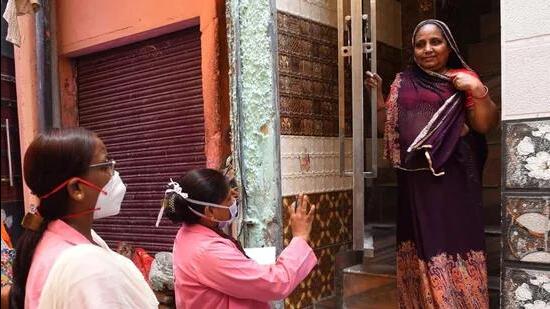
Raising these demands, ASHAs have held several protests across the country over time, with most recent ones being in states such as Maharashtra, Andhra Pradesh, Haryana and Karnataka.
In a written response to the WHO award announcement, the union of Delhi ASHA workers’ association said, “… Delhi ASHA workers’ association union welcomes WHO’s move, and offers heartfelt gratitude for the award. Irony, however, is that while the world has acknowledged our efforts, our very own governments do not admit our contribution. As a result, despite our immense hard work that includes also putting our lives at risk while performing Covid-related duties, there has not been an increase in the remuneration. Turning a blind eye towards such abysmally low payment is wrong and unethical.”
Who are ASHAs?
{{/usCountry}}Who are ASHAs?
{{/usCountry}}Under the central government’s National Health Mission, ASHAs act as a crucial link between the community and the public health system. ASHAs came into being in 2005, when the government created this workforce to reach out to the target population within communities for delivery of its key programme largely related to reproductive and child health. As per the National Health Mission guidelines, ASHA is a literate woman resident of the village it is assigned, usually in the age group of 25 to 45 years.
The pay
ASHAs mostly are not paid a fixed monthly salary; rather they are given an honorarium and programme-based incentives, both by the Centre and respective state governments.
In September, 2018, Prime minister Narendra Modi announced, what the government called, ‘a landmark increase’ in their honorarium. Modi announced the doubling of routine incentives given by the Union government to ASHA workers. In addition, all ASHA workers and their helpers would be provided free insurance cover under Pradhan Mantri Jeevan Jyoti Bima Yojana and Prime Minister Suraksha Bima Yojana, the PM announced. From October 2018 onwards, for certain routine and recurring activities, ASHAs were paid ₹2000, from ₹1000 per month. Additional ₹1000 per month is being paid to them for performing Covid-related work since the start of the pandemic.
“Under the National Health Mission, ASHAs are envisaged to be community health volunteers and are entitled to task/activity based incentives. However, in view of the significant contribution towards the COVID-19 pandemic related work by ASHAs, States were advised to pay an additional incentive of Rs.1000/- per month for those ASHAs engaged in COVID-19 related work using the resources of COVID-19 Health System Preparedness and Emergency Response Package,” said ministry of women and child development in a statement in March, this year.
“Provisions are also made for continued full payment of the existing Routine and Recurring Incentive of Rs. 2000 per month to ASHAs to ensure delivery of essential health services during the pandemic along with additional COVID-19 incentives for ASHAs,” it added.
The work
ASHAs undertake a range of community-based interventions that include visiting assigned households with pregnant women, newborns, mothers, children, eligible couples and those with chronic communicable and non-communicable diseases. They look after those individuals requiring treatment for tuberculosis, leprosy, hypertension or diabetes. With the pandemic disrupting health care delivery system, ASHAs were also tasked with delivering medicines at home for chronic communicable and non-communicable diseases, undertaking home visits to elderly, ensuring that those on dialysis or requiring blood transfusions etc. are facilitated to access such services during the period of lockdown or restrictions. In addition, these workers were also given the responsibility of community-based interventions related to containment of Covid-19 spread including home visits for awareness generation and checking on cases in isolation, contact tracing and facilitating Covid-19 testing. They were also assigned the task of generating awareness among masses with regards to taking vaccine against Covid-19.
The problem
According to government guidelines, ASHAs were supposed to be honorary volunteers and would not receive any salary or honorarium. Her work would be so tailored that it does not interfere with her normal livelihood. They were to have a flexible work schedule and the workload would be limited to putting in only about two-three hours per day, on about four days per week mostly. This, however, does not hold true for their current work arrangement as most ASHAs do not have any other sources of livelihood and they end up spending at least 6-8 hours in a day. Therefore, in need of a revision to their remuneration but not getting it as by definition they essentially are volunteers and not really workers.
“ASHA workers are predominantly women from marginalised backgrounds who are expected to work for minuscule allowances, not wages. The idea that they should work without living wages is built around the gendered assumption that women will naturally contribute unpaid labour caring for communities. ASHAs are doing their job at the expense of their own welfare, livelihoods and insecure futures. The best reward they could receive is to be recognised as public health workers and paid accordingly,” said Kate Lappin, the Regional Secretary for Asia and Pacific at Public Services International, in a statement.
With rising costs and increasingly market-driven economies, the honorarium is far below the living wage calculated around USD 3500-4000 per year as opposed to around USD 500-800 per year that they get, according to the organisation.
The solution
Experts say there is a need to revisit the role and remuneration of ASHAs.
“We need a very serious revision of the ASHAs’ situation— needing a career path as well as financial security for them,” said Poonam Muttreja, executive director, Population Foundation of India.
“Improvement in health indicators that we laud— be it maternal mortality rate or infant mortality rate— it’s the ASHAs who are to be credited in a significant way for it, and what are we providing them in return. Even the incentives are not being paid in time many a time,” she said, adding, “they are overtly overburdened; therefore, there’s a need to rationalise their responsibility. We need to review, recognise and reward them.”
‘We are doing our best, despite challenges’: Ringchamliu, Manipur
Even though the Covid-19 situation has improved in Manipur, ASHAs continue with their usual workloads in their assigned localities and villages with or without getting the minimum wages.
“We are still working in our assigned areas,” Ringchamliu, an Asha worker in Azuram village in Manipur said. “On Thursday, we organised village health, sanitation and nutrition day.”
Azuram village in Tamenglong district became the first village in Manipur to get all eligible residents vaccinated with Covid-19 vaccines in July 2021. As per the latest update of the health department on vaccination, 28,86,838 doses including first dose of 15,67,518, second dose of 12,24,619 and precautionary dose of 94,701, have been administered in Manipur.
Regarding the pending wages and incentives, she said ASHA workers are yet to get incentives for work done for HBNC (home based new-born care), JSY (Janani suraksha yojana) visits besides incentives for monthly routine activities.
Asha workers in Manipur are getting an average of ₹1,500 to ₹2,000 as performance linked incentive in a month. They are also entitled to get ₹600 for visiting pregnant women plus another ₹250 for HBNC (minimum 5 visits).
On the daily working hours, Ringchamliu who has been working as an ASHA since 2007, said that she somehow manages time for family and the work assigned besides other social services too.
“I think it will be good if the pending incentives are given timely to ease our grievances,” says the 37-year-old who is also a mother of five children.
She said that working in a hill village is a challenging task for an ASHA unlike those working in the valley areas of the state. “The villagers call us anytime of the day or night for all their health-related issues,” she said.
“Despite the challenges that we face due to lack of incentives and ununiform work hours, we’re doing our best.”
It may be mentioned that the All-Manipur Asha Workers’ Union have been demanding regularisation of the scheme, besides increasing their honorariums in the state.
There are 4,004 ASHA workers including 3,928 in the rural and 81 in urban areas. Churachandpur district (549) has the maximum number of ASHA workers while Jiribam (57) has the minimum.
‘Two years of Covid-19 pandemic most challenging’: Beizono Neihu, Nagaland
In Nagaland’s Kigwema village, 44 years-old Beizono Neihu who has been working as an ASHA for the last eight years, says the past two years of Covid-19 pandemic have been most challenging in carrying out her duties, since ASHA workers are required to visit door-to-door as the first-contact healthcare source in their designated areas.
“During the successive lockdown periods, it was very difficult for us (ASHAs) to go door-to-door as people were anxious about letting others visit. But it was during that time that our role became more critical as we had to also educate the people how important it is for all to maintain Covid-appropriate behaviour and the importance of getting vaccinated,” she said.
Talking about her routine work, Neihu maintains that although ASHAs are meagerly paid which is not enough to get by most months, she is passionate about the work that she does. A single-parent to her son who is now studying in Class 10, she draws a fixed salary of ₹2,000 per month alongside incentives that vary from ₹200 to ₹300 during vaccination drives and for facilitating maternal healthcare. “We are very lowly paid and when we fail to attend work-related meetings even when there are family emergencies, ₹200 to ₹300 is deducted from our salary again,” Neihu says.
She visits around 800 households in her designated area in the village to carry out her duties. As for her working hours, she said she puts in five to six hours a day.
“With most of the villagers engaged in agriculture and other occupations which require them to be away during the day time, I visit them early in the morning and late afternoon/evenings,” she explained. On the response of the villagers to ASHA workers’ visits, she says most of the time it is the uneducated villagers who are more responsive and open to answering questions for government surveys and eager to know about healthcare programmes.
“The biggest challenge in my work, for me, is dealing with a lot of paperwork because I am not very adept in that aspect but thankfully, I have managed so far. Approaching an educated person’s home is another testing task for us. Not all of them, but some are very impatient, suspicious and guarded, and they tend to find our visits a hassle,” Neihu said, further throwing light on how thankless the work of ASHAs is, whose sole objective is to ensure that the community has access to primary healthcare services. Despite these various challenges, she says she enjoys her work.
“I applied to become an ASHA in 2014. Someone from my village told me that there was a spot left (vacancy) which was yet to be filled, so I thought ‘why not?’, it could be an opportunity for me to help my villagers and also learn about grassroots healthcare services. I have studied only up to ninth standard but fortunately I got selected. Today, I am glad to be serving my people,” she added.
The Kimipfuphe Primary Health Centre (PHC) in Kigwema with which she is attached, awarded Neihu as the Best ASHA of the PHC in 2020.
‘Stood guard to dead bodies several times’: Raji Mol, Kerala
Raji Mol, 33, had to walk alone in the night to attend desperate calls and she stood guard to dead bodies several times at the height of Covid-19 pandemic. An Asha worker specially recruited during Covid-19 days in Thiruvananthapuram, the state capital of Kerala, she used to get back to her house only after ensuring that all her three children (aged 14, 12 and 7 years) were slept so as to avoid any contact with them those days.
The first call of point in Covid days, she used to persuade people to get examined if they develop fever and other symptoms but when she was down with fever during the second round she could not even go to test.
She was forced to take five days leave and bounced back to her routine in no time.
“Since I know symptoms well, I got myself isolated and took medicines for high fever and headache. Symptoms subsided in three days and since I was not having any other major health issues I recovered fast and joined my duty,” she said. She was born and brought up in Rajaji Colony (formerly known as Chenkalchoola), a resettlement area in the heart of the city, populated mainly by poor and marginalised people.
Doing domestic chores in many houses for additional income, she and her husband, also a daily-wage labourer, were without any job during the initial days of the pandemic and later she took up ASHA worker’s role with the help of a local body member.
“One full night I was with the body of a middle-aged man in a house since no ambulances were around. Initially it was terrifying but later I came around. Affected and isolated, people see us with a ray of hope. So, it is our duty to rise up to the occasion,” she said adding in her colony of 750 single and double room flats, eight deaths took place in the second round of pandemic.
She said her normal day starts at 5am and she has to prepare food and complete her domestic chores before leaving for work. “Once I am in the field I literally forget about my personal woes and problems. On an average I visit 40 houses and talk to inhabitants and note down their problems and health status,” she said. Besides the regular visit of the households, she also has to attend regular meetings of health workers and provide feedback to them about the health status of the people around.
She said she gets ₹6,000 a month as an honorarium but this payment was also erratic and now, she has to get two months dues. “We need some health cover and protection. We often talk regularly to our people to maintain their health and we monitor them. But nobody is there to monitor our health and working conditions,” she said.
With pandemic clouds receded, she regularly checks immunisation schedules of the newly-born, ensures iron tablets to pregnant women, supply medicine to TB and other chronic patients. She also keeps an eye on migrant workers living in her area and examines their standard of living. Studied till Class 12, she regularly browses through newspapers of the day to keep herself abreast with things happening around the world.
“We are proud that the WHO lauded the initiative of of the nameless workers like us. We need better remuneration, safety guarantees and working conditions. With our feet always on the ground I am sure we can deliver more,” she said, adding, now the government is doing many surveys through them. Recently the state government launched an app for diagnosing and controlling lifestyle diseases with their help in the state.
‘Proud to be an ASHA worker but earnings are demotivating’: Netradipa Patil, Mumbai
Netradipa Patil, 46 aspired to become a gynaecologist when she was young. While the circumstances in her family did not allow her to pursue medical education, Patil eagerly applied for the position of an ASHA in 2009 when she heard of the opening. “I could not become a doctor, but I could still work in public health as an ASHA worker,” said Patil, a resident of Shirol village in Kolhapur. She is among the 29 ASHAs working in Shirol that has a population of around 36,000 people. Patil alone is responsible for a population of around 1,000.
“The workload is very high now, and the earnings are little,” said Patil. “But it’s the satisfaction of saving lives, and guiding people to improve their health that keeps me going. The villagers have immense respect for us,” she said.
Born in Goa, Patil was married in 1991 at the age of 16 after which she moved to Shirol. She continued her studies after marriage and obtained an MA in Economics in 1998. The mother of two, a 26-year-old daughter and 22-year-old son, Patil often draws from her personal experiences when she is in the field working on maternal mortality and infant mortality programmes.
“Childhood marriages are still a reality in rural areas. I try to do as much as possible to spread awareness and discourage parents from marrying off their daughters early,” said Patil, who spends morning and evening hours visiting households and interacting with the villagers. Her mobile phone rings constantly, with queries about immunisation, requests for assisting a patient or simply accompanying a pregnant woman to the hospital.
“My day starts with phone calls at 7.30am. At times, I get calls even after midnight for medical emergencies,” said Patil, adding that on most days she works for nearly 10 hours. “When I joined in 2009, ASHAs were part of only five programmes like immunisation, reducing maternal mortality, promoting institutional delivery etc. Today, we are part of 74 different programmes and health indicators including the surveillance for non-communicable diseases such as diabetes and cancers, tuberculosis, leprosy, mosquito borne diseases etc. Covid-19 contact tracing and immunisation work are the latest additions,” she said.
Every morning, Patil prepares a micro plan for the day. It contains details of the households she has to visit for surveys or awareness, mobilising the population under her for routine immunisation or directing them to health camps that may be underway and following up on the pending work from the previous days.
Patil earns around ₹8,000, which includes the honorarium from the state and the Centre and programme-based incentives. “The money is too little for the efforts that we have to put in every day,” said Patil who believes that the state should offer a minimum wage of ₹18,000 to the ASHAs. “I am proud to be an ASHA worker but the earnings are demotivating,” said Patil.
I walk at least 5 km every day to meet women: Kamlesh Yadav, Lucknow
The day begins at 5am for Kamlesh Yadav, 46, and for the next three hours the woman tackles the work in her house: cleaning the 700-sq-foot rented accommodation, cooking for herself and her family of three others etc.
At 9am, she dons the avatar of an ASHA, taking the responsibility of around 3,000 residents in her work area.
“Life isn’t easy. Working every day as an ASHA for hours, interacting with people, making them aware about health schemes and convincing them to avail a scheme, is a demanding job profile,” said Kamlesh, who lives with her husband, who retired from the army, and two sons studying for their graduation degree.
“Two days, Wednesday and Saturday, are dedicated to routine immunisation of children and I have to make sure no child is left out,” she said. She maintains a record of children vaccinated for each of the house that she visits at least once a week.
“I have to walk at least 5 km every day to meet women. Going from one house to another and one lane to another to check on them and tell them about the different programmes that they can benefit from,” she said; her register is filled with schedules for different programmes.
Kamlesh has to expedite different programmes such as polio, leprosy, tuberculosis, Mission Indradhanush (routine immunisation of children who missed it), coordinate Covid-19 vaccinations for adults and children, and the latest addition is the Filaria control programme.
“For each day, the activity/programme comes to us a day before and we make people aware about it,” said Kamlesh, who returns back home after 4am. Kamlesh has been working with the health department since 2011.
“Under the malaria programme, we are supposed to make slides with blood samples of 3 to 4 people in a week. They are tested in a lab and the report has to be shared with the people of whose blood I make the slides,” said Kamlesh, who recently trained to make slides. For each new programme or an upgrade in any existing programme, a training session becomes a must.
“The schedule is such that often I eat my tiffin while in the vehicle moving from a training session to field work. When I can afford it, I eat lunch with the community people,” she said.
Kamlesh is happy with her achievements in the field, but isn’t happy with what she gets in return. “I get the greatest satisfaction from my work as I save lives, help people in treatment and ensure the health of children but what I get in return isn’t enough. The honorarium is ₹3,000 per month, and for each programme, I get a daily honorarium. But this does not suffice my financial needs as clubbing my earnings with my husband’s pension isn’t good for living in the state capital, Patna” she pointed out.
(With inputs from Sobhapati Samom, Alice Yhoshu , Ramesh Babu, Jyoti Shelar and Gaurav Saigal)