New Delhi: Bangladesh will give priority to the protection and security of the country’s Hindus and other minorities, interim government head Muhammad Yunus on Friday told Prime Minister Narendra Modi, who had expressed concern about the safety of these communities in his Independence Day speech.
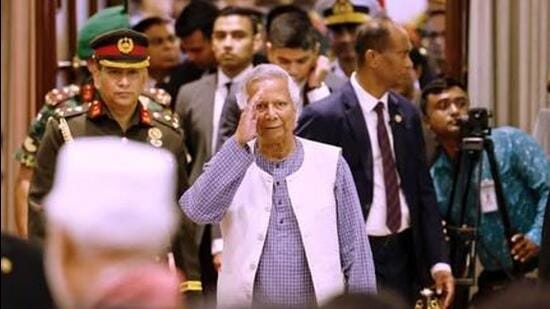
Modi conveyed India’s support for a democratic and stable Bangladesh during a phone conversation with Nobel laureate Yunus, who took over as head of the interim government in Dhaka last week after the sudden collapse of former premier Sheikh Hasina’s administration following weeks of student-led protests. The two leaders also discussed ways to take forward bilateral relations in line with national priorities.
In his Independence Day speech on Thursday, Modi expressed concern over the security of Hindus and other minorities in Bangladesh and hoped the situation in the neighbouring country would become normal soon. During Friday’s phone call, Modi again pointed to the importance of ensuring the protection of Hindus and other minorities in Bangladesh, the external affairs ministry said in a readout.
Yunus gave an assurance the interim government “would prioritise the protection, safety, and security of Hindus and all minority groups in Bangladesh,” the readout said.
{{/usCountry}}Yunus gave an assurance the interim government “would prioritise the protection, safety, and security of Hindus and all minority groups in Bangladesh,” the readout said.
{{/usCountry}}Modi expressed India’s support for a “democratic, stable, peaceful, and progressive” Bangladesh and emphasised New Delhi’s commitment to support the Bangladeshi people through development initiatives.
Following the fall of Hasina’s government, there were reports of attacks on the homes, businesses, and temples of the Hindu minority in different parts of Bangladesh.
A post on X by Yunus’s office quoted him as telling Modi that the interim government is “committed to safeguarding every citizen of the country, including the minorities.” Yunus said reports of attacks on minorities “have been exaggerated” and Indian journalists could visit Bangladesh to “report from the ground on the issues of minority protection.”.
The situation in Bangladesh “has been brought under control, and life is becoming normal across the country,” Yunus said.
Also Read: Who is Muhammad Yunus, the Nobel laureate set to head Bangladesh’s interim govt?
Yunus said his interim government had taken over as a result of the students’ movement, which was a “second revolution” for Bangladesh, and his government will fulfill the democratic aspirations of the students and people.
He thanked Modi for the phone call and his post on X on August 8, immediately after he was sworn in as head of the interim government. Yunus’s office quoted Modi as praising the leadership of the 2006 Nobel Peace Laureate and saying that Yunus has “long experience and his leadership will bring good to the people of Bangladesh.”
Modi expressed his desire to work with Bangladesh “for the benefit of people as close friends” and his desire to work with the Yunus-led interim government. Yunus accepted Modi’s invitation to participate in the third Voice of Global South Summit to be hosted virtually by New Delhi on Saturday.
Meanwhile, external affairs ministry spokesperson Randhir Jaiswal told a regular media briefing that there was no update on the travel plans of Hasina, who fled to India after stepping down on August 5 in the face of massive demonstrations across Bangladesh.
Jaiswal described a question about the possibility of Bangladesh seeking Hasina’s extradition following several cases against her as “hypothetical.” He added, “It is not our practice to answer hypothetical questions at this point in time.”
He reiterated that India had granted approval to Hasina to come to the country at short notice. “The situation is still evolving. At this stage, we have nothing new to share about her plans,” he said.
India is talking to Bangladesh’s interim government to work together for the interests and aspirations of the people of the two countries and to strengthen peace, security, and progress of the two sides, Jaiswal said.