
 E-Paper



Bengal cabinet nod to set up Vidhan Parishad
Bengal has 294 assembly seats. Since the strength of a Vidhan Parishad cannot be more than a third of the legislative assembly, the state can have a maximum of 98 members in the legislative council.


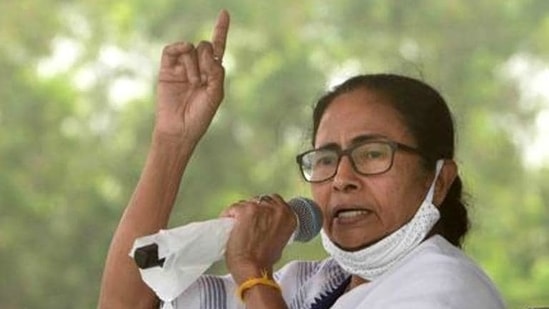
Barely 12 days after being sworn in as the chief minister of West Bengal for the third time, Mamata Banerjee on Monday cleared a cabinet decision to form Vidhan Parishad, or Legislative Council, in the state, which she had promised before the polls. Banerjee had said that eminent people and veteran leaders who were not nominated for the assembly elections would be made members of the Vidhan Parishad, the Upper House of the state legislature.
Bengal has 294 assembly seats. Since the strength of a Vidhan Parishad cannot be more than a third of the legislative assembly, the state can have a maximum of 98 members in the legislative council.
The chief minister’s decision has been questioned by political experts and Left leaders who see this as a pointless exercise, which will add to the burden on the state exchequer.
Incidentally, Banerjee, who lost her election from Nandigram, and Amit Mitra, who has become finance minister without contesting the polls, have to get elected to the House within six months. Since Vidhan Parishad members can become ministers, Mitra is likely to be inducted in the Upper House, said Trinamool Congress (TMC) leaders aware of the development.
Also Read| Videos, witnesses in Narada case show 4 TMC leaders took cash: CBI sleuths
At a virtual meeting of the state cabinet, which took while two senior ministers and a legislator were in the custody of the Central Bureau of Investigation (CBI) in the Narada sting operation case and Bengal was witnessing demonstrations, Banerjee told senior bureaucrats, who also attended the meeting, to expeditiously prepare a draft bill. TMC leaders said that with two-third majority in the assembly, the party can easily pass a resolution.
Only six states - Andhra Pradesh, Karnataka, Telangana, Bihar, Uttar Pradesh and Maharashtra - have legislative councils right now.
Dr Bidhan Chandra Roy, Bengal’s first chief minister after Independence, formed the Vidhan Parishad in 1952 and it continued till 1969 when the second United Front government abolished the Upper House by passing a Bill.
Vidhan Parishad members are elected by civic body members and elected legislators. The governor can nominate some members as well. Bengal’s last Vidhan Parishad had 75 members, of whom nine were nominated by the governor.
The Bharatiya Janata Party (BJP), which has only 75 MLAs in the Bengal assembly against the TMC’s 213, did not react to the development. The Left parties, which, like the Congress, did not win any seat, opposed the idea.
“According to Article 169 of the Constitution, the Parliament has to pass a bill for creation of Vidhan Parishad and the President’s assent is also mandatory,” said Rabin Deb, a CPI(M) central committee member who served as chief whip of the Bengal assembly during the Left Front rule.
Deb argued that Banerjee and Mitra can easily contest any two of the five seats where polls will be held. Two seats in Cooch Behar and Nadia districts are vacant as the winning BJP candidates resigned to retain their Lok Sabha seats. Two candidates at two seats in Murshidabad district died of Covid-19 before the elections were held and the TMC’s winning candidate at Khardah in North 24 Pargans died of Covid-19. Mitra, incidentally, had won from Khardah in the last two polls.
Also Read| Calcutta HC sends TMC leaders to jail after CBI cites Mamata Banerjee’s dharna
“There is no need to form the Vidhan Parishad. The chief minister simply wants to accommodate more people and add to the state’s financial burden. It is another dole. Vidhan Parishad members get the same salary and perks as MLAs elected by people. Like the Rajya Sabha, a Vidhan Parishad also has a chairman and deputy chairman,” said Deb.
“Right now, our priority is to save our supporters from post-poll violence. Our party has not discussed this issue yet,” said Bengal BJP’s chief spokesperson Samik Bhattacharya.
Forward Bloc, the party freedom fighter Subhas Chandra Bose formed in 1939 after quitting the Congress and which is a part of the Left Front, is opposed to formation of the Vidhan Parishad right now.
“We are not opposed to the idea in principle but why do it in such a hurry? The Covid pandemic has affected the state’s economy is a big way. People need the government’s support. Why should taxpayers’ money be spent on Vidhan Parishad members? The last Vidhan Parishad was dissolved because it had outlived its purpose and become an easy way out for people who did not want to contest polls,” said Naren Chatterjee, state secretary of the Forward Bloc.
Amal Kumar Mukherjee, veteran political scientist and former principal of Presidency College, said, “The legislative council has practically no relevance in legislative procedure.”
“The council’s power is very limited. During Bidhan Roy’s tenure, members of the legislative council were chosen on the basis of their great achievements. For example, the great linguist Suniti Kumar Chatterjee was made the chairman of the council. Gone are those days. Now, everything is determined by politics. I don’t think there is any necessity for a legislative council because it will only agree to whatever is decided by the assembly. Further, it will add a tremendous expenditure. The government, however, cannot form it unless the Parliament gives its consent,” said Mukherjee.
Deb said Banerjee first came up with the idea in 2011 after ousting the Left Front government but backed out on the face of opposition from other parties.


