An unusual black powder and chunks suspected to be coal particles have begun washing up along beaches in Goa leading to speculation that imported coal that is being handled at Mormugao Port was making its way to the state’s beaches.
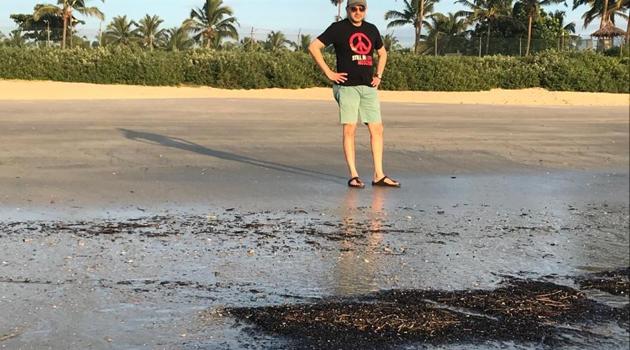
Two separate instances of the dark particles were found -- in South Goa along the Benaulim beach by fishermen and water sports operators as well as in Querim beach in North Goa by environmental campaigner Claude Alvares who held up chunks of a black solid that resembled coal.
“We noticed it yesterday for the first time, the black particulate matter that was different from the tar balls,” Pele Fernandes, a water sports operator from Benaulim beach, said.
“A few tourists were asking me what it is and I had to say I don’t know even though I suspected it was coal because I feared that they may not visit the beach again,” Fernandes said.
Speaking of his find, the Director of Goa Foundation Claude Alvares said that the coal washing up along Goa’s beaches was “only because the loading and unloading operations at MPT are still very primitive.”
The news comes even as protests across Goa have intensified against a railway line double tracking that is believed will only be used to transport more coal from the port to the hinterland.
{{/usCountry}}The news comes even as protests across Goa have intensified against a railway line double tracking that is believed will only be used to transport more coal from the port to the hinterland.
{{/usCountry}}At its peak around 12-14 million metric tons of coal was imported from Indonesia and Australia via Mormugao Port which has since reduced to around 9-10 million metric tons of coal this year. The coal is loaded and unloaded from ships in the open air allowing coal dust to be carried away by the wind into the surrounding Vasco da Gama town and into the water bodies including the sea.
Earlier, a study published in 2019 by researchers at IIT-Kharagpur and the National Institute of Oceanography in Goa who were studying the presence of mercury in the waters of Goa had found a “dark black powder from the adjacent beaches of the Mandovi river” in which the concentration of mercury in this black powder was found to be 200.5 ± 5.0 microgram per kg, which they said could explain the higher concentration of mercury in the waters of the Mandovi, which was similar to the concentration of mercury in the coal obtained from the Mormugao Port.
“The physical appearance of the black powder looked very similar to that of the fine particles of coal. The scanning electron microscope images also support that the black powder was coal particles. However, further investigation is required to identify the sources of this fine black particle associated with high concentration of Hg,” the study noted.
The Goa government has publicly pledged to reduce coal imports with chief minister Pramod Sawant assuring that the state will not be allowed to turn into a ‘coal hub’ for import of coal for steel industries in neighbouring states.
“I assure you coal import and handling will drop by 50 per cent. We will reduce coal and are in the process of stopping it as soon as possible. We cannot stop it altogether. Industries are on (have been running) for 40 years,” Sawant had said on Sunday.