The Border Security Force’s (BSF) newly launched School of Drone Warfare is shaping India’s strategy for future conflicts at the border, training drone warriors and drone commandos in mission mode to enhance the nation’s ability to tackle aerial threats.
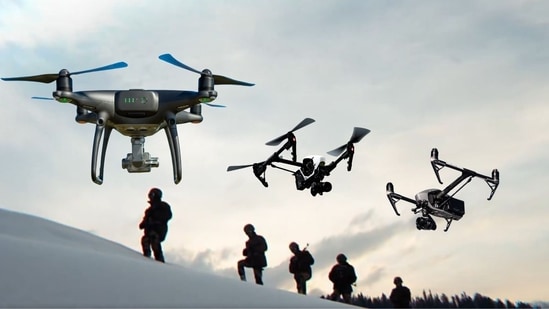
Aimed at enhancing India’s tactical and technological capacity against new-age warfare, particularly in the wake of Operation Sindoor, the facility is training BSF personnel in drone operations, including piloting, surveillance and reconnaissance, tracking, jamming, neutralising hostile unarmed aerial vehicles (UAVs), AI-based tracking, and dropping explosive payload on enemies in case of conflicts.
Inaugurated by BSF director general (DG) Daljit Chawdhary on September 2 at the Officer’s Academy in Tekanpur near Gwalior in Madhya Pradesh, the school aims to train at least 500 drone commandos and warriors (around 10-12 batches) in a year. HT had reported in July that BSF is creating “drone squadrons” at the western border.
The first batch of 42 drone warriors –– officers who will further educate their subordinates –– has already completed a training course at the school and gone back to their respective battalions on the India-Pakistan border. A batch of drone commandos is currently undergoing an eight-week training at the facility.
“As we saw during Operation Sindoor, the threat has evolved from boots on the ground to drones. The School of Drone Warfare is an answer to this threat. We are training jawans who will run all the operations on the ground as drone commandos and officers who will plan, execute the strategy as drone warriors,” BSF Academy director Shamsher Singh told HT during a visit at the training facility on Saturday.
{{/usCountry}}“As we saw during Operation Sindoor, the threat has evolved from boots on the ground to drones. The School of Drone Warfare is an answer to this threat. We are training jawans who will run all the operations on the ground as drone commandos and officers who will plan, execute the strategy as drone warriors,” BSF Academy director Shamsher Singh told HT during a visit at the training facility on Saturday.
{{/usCountry}}Singh added that the BSF’s training curriculum has also been updated “by making drone warfare as a mandatory subject for everyone, from officers to jawans, during their (regular) training as well”.
The school, granted initial funding of ₹20 crore, is equipped with simulators and live drone flying zones, facilities for payload integration in UAVs and night operations, tools for radio frequency (RF) jammers and kinetic interceptors, apart from linked hardware and Artificial Intelligence (AI) tools.
A trainer at the school, a BSF officer speaking on anonymity, said, “Not only are we training personnel to operate drones, but they are being taught how to interpret drone data, understand radio frequencies, conduct field forensics after a drone is brought down.”
The school, according to Singh, is studying the pattern and drone use by various countries including Pakistan, Iran, China, Israel, Ukraine, Russia, etc in the last two-three decades.
The school is collaborating with BSF’s Rustamji Institute of Technology (RJIT), various Indian Institute of Technology (IITs), academia, private companies, other security agencies and public sector organisations involved in manufacturing drone-related products.
The BSF has also created a police technology innovation centre at the Academy which has its own expert officers, industries, startups, academicians and innovators, to find solutions to emerging challenges in the internal security domain, including drones or UAVs.
Singh said, “We have already gathered a problem statement from all our frontiers, including Pakistan border to Left-Wing Extremism (LWE) affected areas. As many as 48 problems have been identified for which we are working to find viable solutions.”
The border guarding force, along with the ministry of home affairs (MHA), also interacted with units, local residents and sister agencies posted in sensitive sectors like Jammu, Punjab and Rajasthan to understand the issues during conflicts like Operation Sindoor. The list of concerns range from bunkers for civilians, availability of weapons, to communication channels with civilian authorities, among others, according to an officer, who asked not to be named.
In response to the Pahalgam terror attack, India launched Operation Sindoor on May 7 and struck terror and military installations in Pakistan and Pakistan-occupied Kashmir (PoK) following the April 22 Pahalgam terror strike in which 26 people were killed. Between the launch of the operation and the ceasefire on May 10 evening, Indian forces bombed nine terror camps in Pakistan and PoK, killing at least 100 terrorists, and struck targets at 13 Pakistani airbases and military installations.
During the military action, BSF had neutralised multiple drones using ground-based weapons and destroyed Pakistan Ranger outposts across the border through artillery fire. Union home minister Amit Shah, in May, said that the border force had destroyed 118 Pakistani posts during Operation Sindoor.
BSF mans most of India’s borders, overseeing 687 border outposts at the International Border (IB) and Line of Control with Pakistan.