Communal polarisation in western Uttar Pradesh after the 2013 Hindu-Muslim riots played a big role in the Bharatiya Janta Party’s (BJP) stellar success in the 2014 and 2017 elections in India’s largest state. Kairana parliamentary constituency and Noorpur assembly constituency, for which by-polls were held, are both in this region of the state.
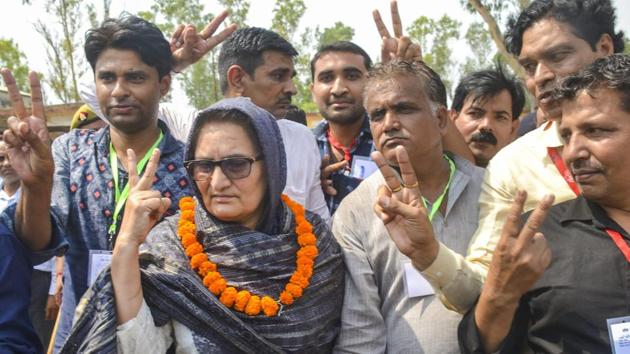
The BJP’s defeat in both these seats is bound to raise questions about whether or not communal polarisation still drives political choices in this region.
An HT analysis of demographics and election results shows that bulk of the non-Dalit Hindu population might still be consolidated behind the BJP. Here’s why.
We use calculations by How India Lives to arrive at the share of Muslims and Dalits in these two seats.
It is to be assumed that an overwhelming majority of Muslims must have voted for the united opposition candidates, both of whom were Muslims. One can also assume that the BSP’s support to the united opposition candidates would have got at least the majority of Dalit votes for them.
According to the CSDS-Lokniti’s Mood of the Nation Survey, which was conducted during April 28 to May 17, 55% of Hindu Dalits were of the view that Narendra Modi’s government should not get another chance.
We use these findings to draw two kinds of comparisons vis-à-vis the united opposition’s vote in Kairana and Noorpur.
{{/usCountry}}We use these findings to draw two kinds of comparisons vis-à-vis the united opposition’s vote in Kairana and Noorpur.
{{/usCountry}}The first one assumes a complete transfer of all Muslim and Dalit votes to the anti-BJP candidate and the second one assumes a transfer of all Muslim votes but only 55% Dalit votes (in keeping with the CSDS-Lokniti findings) to the united opposition against the BJP.
The results are revealing. In both seats, the united opposition’s vote share is less than the combined population share of Muslims and Dalits.
Even when one accounts for the fact that only 55% of the Dalits voted for the opposition, the vote share is only marginally ahead of the adjusted population share of Muslim and Dalits.
The assumption these calculations make is that voter turnout was similar among all social groups (See Chart 1).
These numbers suggest that at best the anti-BJP candidates got a very small share of non-Muslim and non-Dalit votes.
They also raise serious questions on claims about a significant section of Jats and other Hindus deserting the BJP in western UP.