Congress MP Shashi Tharoor on Tuesday raised questions over the practical implications of the newly enacted Prevention of Insults to National Honour (Amendment) Act, 2026, hours after President Droupadi Murmu gave her assent to the legislation extending status and protection to the National Song, Vande Mataram, on par with the National Anthem, Jana Gana Mana.
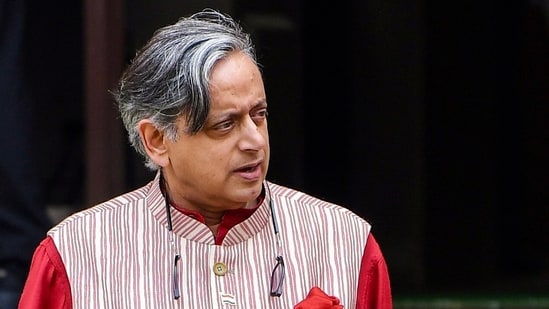
In a post on X, the Thiruvananthapuram MP noted that the amendment had been passed without discussion in Parliament. He said it requires the singing of the National Song in full at the start and ending of any official function, in addition to the National Anthem.
“As one who greatly respects both, and can sing the first two stanzas of the former (but not the other four, which were never required till now) as well as the entire anthem, i would like to point to just one practical consideration our zealots appear to have overlooked: human nature,” he wrote.
He then laid out a timing-based argument: “'Jana Gana Mana' requires audiences to stand respectfully and focus their attention for a reasonable 52 seconds… The National Song in full takes 3 minutes and 10 seconds.”
He also mentioned state-level protocol, such as in Tamil Nadu, which has decided that both Vande Mataram and Jana Gana Mana will be preceded by the State Song in Tamil “for another 2 minutes”.
{{/usCountry}}He also mentioned state-level protocol, such as in Tamil Nadu, which has decided that both Vande Mataram and Jana Gana Mana will be preceded by the State Song in Tamil “for another 2 minutes”.
{{/usCountry}}“Do we really expect audiences to stand still and respectfully for six minutes before and after every function, a total of 12 extra minutes?” Tharoor wrote.
He questioned the underlying premise of the law itself: “Can respect and patience be legislated?… I fear that the intent of the Bill, to promote greater respect for the National Song, will not be achieved, but its opposite may well be.”
What are the law and rules on Vande Mataram now?
The new law amends the Prevention of Insults to National Honour Act, 1971, by substituting Section 3 to explicitly include Vande Mataram alongside the National Anthem.
Under the amended provision, any person who intentionally prevents the singing of the National Song, or causes disturbance to an assembly engaged in its rendition, is liable to imprisonment for up to three years, a fine, or both. This is the same rule applied to the National Anthem since 1971.
However, the amendment does not, on its own, make the singing of the National Song compulsory. That had come before it via a government circular. The requirement for all six stanzas to be rendered at official functions stems from a Union home ministry circular issued earlier this year. The amendment in law now attaches criminal liability to deliberate disruption of the National Song's singing.
This means that if Vande Mataram is made compulsory by an authority in charge of a function, anyone objecting to that can be jailed. Some states ruled by parties other than the Centre's ruling BJP – such as Kerala – have stood against mandating the singing of Vande Mataram in full.
The amendment bill was introduced in the Rajya Sabha on July 24, passed by it on July 29, and cleared by the Lok Sabha on July 30 amid Opposition protests, before receiving Presidential assent on Tuesday.
Earlier, only the first two stanzas of Vande Mataram were traditionally sung at official events, since the remaining four contain imagery invoking the nation as a Hindu goddess, seen as excluding non-Hindu citizens. The BJP-led government of PM Narendra Modi, which describes itelf as “Hindu nationalist”, argued that Vande Mataram was central to India's freedom struggle.