E-Paper



6 stanzas of Vande Mataram a must before national anthem | What are the new rules for the national song?
Vande Mataram new rules: Till now, there was no official protocol for Vande Mataram – unlike Jana Gana Mana, which has clearly defined rules.

 Prefer HTon Google


The Union home ministry has mandated that a six-stanza-long, 3 minutes and 10 seconds version of Vande Mataram be played or sung at a raft of official occasions, including during the unfurling of the Tricolour, arrival of the President at events, before and after her speeches and addresses to the nation, and before and after the arrival and speeches of governors.
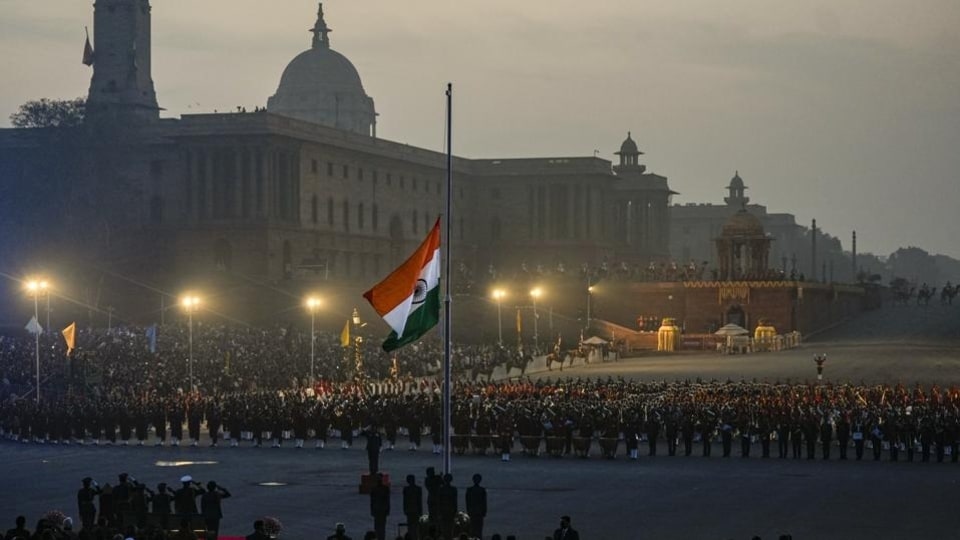

In a 10-page order issued on January 28, seen by HT, the ministry also said that if the national song and the national anthem, Jana Gana Mana, are sung or played together, Vande Mataram will be played first, and that the audience shall stand in attention during the singing or playing.
“Whenever the official version of the national song is sung, or played, the audience shall stand to attention. However, when in the course of a newsreel or documentary the national song is played as a part of the film, it is not expected of the audience to stand as standing is bound to interrupt the exhibition of the film and would create disorder and confusion rather than add to the dignity of the national song,” said the note, issued in English and Hindi to all states and Union territories, ministries and constitutional bodies.
The ministry note also gives a list of events and places where the song may be played, including in school assemblies.
The move appears to be in sync with the Union government’s recent push to popularise Vande Mataram, which earlier included an acrimonious debate in Parliament to mark the 150th anniversary of the national song and displaying several tableaux during the Republic Day parade themed on the song.
Written by Bengali literary icon Bankim Chandra Chatterjee in Sanskritised Bengali in the 1870s, the song was first adopted by the freedom movement to praise the motherland. In 1950, the first two stanzas of the song were adopted as India’s national song.
Till now, there was no official protocol during the singing of Vande Mataram – unlike Jana Gana Mana, which has clearly defined rules on the tune, duration and singing of the song. The expanded, six-stanza version of the song has not been sung in official events till now.
“The following instructions are being issued for general information and guidance on the official version of the national song, the occasions on which the song is to be played or sung, and about the need for paying respect to the national song by observance of proper decorum on such occasions,” the order said.
The order created three categories of events – ones where the national song shall be played, ones where it shall be played and sung, and ones where it may be sung or played. The note said the “the official version of the national song shall be played” on the following occasions – civil investitures, arrival of the President at formal state functions and other functions organized by the government and on his departure from such functions, immediately before and after the President addresses the nation over All India Radio and television, arrival of the governor/lieutenant governor at formal state functions within his state/Union Territory and on his departure from such functions, when the national flag is brought on parade, and any other occasion for which special orders are issued by the Government of India.
“When the national song is played by a band, the song will be preceded by a roll of drums to assist the audience to know that the national song is going to be played, unless there is some other specific indication that the national song is about to be played, as for example, when fanfares are sounded before the national song is played. The duration of the roll, in terms of marching drill, will be 7 paces in slow march. The roll will start slowly, ascend to as loud a volume as possible and then gradually decreases to original softness, but remaining audible until the seventh beat. One beat rest will then be observed before commencing the national song,” said the order.
The second category – where the playing of the song is to be accompanied by “mass singing” – include the unfurling of the national flag, on cultural occasions or ceremonial functions other than parades.
“This could be arranged by having a choir of adequate size, suitably stationed, which would be trained to coordinate its singing with the band etc. There should be an adequate public audition system so that the gathering in various enclosures can sing in unison with the choir; printed lyrics of the official version of the national song may be circulated amongst the participants, wherever required,” the note said.
Other such events include the arrival of the President at any government or public function (but excluding formal state functions) and also immediately before their departure from such functions. “On all occasions when the national song is sung, the official version shall be recited accompanied by mass singing,” said the order.
The third category of events – where the national song may be sung – include school programmes.
“In all schools, the day’s work may begin with community singing of the national song. School authorities should make adequate provision in their programmes for popularising the singing of the national song, national anthem and promoting respect for the national flag among students,” the order said.
The note said the song may also be sung on occasions that are not strictly ceremonial but are “invested with significance because of the presence of ministers etc”.
“The singing of the national song on such occasions (with or without the accompaniment of instruments) accompanied by mass singing is desirable. It is not possible to give an exhaustive list of occasions on which the singing (as distinct from playing) of official version of the national song can be permitted. But there is no objection to the singing of the national song accompanied by mass singing so long as it is done with due respect as a salutation to the motherland and proper decorum is maintained,” the note said.
The move comes at a time when the song’s history, its truncated form, and political choices have taken centre stage following an extended debate in Parliament last year. During the debate during the winter session of Parliament in December 2025, Prime Minister Narendra Modi led a nearly 10-hour debate in the Lok Sabha, tracing the song’s origins and its role in the freedom struggle. Modi accused the Congress of betraying and sabotaging the song by removing crucial verses. He described it as a “division and partition of the song” and argued that it weakened the original intent of the composition and caused Partition. “Vande Mataram was divided first, and then the country was divided,” Modi said, accusing the Congress leadership of compromising on a national symbol.
The theme of the Republic Day parade this year was also “Swatantrata Ka Mantra - Vande Mataram”.