E-Paper



Delhi's AQI tanks as air disaster looms on Diwali
Delhi's air quality worsened to "very poor" as AQI hit 307, with Diwali firecrackers threatening to push it to "severe" levels amid stubble smoke.

 Prefer HTon Google


Pollution levels in Delhi surged and returned to the “very poor” zone of the air quality index (AQI) on Wednesday, as a thin cloak of grey haze sheathed the city, setting the stage for a potentially bruising Diwali, when the flagrant use of firecrackers will likely drag the Capital into yet another annual air emergency.
The AQI jumped to 307 at 4pm, compared to 268 (poor) at the same time the previous day, Central Pollution Control Board (CPCB) data showed, with barely any surface-level winds of note, even as the long-range transport winds began blowing in from the northwest once again, sweeping in with them hazardous plumes of smoke from farm fires in Punjab. By 11pm, the AQI worsened to 317.
These winds, coupled with violations of the blanket firecracker ban, may give Delhi its first tryst with “severe” air this season, experts warned, as the Capital neared the end of its most polluted October since 2020.
Every year, Delhi’s skies rumble with the sounds of firecrackers that explode across the city with no intervention from enforcement authorities despite far-ranging curbs on their manufacture, sale and use.
This results in a deadly cocktail — emissions from these firecrackers, laden with toxic chemicals like barium, sulphur and lead, dovetail with the already steep levels of local pollutants and smoke from farm fires. The nearly still winter air keeps these pollutants trapped close to the earth, smothering residents with fine particulate matter (microscopic pollutants) that freely travel into people’s lungs and can cause severe respiratory and cardiac illnesses.
Read more: Delhi air pollution: Ahead of Diwali, 79 cases filed, 19,005 kg firecrackers seized so far
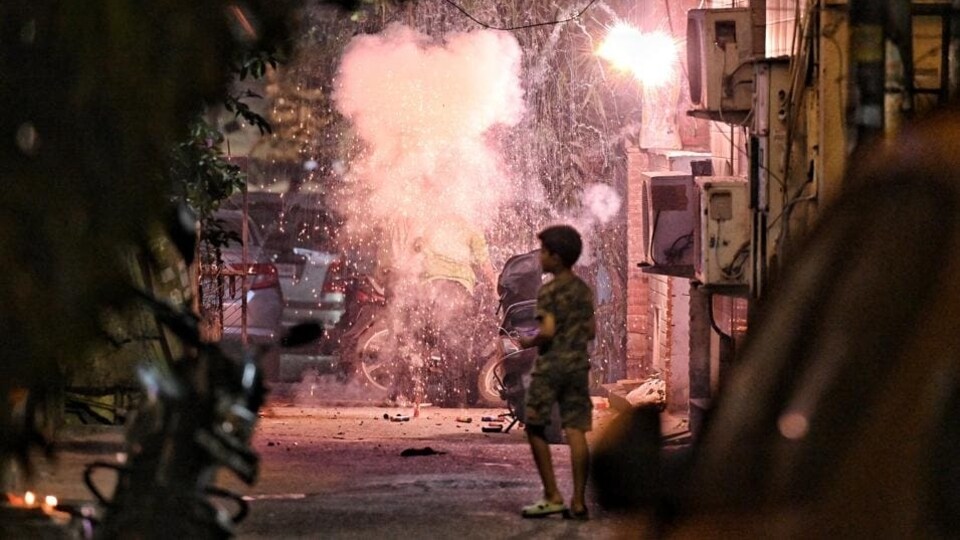
Indeed, early signs of the firecracker ban being flouted were evident on Wednesday evening, as explosives could be heard across the Capital, lightning up its dreary evening skies. Diwali will be celebrated on Thursday.
The Capital’s AQI is yet to touch severe this winter, with 364 the highest reading so far, recorded on October 23.
CPCB classifies AQI between 0-50 as “good”, between 51 and 100 as “satisfactory”, between 101 and 200 as “moderate”, between 201 and 300 as “poor”, between 301 and 400 as “very poor”, and over 400 as “severe”.
“Delhi’s air quality is likely to be in the ‘very poor’ category from October 31 till November 2. The air quality may reach the ‘severe’ category on October 31 and November 1 in case of additional emissions from firecrackers and stubble/waste fires,” said the Centre’s Early Warning System for Delhi (EWS) in its forecast on Wednesday.
Data from previous years shows that various iterations of firecracker curbs, including a blanket ban since 2020, have been thrown to the wind.
This in turn has led to a sharp spike in the AQI, which has deteriorated sharply the day after Diwali in seven of the last eight years.
The only exception was 2022, when strong winds on Diwali day helped disperse firecracker emissions almost instantly.
Last year, Delhi’s AQI the day before Diwali (November 11) was 220 (poor). On Diwali day, it improved marginally to 218 (poor), before firecrackers in the evening wiped out the relatively clean air, sending Delhi’s AQI spiralling by 140 points to 358 (very poor) the next day.
In 2021, the AQI spiked by 148 points from the day before Diwali (November 3) to the day after. The AQI was 314 (very poor) on November 3. It was 382 (very poor) on Diwali day and 462 (severe) the day-after Diwali.
This was also the highest AQI Delhi has seen on the day after Diwali. The second worst was 2016, when the AQI was 445 (severe) the next day.
Mahesh Palawat, vice-president at Skymet meteorology, said the winds were calm throughout Wednesday.
“They may remain calm overnight, before picking up marginally on Diwali day,” he said, adding that stronger winds are likely on Friday, though their influence on the air quality will depend on the quantum of firecrackers that are burst.
PM10 (particulate matter less than 10 microns thick) was the lead pollutant in Delhi’s air.
Two of Delhi’s pollution monitoring stations clocked severe readings at 4pm – Anand Vihar (407) and Mundka (401).
A firecracker ban has been in place in Delhi since 2017, when the Supreme Court suggested banning the sale of firecrackers in the capital to assess whether it would make a difference on the air quality.
Experts and forecasters underscored that the switch in the direction of winds, which blew in from the southeast till Wednesday, will worsen the air significantly.
Data from the Centre’s Decision Support System (DSS) showed that the contribution of stubble burning to Delhi’s PM 2.5 was 3.44% on Wednesday; 1.81% on Tuesday and 3.34% on Monday. The highest single day contribution this season was 15.97% on October 23, when winds remained northwesterly throughout the day, giving the city its highest AQI yet this season.
Anumita Roychowdhury, executive director, research and advocacy at the Centre for Science and Environment (CSE), said Delhi’s worsening air was primarily down to local factors, with conditions likely to worsen if stubble smoke and firecracker emissions are added to the mix.
“We see this every year, that Delhi’s background emissions are already high at this time of the year and firecrackers or farm fires act as a tipping point. If there is even one, or both of these factors in play, we may see significant deterioration again,” she said.