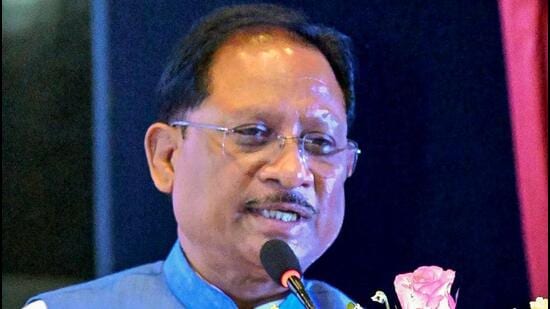
RAIPUR: Chhattisgarh chief minister Vishnu Deo Sai on Tuesday chaired a meeting of the Unified Command in Nava Raipur to review the security situation and development works in left-wing extremism (LWE)-affected areas.
Chhattisgarh Chief Minister Vishnu Deo Sai (CMO Chhattisgarh X)
{{^htLoading}} {{/htLoading}}
Deputy chief minister and home minister Vijay Sharma, chief secretary Amitabh Jain, DGP Arun Dev Gautam, additional chief secretary (Home) Manoj Kumar Pingua, secretary to CM Rahul Bhagat and senior officers from Central Reserve Police Force, Indo-Tibetan Border Police, Border Security Force, Central Industrial Security Force, Sashastra Seema Bal, the Indian Air Force and state police attended the meeting at the Circuit House in Atal Nagar, according to a government statement.
The meeting reviewed ongoing anti-Maoist operations and the progress of development initiatives in interior areas.
“This routine meeting of the unified command discussed two points in detail. Our security forces have been fighting strongly against naxalism and achieved unprecedented success in the last 20 months, neutralising top cadres. We expressed gratitude to the jawans,” Sai told reporters.
{{^htLoading}} {{/htLoading}}
{{^usCountry}}
He added that with the decline of Maoist activities, the state must also win the confidence of local residents. “We have started the Niyad Nellanar (your good village) scheme to ensure benefits of government schemes reach remote villages,” he said.
{{/usCountry}}
{{#usCountry}}
He added that with the decline of Maoist activities, the state must also win the confidence of local residents. “We have started the Niyad Nellanar (your good village) scheme to ensure benefits of government schemes reach remote villages,” he said.
{{/usCountry}}
Sai expressed confidence that the central government’s target to eliminate naxalism would be achieved by March 31, 2026.
According to police data, 454 Maoists have been killed, over 1,600 arrested and nearly 1,700 have surrendered since December 2023. During this period, 65 new security camps have also been established in the region.
Deputy CM Sharma said the meeting discussed inter-state coordination, use of technology, the surrender process and other operational issues. Development works, including the expansion of railway lines and roads and setting up new schools in affected areas, were also reviewed.
Ritesh Mishra is the State Correspondent for Chhattisgarh with Hindustan Times. He reports on Maoism, internal security, politics, mining, governance, and major developments shaping the state. Based in Raipur, he has covered Chhattisgarh since 2016, reporting extensively from the Bastar region and other conflict-affected areas. With nearly two decades of experience in journalism, Ritesh has built a reputation for ground reporting from some of India's most challenging terrains. His coverage spans Left-Wing Extremism, counter-insurgency operations, elections, tribal affairs, environmental issues, infrastructure, mining, and socio-economic developments. He has reported on major security operations, policy initiatives, wildlife crime, and the changing dynamics of conflict and development in Central India. Before moving to Chhattisgarh, Ritesh spent eight years reporting from Madhya Pradesh, covering politics, administration, crime, development, and social issues. Throughout his career, he has reported on various forms of extremism in Central India, combining field reporting with in-depth analysis to produce accurate, balanced, and impactful journalism. Prior to joining Hindustan Times, Ritesh worked with The Pioneer and The Free Press Journal, where he covered a wide range of beats and honed his skills in political, investigative, and field reporting.
His reporting is marked by exclusive stories, extensive fieldwork, and a commitment to factual, on-the-ground journalism that brings complex issues to a wider audience.
Get Latest News, breaking headlines, and top India News, and today real-time updates from across the nation. Stay informed on politics, government policies, crime, Today Weather, and major developments on Hindustan Times
Get Latest News, breaking headlines, and top India News, and today real-time updates from across the nation. Stay informed on politics, government policies, crime, Today Weather, and major developments on Hindustan Times
Home/India News/Chhattisgarh CM chairs unified command meeting in Nava Raipur
{{^htLoading}}
Advertisement
{{/htLoading}}
SHARE THIS ARTICLE ON
{{#usCountry}}{{/usCountry}}
Notifications
Get breaking alerts directly from the newsroom
Notifications are on!You'll be notified when news breaks