New Delhi: China’s military has raised new militias comprising Tibetan youths in the strategic Chumbi Valley in Tibet Autonomous Region (TAR) as part of enhanced efforts to recruit more Tibetans amid the standoff with India on the Line of Actual Control (LAC), people familiar with the developments said on condition of anonymity citing intelligence reports.
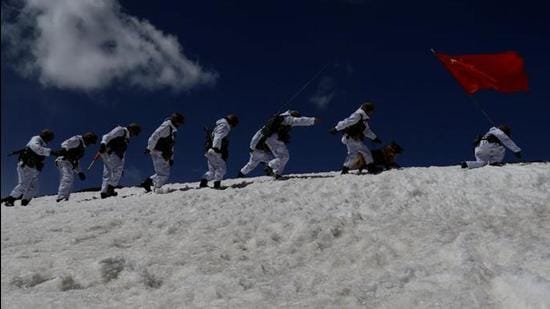
Since last year, Indian security agencies have gathered information on the People’s Liberation Army (PLA) holding recruitment drives across TAR to rope in more locals. However, these are the first reports about the raising of new Tibetan militias in the eastern segment of the LAC, the people said.
At least two batches of Tibetans have been recruited for the militias; each batch comprises about 100 youths. One batch has completed its training with the PLA and has been deployed at different locations across Chumbi Valley, including Yadong, Cheema, Rinchengang or Renqinggang, PB Thang and Phari, the people said.
The second batch is being trained at a PLA facility in Phari, the people said, citing intelligence reports and communications intercepts from different security agencies. The militias currently operate without uniforms or ranks, the people added.
“The militias are being raised with the aim of being deployed mostly in local border areas to exploit their knowledge of the local terrain, language, demography and weather conditions,” one of the people cited above said.
{{/usCountry}}“The militias are being raised with the aim of being deployed mostly in local border areas to exploit their knowledge of the local terrain, language, demography and weather conditions,” one of the people cited above said.
{{/usCountry}}The militias are separate from the Special Tibetan Army Unit recently created by the PLA. Hindustan Times had first reported on the PLA’s efforts to raise its first formation comprising soldiers of Tibetan ethnicity on April 17.
Indian security agencies are keeping a close watch on the development in view of the strategic location of Chumbi Valley, a 100-km protuberance of Chinese territory located between Bhutan in the east and Sikkim in the west. The valley’s location has long resulted in concerns that it could be used to launch operations to snap strategic communications links in the Siliguri Corridor.
The security agencies have also learnt that Tibetans recruited into the PLA’s Special Tibetan Army Unit are taken to Buddhist monks for their blessings after completing their training.
“There are no records of such a practice of taking Tibetan recruits to Tibetan monks for their blessings. This is likely a new strategy by the PLA to get some religious mileage from the newly-recruited Tibetan troops,” the person cited above said.
HT had earlier reported that PLA officials from Lhasa visited Rudok town in Ngari Prefecture in the far west of TAR in the third week of February to recruit Tibetans soldiers. The officials also travelled to Zanda or Tsamda County, a border region of TAR, to select Tibetan recruits from several PLA camps for induction into the special unit.
According to China’s official statistics from 2010, there were 2.1 million Han service personnel, compared to 4,300 Tibetans. More recent figures aren’t readily available.
These developments have come against the backdrop of the border standoff that began in May last year and a rapid build-up of infrastructure on the Chinese side along the LAC, including airports, helipads, missile facilities and air sites. The disengagement process along the LAC has also stalled after a limited drawdown of troops, armoured formations and artillery on the north and south banks of Pangong Lake in February.
An expert on Tibet, who declined to be named, said the PLA’s efforts appeared to be aimed at roping in more unemployed Tibetan youths and also countering India’s Special Frontier Force, a secretive unit comprising Tibetans that was used in operations near Pangong Lake last year.
“Most Chinese troops are from the plains and can’t perform well at high altitudes. The Chinese also realise it is best for them to recruit young Tibetans who are unemployed. It is not just about targeting India but also about gaining the sympathy of unemployed young men,” the expert said.