India and Japan will cement economic security, semiconductors, alternate supply chains rather than peg the close partnership around the growing bilateral defence relationship during Prime Minister Sanae Takaichi’s on-going three day visit to India.
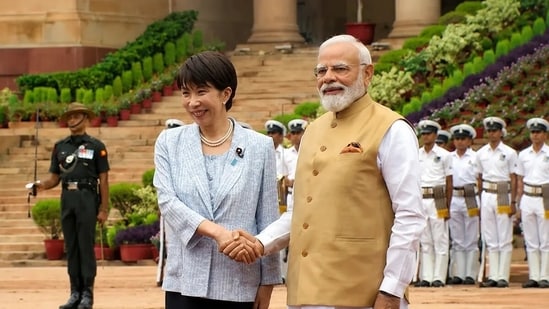
Japan PM Sanae Takaichi is in India on a three-day visit.
{{^htLoading}} {{/htLoading}}
The big focus of the visit is going to ramp up economic ties to a new level with Tokyo raising the level of investment into India to promised USD 61 over the next decade and pushing the bilateral trade beyond the present USD 27.5 billion. Apart from being a co-member of the QUAD, Japan is among the largest investor into India infrastructure projects including Bullet train between Mumbai and Ahmedabad with another bullet train from Delhi to Kolkata via Varanasi projected soon.
While the two leaders will discuss the situation in the Middle-East with Iran using the Straits of Hormuz as a leverage to secure maximum advantage out of US, the security situation in South China Sea due to PLA Navy expansion will also figure in the meeting. PM Takaichi has already made bold moves to secure Japan by asking the lawmakers to review the pacifist article 9 of Japanese Constitution apart from deploying Tomahawk missiles onboard Japanese destroyers. She has also ensured that surface to air missiles are also deployed in Okinawa to tackle any Taiwan emergency.
{{^htLoading}} {{/htLoading}}
{{^usCountry}}
Even though the focus of the visit is economic, the bilateral defence ties will also be strengthened even though the Japanese equipment is prohibitively expensive. However, India and Japan will sign an agreement for the Indian Navy to acquire Unified Complex Radio Antenna (UNICORN) to boost warship stealth in collaboration with BEL.
{{/usCountry}}
{{#usCountry}}
Even though the focus of the visit is economic, the bilateral defence ties will also be strengthened even though the Japanese equipment is prohibitively expensive. However, India and Japan will sign an agreement for the Indian Navy to acquire Unified Complex Radio Antenna (UNICORN) to boost warship stealth in collaboration with BEL.
{{/usCountry}}
While the main agenda will be semiconductor manufacturing and resilient supply chains, Japan is also keen to help India to develop a trans-shipment hub as part of the Greater Nicobar Project in order to secure the Indo-Pacific.
Seen to be a protégé of PM Modi’s late friend Shinzo Abe, Takaichi is known to be upfront when it comes to Japan’s security unlike the Left-Liberal PMs of the past. It is in this context, that PM Modi and PM Takaichi have a similar line of thinking when it comes to countries which are of mutual security concern to both the countries. The visit is expected to take India-Japan partnership to the next level with more hi-tech projects to be announced and understanding each other’s global and regional security concerns
Shishir Gupta is Executive Editor at Hindustan Times and one of India's top journalists covering national security, strategic affairs, foreign policy and geopolitics. Over the past three decades, he has extensively reported on India's military, diplomatic and security landscape, covering every major conflict and national security challenge, from the 1999 Kargil War and the 2020 East Ladakh standoff to Operation Sindoor in 2025. He has also covered major terror attacks, including the IC-814 hijacking, the 26/11 Mumbai attacks and the 2025 Pahalgam terror strike, along with numerous Pakistan-backed terrorist incidents in the Kashmir Valley and across India. He has reported on national and state elections for more than three decades. A recognised authority on strategic affairs, Gupta has covered India's nuclear programme since the Pokhran-II (Shakti series) tests in May 1998 and has written extensively on global nuclear issues, Indian diplomacy and the country's expanding global outreach. He has also reported widely on international conflicts and terrorism, with a special focus on the Indian subcontinent. Gupta has interviewed Prime Minister Narendra Modi more than four times, including Modi's first interview with the print media after becoming Prime Minister in May 2014. His other interviews include three with the Dalai Lama, as well as conversations with Benjamin Netanyahu, Amit Shah, Yogi Adityanath, S. Jaishankar, Nirmala Sitharaman and Piyush Goyal. He is the author of Indian Mujahideen: The Enemy Within (Hachette, 2011) and Himalayan Face-off: Chinese Assertion and Indian Riposte (Hachette, 2014). He was awarded the Chevening-Wolfson Joint Scholarship at Wolfson College, University of Cambridge, UK, in 1998 and participated in the International Visitor Leadership Program (IVLP) of the US State Department in 2006. He received the Ben Gurion Prize from Israel in 2011 and the K. Subrahmanyam Prize for Strategic Studies in 2015 from the Manohar Parrikar Institute for Defence Studies and Analyses (MP-IDSA). Since 2024, he has hosted Point Blank, Hindustan Times' weekly YouTube show on global geopolitics.
Get the latest India News, breaking headlines and real-time updates from across the country. Stay informed about politics, government policies, crime, weather and major national developments.
Home/India News/Chips over subs: Why Sanae Takaichi's India visit is about economics first
{{^htLoading}}
Advertisement
{{/htLoading}}
SHARE THIS ARTICLE ON
{{#usCountry}}{{/usCountry}}
Hindustantimes wants to start sending you push notifications. Click allow to subscribe